Eight Million Protestors and No Kings: The Case for Showing Up
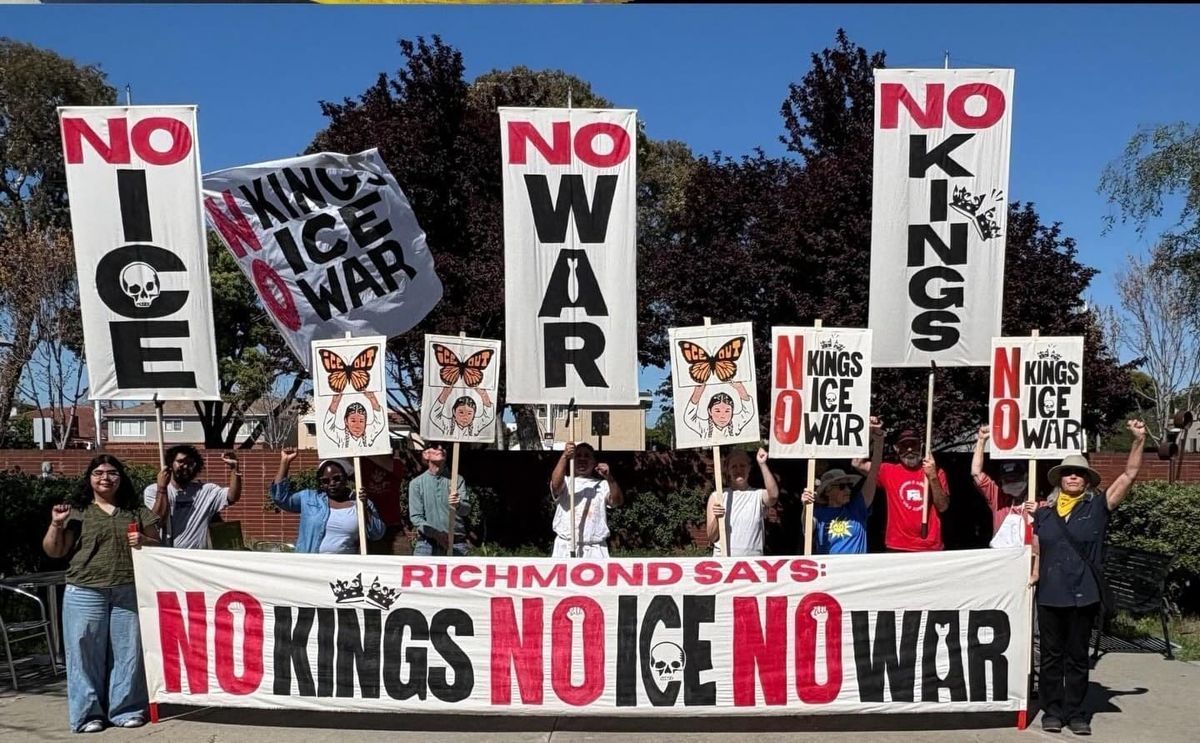
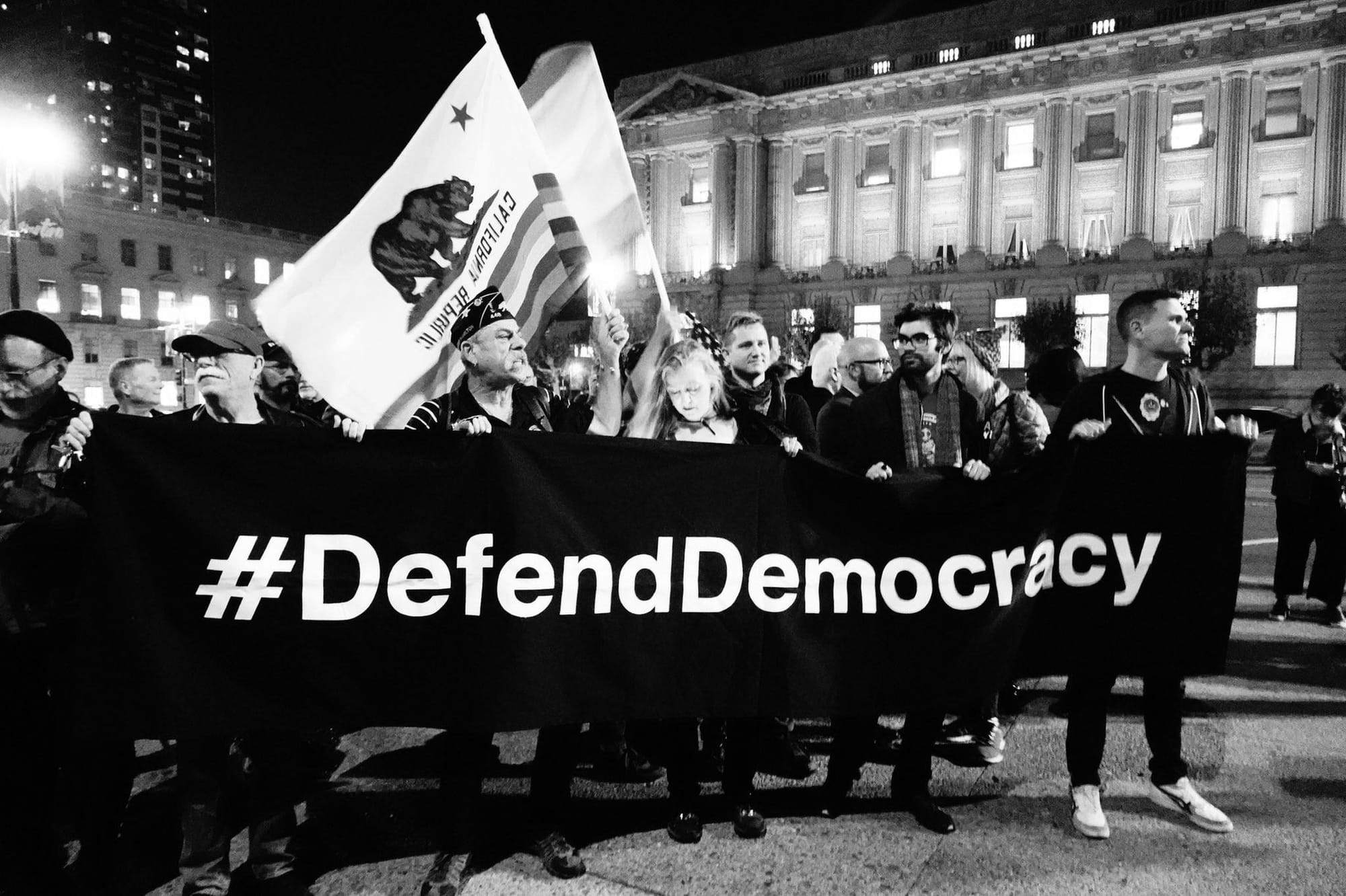
It wasn't just bigger than the previous #nokings. It was different. Here's how USA Today unpacks that: "The organizers' crowd count, not verified by independent analysts, put the total at 8 million people, topping the 7 million estimated at the previous No Kings day, in October. This time, there were more events scheduled − 3,300 versus 2,700 − and larger crowds were reported in some places, boosted in part by opposition to the war in Iran. In a nation with a population approaching 349 million, the participation of 8 million people means that more than 1 of every 50 U.S. residents joined a No Kings rally.Organizers said two-thirds of participants who signed up live in suburban, small town or rural areas. That's a 40% increase over last time in protesters from outside big cities. The left-leaning protests with the Revolutionary-era call against President Donald Trump as a would-be monarch and authoritarian had the broadest geographic reach of any single-day protest in the United States in more than a half-century [that's an indirect reference to Earth Day 1970]. They included not only familiar precincts in New York and Los Angeles and Austin but also communities in all 50 states and every congressional district, including rural and Republican areas."
So it was not only big but dispersed not in the sense of diluted, but distributed --deeper into non-urban areas and in every congressional district in the country (and every continent – at the urging of a friend I scrambled to try to make contact with someone who might take a picture of a No Kings moment in Antarctica; I failed but someone did it). Tennessee Indivible notes, "Pulaski, TN [a town of less than 10,000] showed out today — 100 people came together in a county where most folks said organizing would never take root.In a place with this much history, this much pressure, and this much expectation of silence, seeing that many neighbors stand up is nothing short of a breakthrough.This is what a shift looks like in a red state."
Jason Sattler, who writes as LOLGOB at his newsletter The Cause, reports, "Dana Fisher and Arman Azedi from American University were in DC with clipboards, surveying participants in the No Kings 3 march across the Frederick Douglass Bridge. They have done this at every major resistance rally since the Women’s March in 2017." He cites among their results, "At the People’s March in January 2025, 10% of participants said they heard about the event through an organization. Yesterday, that number was 34%. Word-of-mouth from family and friends, historically the most common channel for protests, dropped from 48% to 38%. People are no longer being summoned by just outrage. They are being mobilized by infrastructure, which now likely includes their friends and family. This is the difference between a movement that surges and a movement that can win. 47% of DC marchers reported being members of a group, including groups that organized the event. 27% were members of FreeDC, the local organizer. 10% were Indivisible.... What you are watching is the conversion of protest attendance into activism. The people who showed up on Saturday were not taking a day off from normal life to register their feelings. They were the most civically active slice of the electorate, and they are getting more active. [Nonviolence scholar Steven] Levitsky described the three domains in which democracy is defended or lost: the ballot box, the courts, and the streets. His point was that no single one is sufficient — and that the streets, far from being the weakest, are the foundation the other two rest on." There's a quality of resoluteness out there. People have absorbed the monstrosity of the destruction and the corruption, and it appears to have steeled their commitment to continue to show up and resist.
I've been to a lot of protests over a lot of years. There was an era when they felt very narrowly focused (and people trying make it about another issue felt like interlopers). One thing striking about this round of #nokings protest is that people recognize that it's all connected, because women's rights, immigrant and refugee rights, trans rights, voting rights, racial justice, public health, environmental and climate issues, the rule of law, and accountability are all under attack by the same players. I saw signs about Iran, signs about Cuba, about the Constitution, funny signs, furious signs, signs against Trump and the regime, signs for democracy and justice, and I saw a whole lot of Fuck Ice messaging.
Just before #nokings this Saturday, March 28th, a lot of criticism of it, of big protests in general, and of the organizers and participants in this one began to appear. When a lot of people suddenly begin to say the same stuff, I always wonder if division is being sown, and if so, by whom? It was the sudden online proliferation of these attacks that made me wonder; some of it was from real people, including people I know, but one friend reported a bot popping up on her social media to do it. On BlueSky disparagement of "normies" suddenly became a thing. A lot of the stuff I saw often made the same argument: that the people going to No Kings are not doing anything else and those who go consider that going to the protest is the whole job of addressing the crisis of advancing authoritarianism (advancing but also crumbling authoritarianism to be exact). That somehow it's a placebo and a soporific. That the participants are, in that most scornful term of those who consider themselves the true left, "liberals," a term that seems to equate to meekness and mildness and Not A Revolutionary.
The evidence suggests that a lot of mild-mannered people have been radicalized. One BlueSky guy reported 'Walking thru the “Ultra Normie” No Kings rally in my extremely rural, white town and there are Patagonia wearing moms carrying signs that say “DEAD PEDOPHILES DONT REOFFEND” and “ICE GETS THE WALL” and I hi fived an old guy with a sign that said MY DADDY FOUGHT NAZIS AND SO WILL I” this is wild. I cannot stress enough how these are PTA moms and soccer coach dads and I can best describe the vibe as “festively bloodthirsty.”' But the whole idea that there's a small cadre of revolutionaries who do all the political heavy lifting in this country isn't really accurate; a lot of it – I hope to do an essay on this soon – has been not just for decades but centuries by those who might be dismissed as nice ladies.
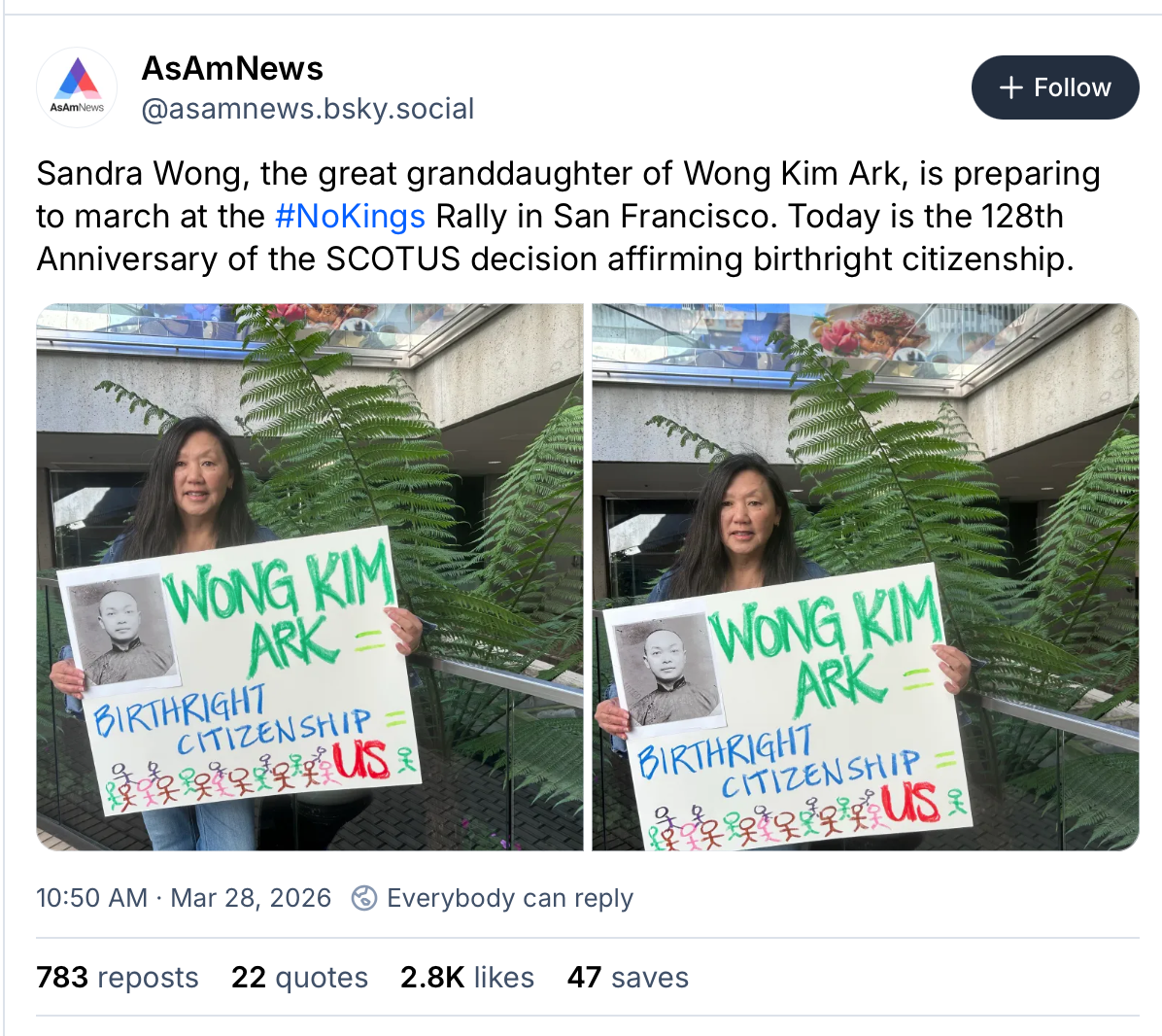
And people who showed up are showing up in other ways. As LOLGOP reported above, "47% of DC marchers reported being members of a group, including groups that organized the event." At the San Francisco event, I marched with a climate lawyer and saw people involved in unions, rights organizing, trans rights activism, and lots of other stuff. I didn't see her but I was moved to read about Sandra Wong, whose San Francisco great-grandfather sued all the way to the Supreme Court to get his birthright citizenship under the Fourteenth Amendment recognized. Her presence was a powerful reminder that the right is trying to undermine that right guaranteed by the Constitution since 1868 (and the Supreme Court is about to hear a case challenging that right this week).
Tim Hjersted wrote a piece called "How To View Protests Like an Organizer "in response: "These critiques come from people who consider themselves more radical than the average protester. They carry a tone of world-weary sophistication. The implication being that those who show up are naive, and those who stay home see the bigger picture. Here’s the problem: this attitude is strategically illiterate. It mistakes cynicism for analysis. And it guarantees the one outcome its proponents claim to fear most: a movement that never escalates beyond what it already is. An organizer looks at a mass protest and sees something completely different. Where the cynic sees a feel-good spectacle, the organizer sees thousands of people ready to get involved — a chance to connect them with local groups, deepen their engagement, and build the relationships that every form of deeper resistance depends on."
He continues, "Protests rarely achieve their maximalist demands on their own. But they do things nothing else can: they shift public discourse (Occupy didn’t break up the banks, but the language of the “99%” permanently changed how Americans talk about inequality), they energize waves of downstream organizing (the Women’s March fed directly into the candidate recruitment and voter mobilization that flipped the House in 2018), they build relationships between people and groups who might never have connected otherwise, and they make visible the scale of opposition in a way that no online petition or social media post ever will."
But also what's wrong with feeling good? "Joy doesn't betray but sustains activism. And when you face a politics that aspires to make you fearful, alienated and isolated, joy is a fine initial act of insurrection," I wrote a while back. Timothy Snyder posted, "I was at a #NoKings rally yesterday and rather than writing another essay about why this matters I will just say that it is pure joy to meet the people who want to stand out and the people who are doing the work. Thank you."
There's fierce joy in feeling far from alone, and something magical can happen and has, again and again, when thousands of individuals feel part of a greater whole, feel the power of solidarity and the possibility that arises from it when they become civil society incarnate. I'm a believer in the almost sacred space of the street and th power of what happens there. I was really struck by LOLGOP's citation above of "the three domains in which democracy is defended or lost: the ballot box, the courts, and the streets. His point was that no single one is sufficient — and that the streets, far from being the weakest, are the foundation the other two rest on."
We need all three and more: we need organizing and building power in organizations and networks outside the established system of government. So far as I can tell, that work is being done, and it is as invisible as it is important, these millions of people learning to trust each other and work together to build alliances and organizations. A lot of the weakness and corruption in our society arises from the isolation and the withdrawal from public life that Silicon Valley inculcates and profits from. I believe that coexisting with strangers in public is a foundation, of democracy, an embodied participation in literal public life that underpins the capacity to participate in political public life.
I wrote in Wanderlust: A History of Walking long ago, "The street is democracy's greatest arena, the place where ordinary people can speak, unsegregated by walls, unmediated by those with more power. It's not a coincidence thatmedia and mediate have the same root; direct political action in real public space may be the only way to engage in unmediated communication with strangers, as well as a way to reach media audiences by literally making news. Few remember that 'the right of the people peaceably to assemble' is listed in the First Amendment of the US Constitution, along with freedom of the press, of speech, and of religion, as critical to a democracy. Citizenship is predicated on the sense of having something in common with strangers, just as democracy is built upon trust in strangers. And public space is the space we share with strangers, the unsegregated zone. In these communal events, that abstraction the public becomes real and tangible."
I do not know where we go from here. I know that a lot of people are working on it. In 2019, Greta Thunberg said “Avoiding climate breakdown will require cathedral thinking. We must lay the foundation while we may not know exactly how to build the ceiling.” I believe that millions are endeavoring to build a cathedral of democracy and a stronghold against authoritarianism. You build it in private in organizations and networks, and you build it in the streets with direct defense of those under attack and with protests like the monumental one on Saturday.
p.s. I found this a very useful piece for thinking about what should happen: