Everything Is Changing Fast: A Brisk Tour Through Shifting Views

In this chaotic, transformative period, a lot of realities are changing in a lot of ways, and public opinion is often either changing with it or leading the change. We are not who we were even a few years ago when it comes to opposition to "Epstein class" billionaires, artificial intelligence, ICE ,and immigration enforcement. As Perry Bacon of the New Republic put it recently, "Guess What Moderate Democratic Voters Aren’t Anymore? Moderate." He continues, "Around 70 percent of moderates (combining the moderate and moderate-to-liberal respondents) said Democrats are 'too timid' in taxing the rich, taxing corporations, and cracking down on companies that break the law. A clear majority of moderates said the party is too timid in regulating Big Tech companies. Fewer than 5 percent of moderates said Democrats are “too aggressive” in their dealings with the rich, corporations, and Big Tech." That's an anti-elite wave right there.
As I mentioned here recently, one way you can see the new attitude in action is as local campaigns, often successful, to prevent tech corporations from building data centers in their area and ICE from buying warehouses to convert to prisons. There's a quite exhilarating wave of opposition to AI right now. Elites, including a lot of mainstream media as well as the creators and profiteers of the technology, often insist that it's inevitable, all-powerful, and we should just lie down and let the tanks of big tech run us over. Again. The public is not having it, and whether they're seeing the slop and sludge AI spreads, the threats to jobs, the corrosive effect of chatbots on vulnerable users, the potentials for profound dangers, or the reckless amorality of those in charge of the technology, they are skeptical about the promises. There were three attacks recently, including two targeting the home of OpenAI CEO Sam Altman and one the home of an Indianapolis city councilman who voted for a data center there.
At his superb tech-critical newsletter Blood in the Machine, Brian Merchant writes, "the events signal an escalation in the blowback to generative AI and the broader AI project undertaken by Silicon Valley. Less than two weeks ago, I noted that it’s open season for refusing AI, and detailed a host of ways that politicians, workers, and advocacy groups were pushing back or banning outright AI in communities, industries and the workplace. Embodying the trend were Bernie Sanders and Alexandria Ocasio-Cortez, who introduced a bill proposing a nationwide moratorium on data centers.In the short time since I wrote that post, such pointed AI refusal has continued apace. Maine looks set to become the first US state to ban data center development outright. Form letters for refusing AI at work are circulating widely. Public polling of AI sentiment is in the gutter; it’s never been popular, and it’s especially unpopular now. A widely discussed NBC poll found that just 26% of Americans had positive feelings about AI; around half had negative feelings. Gen Z in particular loathes AI: For respondents aged 18-34, AI’s net favorability rating was minus 44."
A Gallup survey of opinions on immigration last summer demonstrates a majority of the public has supported it all along and now supports it more. But if you took in mainstream-to-right-wing news you heard a whole lot from the anti-immigration minority as the people whose views matter, and that gave the impression that anti-immigration positions were majority opinions. People are hugely influenced by whether they believe a lot or only a few people share their position; if they know they're in the majority, they are likely to feel more confident about their position in ways that have real consequences (and likewise feel more confident in rejecting minority opinions). That includes views on climate change: a lot of people assume that support for climate action is a minority position when it's a broadly majority one. The same goes for reproductive rights and vaccines; we've heard only too much from a loud minority, aka an amplified minority, over the past several years on abortion.
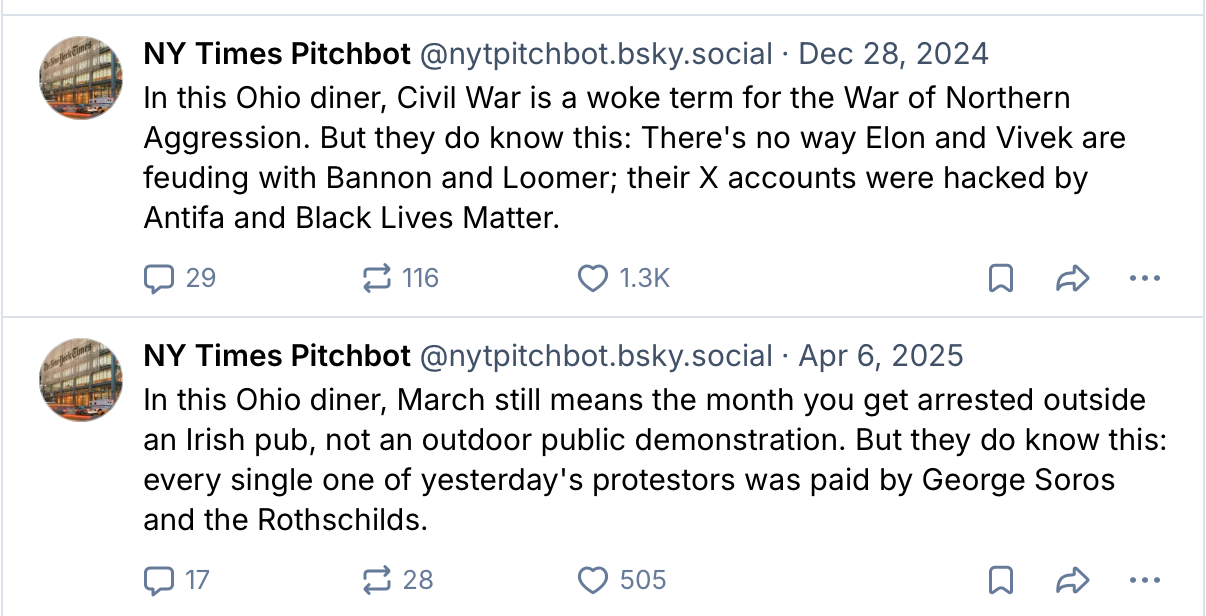
The phrase "representation matters" is usually about voting rights, but it can also mean seeing your own constituency or positions represented. Liberal-to-left views tend to be underrepresented or treated as extreme, marginal, or unpopular, and misrepresented by hostile forces with grim fantasies like "the war on Christmas." Mainstream media is forever insisting that the right-wing rural or suburban white voter matters more symbolically and morally than the left or progressive urban nonwhite voter, which is why we see the former asked to share their opinions far more often than not the latter.
The Associated Press reported last summer, "Just months after President Donald Trump returned to office amid a wave of anti-immigration sentiment, the share of U.S. adults saying immigration is a “good thing” for the country has jumped substantially — including among Republicans, according to new Gallup polling. About 8 in 10 Americans, 79%, say immigration is “a good thing” for the country today, an increase from 64% a year ago and a high point in the nearly 25-year trend. Only about 2 in 10 U.S. adults say immigration is a bad thing right now, down from 32% last year." It seems extremely likely that it has shifted far more since then as the public has witnessed the brutal cruelty, disruption, indiscriminateness, and economic impact of attacking immigrants, people of color regardless of immigration status, and white people who stand up for the former groups (as well as imprisoning white tourists and longtime non-citizen residents). As I keep saying, the Trump Administration assumed it could do things and we could do nothing about it, that their positions would matter and ours would not. That's one of the many things they're wrong about. But it's also striking that we never did hear much about this widespread support for immigration.
Another notable trend over the past couple of years is the decline in support for the Israeli government and military. Like opposing the NRA, opposing the Israeli government used to be something politicians were scared to do. The big shift in public opinion on the subject led the way (which is another reason why I hesitate to call politicians leaders; they are often followers of public opinion which is, at best, doing their job of representing us and at their worst following the money).

Another more recent striking shift is the decline in support for Trump, and it's now often said that MAGA itself is breaking up. Trump's extraordinary decline in the polls shows that he's not just losing centrists and relatively uncommitted people who voted for him or believed his promises but that his base is itself splintering. Major factors include the Epstein files and their suppression, the sabotage of the economy (the tariffs and rising fuel and fertilizer prices have hit farmers and rural America hard), the war in Iran, and most recently, the attack on the pope.
Simon Rosenberg in a newsletter essay titled, "The Trump Regime Is Rotting, Decaying, Crumbling, Unraveling, Falling Apart," declares, "The regime has started to truly crumble and fall apart under the weight of it all. Noem, Bondi, Bovino, Kent all gone. Prominent right wing media figures are in open rebellion against Trump. Vance’s Pakistani peace talks and salvage efforts in Hungary failed, spectacularly. Zelenskyy, Trump’s nemesis, has emerged as the courageous and respected leader of the free world, with Peter Magyar joining him as a powerful symbol of the power of people to triumph over Greater MAGA and autocracy. Democrats had huge, blowout performances in Georgia and Wisconsin last week, and saw polling showing us ahead in AK, ME, NC, and OH - enough to flip the Senate. Trump’s demands to fully fund DHS/ICE and pass the SAVE Act were publicly rejected by Thune and Johnson. His madness is becoming undeniably worse, as he threatened genocide in Iran, has repeatedly attacked the Pope and the Fed Chair, and keeps posting blasphemous AI images of himself." That Trump and Vance have sought out a fight with the pope for criticizing the fight they've picked with Iran shows that they're stupid enough to pick fights they can't win.
In another striking reminder of how things have changed, Katy Butler writes about the swift fall of former Congressman and gubernatorial candidate Eric Swallwell the Los Angeles Times, "Until a decade ago, shame was a weapon wielded widely against female accusers to shut them up. Rich and powerful men largely dictated the public narrative. When accused of acquaintance rape or harassment, they followed a simple playbook: declare innocence or argue consent. Hire investigators to dig up dirt on the woman, and feed the findings to reporters. Watch the alleged victim retract her charges or be discredited and silenced. See the criminal case collapse or end in a mistrial, acquittal or successful appeal.... In an era when “the news” was largely defined by top editors at a few gatekeeper media like the New York Times and the television networks, the tactics often worked. The editors were usually unscathed white men, ignorant about sexual assault, easily manipulated by predators, and fearful of false accusations, which are rare, and no more likely in rape cases than in any other crime." Feminists changed this, by which I mean not just high-profile advocates with platforms, but everyone who spoke up about the realities and pervasiveness of sexual abuse and gender violence. The public understands those issues and women's rights in a different way than it did before the current great wave of feminism began circa 2013-14.
At some point in the past, the Republican Party reached a crossroads. The party could either adapt to an increasingly progressive, increasingly multiracial democracy in which women were increasingly empowered by modifying its positions to appeal to the broad spectrum of voters. Or it could double down on its positions – support for the rich, first of all, hiding out behind hot-button issues like guns and abortion – and go to war with democracy. Of course they chose the latter path, and as their positions became increasingly unpopular they had to become increasingly undemocratic. Trump, the man who would be dictator, the attempted stealer of elections and suppressor of votes, the enthusiast for reinstating the old inequalities of race and gender and suspending civil and human rights, the fan of Putin and Orban, is where that decision was always leading. Mainstream media has colluded by continuing to cover the parts as though they were truly symmetrical (which often requires blowing up some minor democratic misdemeanor as though it were the equivalent of a Republican felony or just playing down the corruption and harm of the latter party).
The Democrats are very far from perfect, but the party itself has evolved, as old centrists like Nancy Pelosi (a political genius, but not exactly a climate or economic justice champion; she steps down at the end of her current term) retire and young progressives like Arizona's first-term congresswoman Yassmin Ansari step up (a climate champion, Ansari has initiated impeachment hearings against Secretary of Defense Pete Hegseth). In the wake of the 2024 election, there was an avalanche of opinions that, despite the thin margin of Trump's win, the swing of Latino and Asian voters to Trump meant that the whole country went right and would stay right. It was a hot take and a bad take. A lot of those voters found out what they really voted for and didn't like it. The Trump Administration itself is pushing the country to the left, is behind those blowout elections for Democratic candidates winning by margins far beyond the party in the 2024 election.
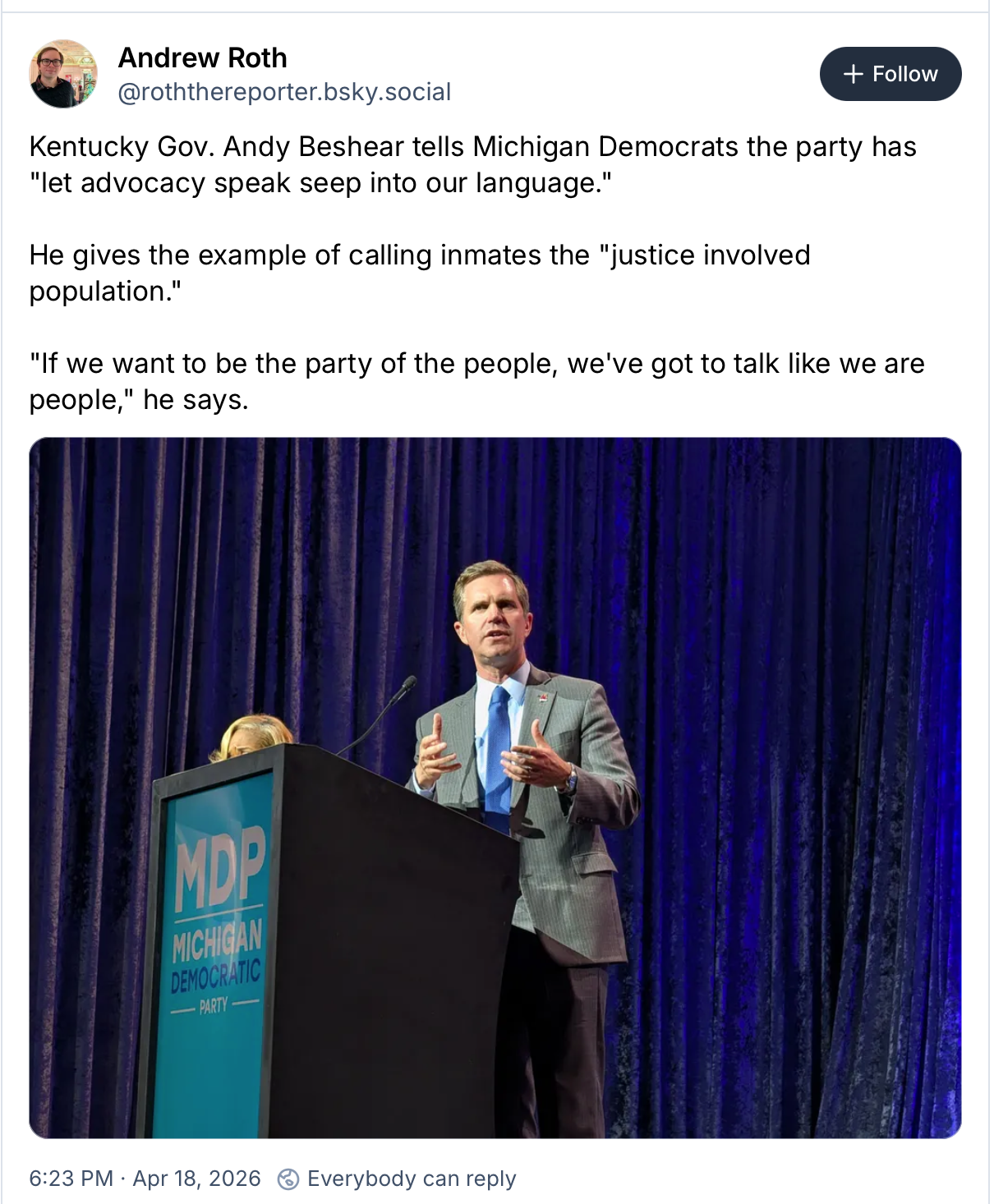
As we approach the midterm elections this fall and the next presidential, a cacophony of pundits is endeavoring, as usual, to instruct politicians on what constitutes a safe winning platform, and as usual, a lot of the advice is, well, the ingrown toenail of advice. It often focuses on selling out a minority population to appeal to a majority or tacking to the center even as (see above) so-called moderates become less moderate. Or it makes a lot of fuss about an obscure bit of language though it's widely deployed and widely reviled (see below). Or the same kind of fuss is made about minor trends hyped in inflammatory articles.
In a recent essay about trans rights and public opinion by Julia Serano in the Boston Review, she writes, "But the notion that retreating from trans rights will benefit Democrats in future elections rests on three false assumptions. The first is that the current anti-trans backlash is the result of “activists going too far,” a trope that is levied against virtually every social justice movement. This framing allows opponents to cast the rolling back of rights as a “realignment” with public opinion and a return to the “natural order” of things. But that is not at all what has happened here. What is new is that, starting around 2015—in the wake of increased trans visibility in the media (sometimes called the “transgender tipping point”) and the Supreme Court’s decision in Obergefell legalizing same-sex marriage—social conservatives began shifting their efforts toward targeting trans people instead. The attacks have since grown into a highly coordinated and well–funded movement that churns out both anti-trans and broader anti-LGBTQ legislation at unprecedented levels. This is the real reason why Republicans have become obsessed with “fairness in women’s sports,” “biological sex,” “social contagion,” “restrooms,” “grooming,” and other soundbites that didn’t exist ten or fifteen years ago. In other words, there hasn’t been an organic shift in public opinion on trans people but rather a massive astroturfing campaign against us." In fact, she notes, " poll after poll after poll has shown that voters reliably rank transgender issues among the least important to them."
There are issues that right-wing groups have spent billions to try to make you and me and all the ships at sea care about, as in angry about: immigration, social services (remember Reagan's "welfare queens"), government regulations (the ones that prevent you from getting cancer and nature from being destroyed), and of course the very existence of trans people. Sometimes money talks. But in the last few years we've had some striking examples of votes money can't buy – for example, the huge sum Elon Musk dumped in a race for a seat on Wisconsin's supreme court last year didn't net him a judge. Public opinion shifts for more authentic reasons too.
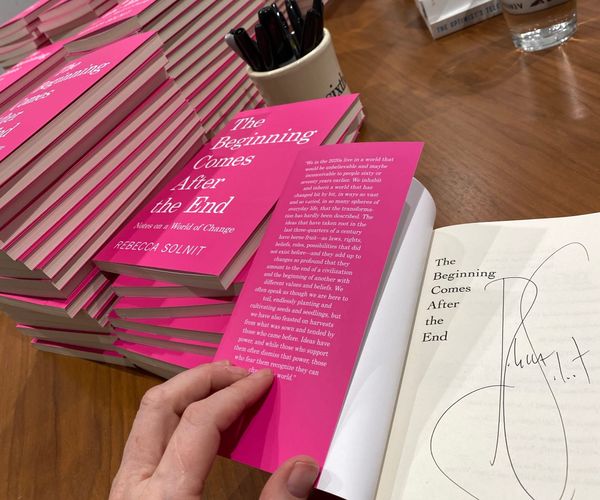
The main thing I wanted to tell you about today is just that it is shifting, and shifting a lot, often toward more progressive positions. (My newest book is about the huge shift over the past 70 years in public opinion about race, gender, nature, equality, and pretty much everything else, away from the old inequalities, with the right essentially now a backlash movement to "make America 1958 again," or maybe 1858.) In a funny way that goes back to their obliviousness to consequences I keep talking about, the Trump Administration is driving some of this, which makes it backlash to the backlash. But it's also driven by protest movements, direct experiences, and legitimate news stories about things like the catastrophic attack on Iran. Watch out for politicians and pundits who insist that winning elections requires sticking to safe old positions or pandering to centrists while abandoning progressives nationwide while asserting that the electorate is more conservative than it is. It's changing. Everything is.