Flowers Bloom on Soldiers' Graves: Lessons in Power and Consequence

What is power? It is at its most essential the ability to influence an outcome on any or all scales, to protect one's own at a minimum and to influence, even control others at a maximum. Violence is constantly misunderstood as power, and it certainly looks like power, and in some respects it is power, but a limited kind of power to harm and destroy. The threat of violence is often used to coerce – but also often has negative consequences, including the loss of other kinds of power, the powers that come with relationship, connection, alliance, trust. Violence isolates and alienates; it makes enemies, it stirs up dangers that linger. Friends are another kind of power built through another set of skills.
Botanist David George Haskell's new book How Flowers Made Our World: The Story of Nature's Revolutionaries describes a kind of power often ignored or dismissed, just as flowers themselves are. He writes, "When flowers arrived, they upended and transformed the planet. They were late arrivals on the world stage, appearing about two hundred million years ago, long after the evolution of complex animals and other land plants. By one hundred million years ago they were the foundation of most habitats on land." He expanded on the subject in a Wonder Cabinet podcast interview, declaring “We often think of power and revolution as about control, authoritarianism, and violence. Might makes right. But that's not the only way in which revolution and power and transformation take place. Flowers offer a different narrative. They changed the world in revolutionary ways through cooperation, through collaboration, often mediated by beauty, by sensory experiences. So a flower is quite literally speaking to the sensory system of a bee or of a hoverfly or of a bird to draw that animal into establish a cooperative relationship, a reciprocal relationship. And we're just the latest animal to become enchanted by the flowers and to become loyal collaborators with the flowers.”
Flowers, as he unpacks, developed the power to influence others' behavior by building symbiotic relationships– "I'll feed you fruit if you scatter my seeds; I'l give you nectar and pollen in return for pollination; I'll let you domesticate me and provide you with your daily bread and you'll plant and tend me across countless fields for countless generations." In an earlier book, The Botany of Desire, Michael Pollan speculated that plants had domesticated us as much as we had domesticated them, since we serve their needs so that they may serve ours, from the most practical issue of bodily sustenance to the most poetic one of bouquets and beauty. That's flower power.

But as Jonathan Schell reminded us in his landmark book from 2003, Unconquerable World: Power, Nonviolence, and the Will of the People, violence as military attack is often deployed because politics – the art of persuasion, the building of alliance, the finding of common ground – has failed. Violence itself often fails too. Schell came of age as a young writer who went to Vietnam at the height of the US war there and perceived that for all its superior military might, the US could not conquer the people of that country. Because the US or some of its leaders didn't learn that lesson, the same mistake was made in Afghanistan, Iraq, and is being made now in Iran. People who have violence at their disposal often confuse it with power, and while it can achieve some things it fails at others. I think of the abusive spouses who think they can coerce love but often can only extort a reluctant simulation of same by someone whose motivating feeling is fear rather than love and whose desire is often to escape.
Something that's struck me about the Trump Administration throughout its second term is its profound misunderstanding of power. Over and over again, Trump and his minions demonstrate that they think they have a monopoly on power and that history will unfold as their actions without any reactions, a literally inconsequential view as in "there will no consequences other than the ones we impose." It's a version of reality so simple I would not accuse a toddler of holding it; toddlers know well there will be reactions and consequences, because they know others have power.
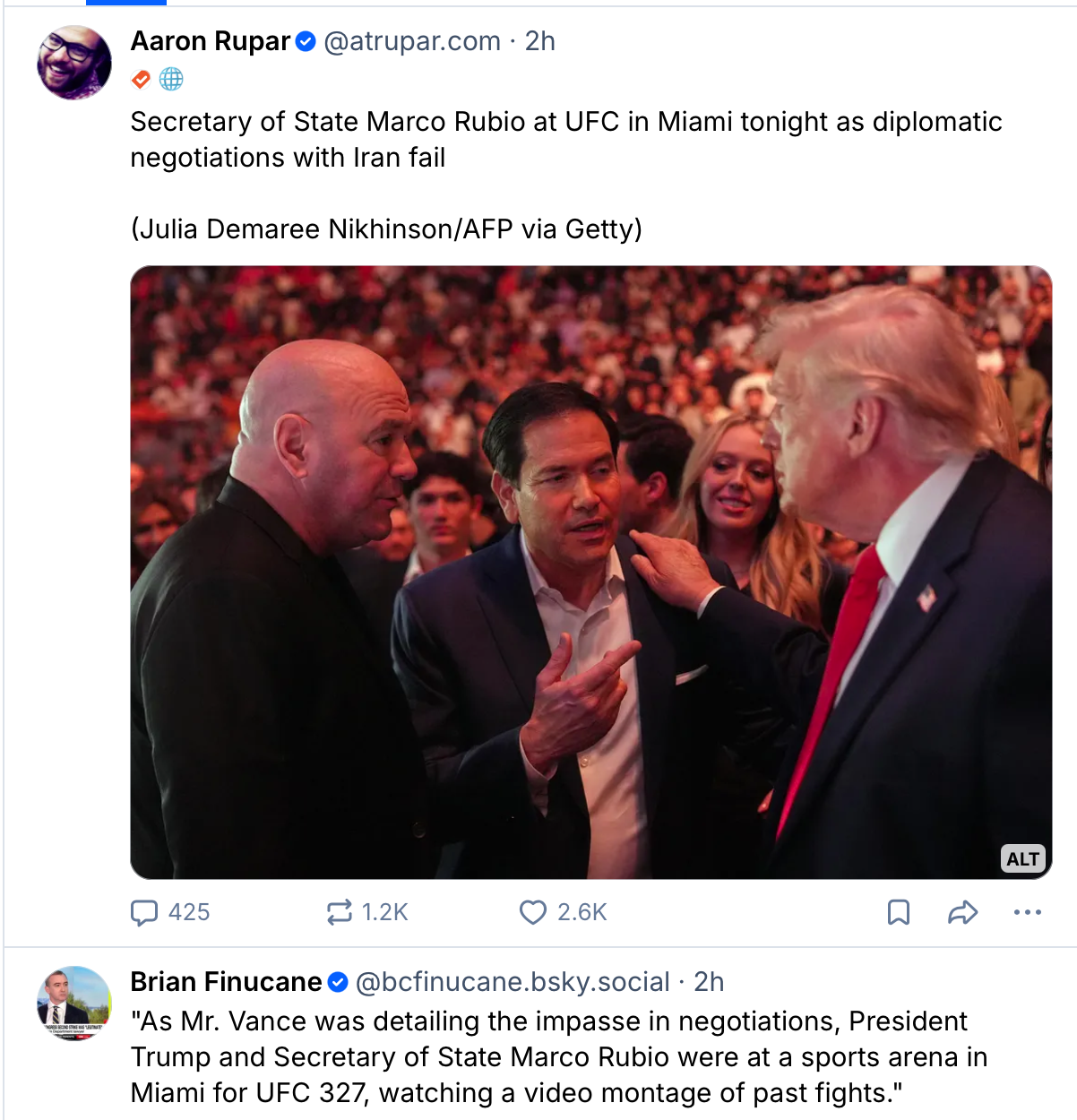
But the Trump Administration's thugs, for example, went into Minneapolis thinking they were a conquering army that would terrorize and intimidate the populace into subjugation and found that the populace was fearless in its defiance. It was a defiance motivated by a kind of moral beauty – solidarity, care, loving thy neighbor – this administration has trouble imagining, especially when it reaches across differences of ethnicity and religion as it did in Minneapolis. In this sense love is a power, or a motivating force to exercise the power of solidarity with the oppressed and noncooperation with the oppressors. The abominable JD Vance doesn't understand these forces; he had earlier misinterpreted Catholic theology to claim that “We should love our family first, then our neighbors, then love our community, then our country, and only then consider the interests of the rest of the world.” Catholic theologians smacked him down then, and they haven't stopped since.
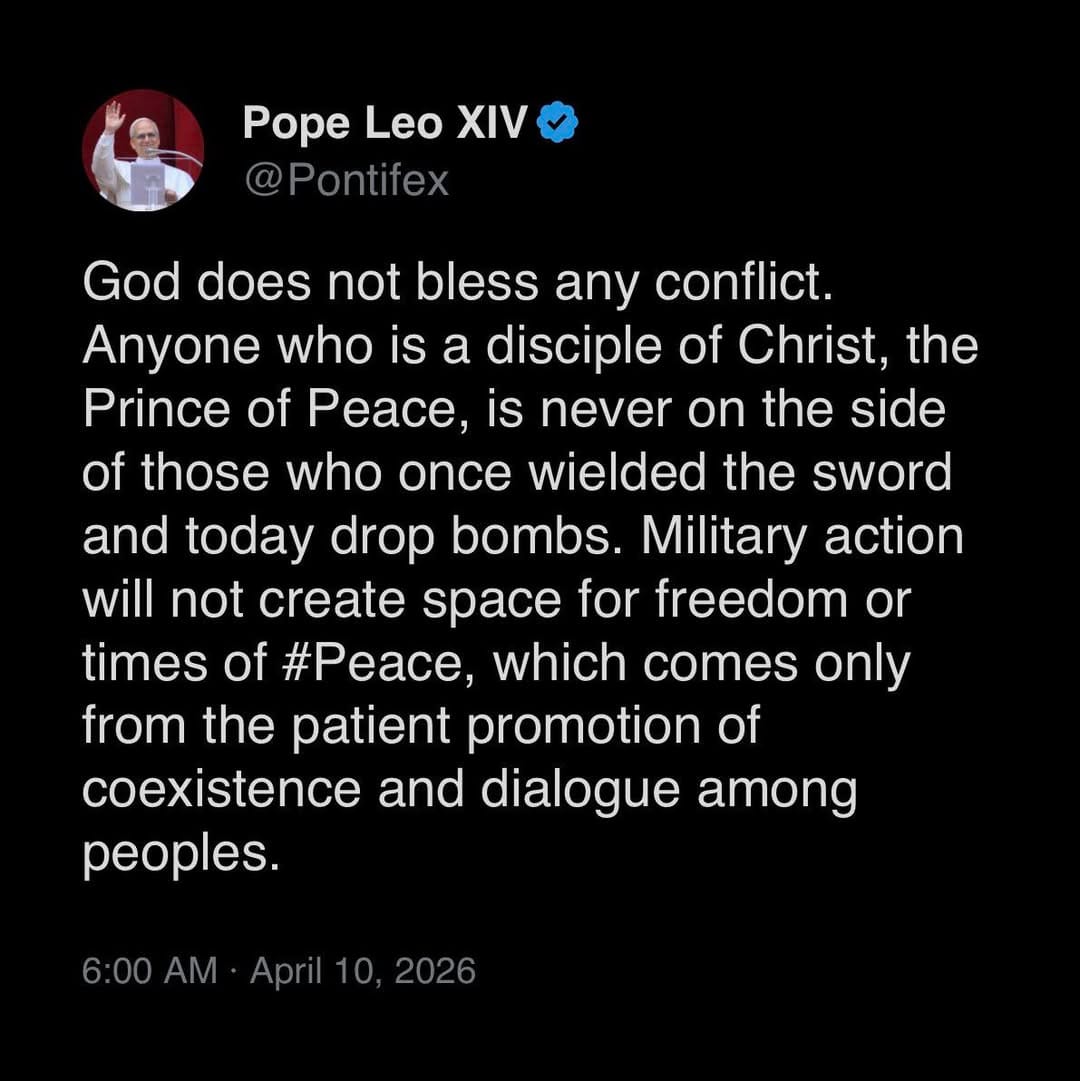
Speaking of the Catholic church, this week the New Republic described this extraordinary situation: "Days after Pope Leo XIV delivered his State of the World speech, Undersecretary of Defense for Policy Elbridge Colby summoned Cardinal Christophe Pierre, the Vatican’s U.S. representative, to a closed-door Pentagon meeting for a bitter lecture. 'The United States,' Colby said, according to a blistering new report by The Free Press, 'has the military power to do whatever it wants in the world. The Catholic Church had better take its side.' One U.S. official present at the meeting brought up the Avignon papacy, a period in the fourteenth century in which the French monarchy bent the Catholic Church into submission, ordering an attack on Pope Boniface VIII that led to his downfall and subsequent death and forcing the papacy to relocate from Rome to Avignon, a region inside France."
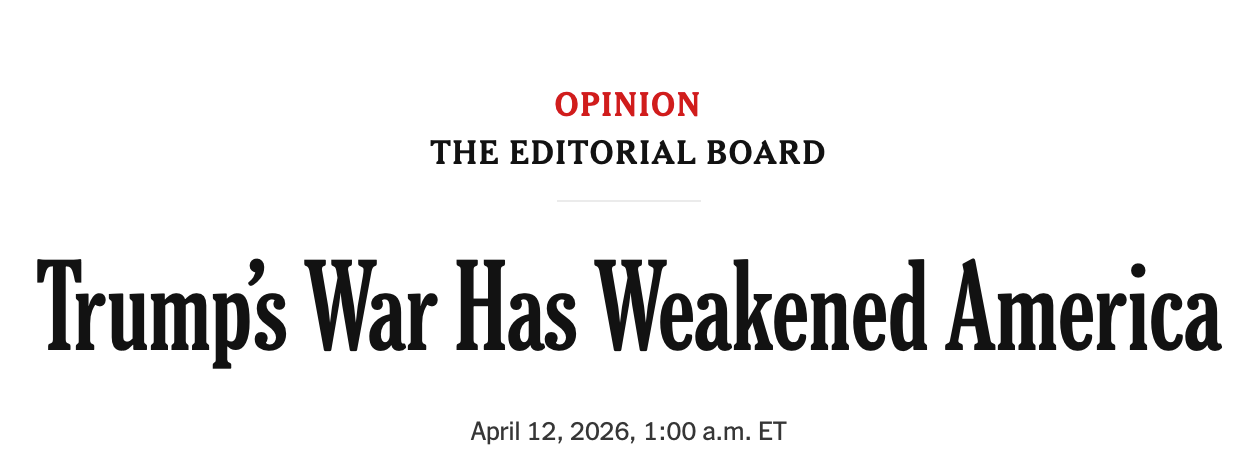
Yes, these idiots reportedly threatened the head of this ancient institution, on the basis that the pope had better not dare oppose its power. But unless it wants to use violence against the pope and the Vatican, the Trump Administration has very little power in that situation. And if it did use violence, the blowback would be profound, domestically and internationally. The power the administration constantly squanders without understanding the consequences is soft power. Take for example, the fact that when Trump wanted European countries to help him re-open the Strait of Hormuz, which was only closed because of his feckless unforced mistake of a war, heads of state laughed at him because he'd destroyed the US's once-good relationships with a number of their countries with his threats against Greenland, waffling on support for Ukraine and NATO, and tariffs.
USAID created soft power around the world while also doing actual good in saving lives and preventing suffering; dismantling the organization was one of many actions this administration took that weakens this country in the long run and, really, the short run – that with all that macho strutting and bullying, they don't understand that they are weak and making this country weak says more about the epic incomprehension. This should remind us that knowledge is power, and understanding is power; stupidity is a weakness of theirs that has often benefitted the rest of us. Including, for better or worse, Iran, which in many respects has won this war. The country has suffered horrific losses, including the death of more than 160 schoolgirls in an attack on a school that was apparently a result of the Hegseth-era military's sloppy choice of targets. The heroic uprising against the regime was undermined, not strengthened, as the Trumpists thought, by this attack. They strengthened the regime instead. And Iran has seized control, for now, of the Strait of Hormuz and is demanding huge tolls from ship traffic there.
That the war has had catastrophic impacts around the world on the price and availability of fossil fuel and fertilizer (aka nutritional supplements for flowering plants) is a way the US has sacrificed more soft power and good will and created more suffering. The fact that this fossil-fuel crisis is pushing both nations and individuals to speed the transition to renewable energy is another consequence the fossil-fuel-allied regime did not foresee. Likewise, the Trump Administration has exercised its power to sabotage climate efforts and renewable energy in ways that make this country weaker in the long term, but Trump is on his way out and clearly does not care about the long term in any way other than in masturbatory monuments to himself and illicit wealth for his family. In a similar way, Netanyahu has devastated Israel's relationships with its neighbors and much of the world, because he apparently only cares about his own fate and not about his country's, let alone the lives of those he has slaughtered in Gaza and Lebanon.
While the primitive machismo of the Trump administration sees violence and the ability to inflict harm as power, and asserts that because it is powerful it does not need alliances and good relationships internationally, these things have not made it and our country strong, but weak.
Vice President JD Vance has a playground bully's understanding of power, as has been clear at least since he went to Europe in 2025 and went out of his way to insult and patronize the world leaders he met with there. It too sacrificed the longterm power of having the trust and support of European heads of state and diplomatic leaders. Vance said this week in response to the Iranian refusal to give up the right to enrich uranium, "You know what? My wife has the right to skydive, but she doesn't jump out of an airplane because she and I have an agreement she's not gonna do that, because I don't want my wife jumping out of an airplane." This stunningly idiotic analogy seems intended to mean that Iran is like his wife, someone who has to agree to his wishes, but he has instead shown that he doesn't understand analogies, power, Iran and, possibly, wives.
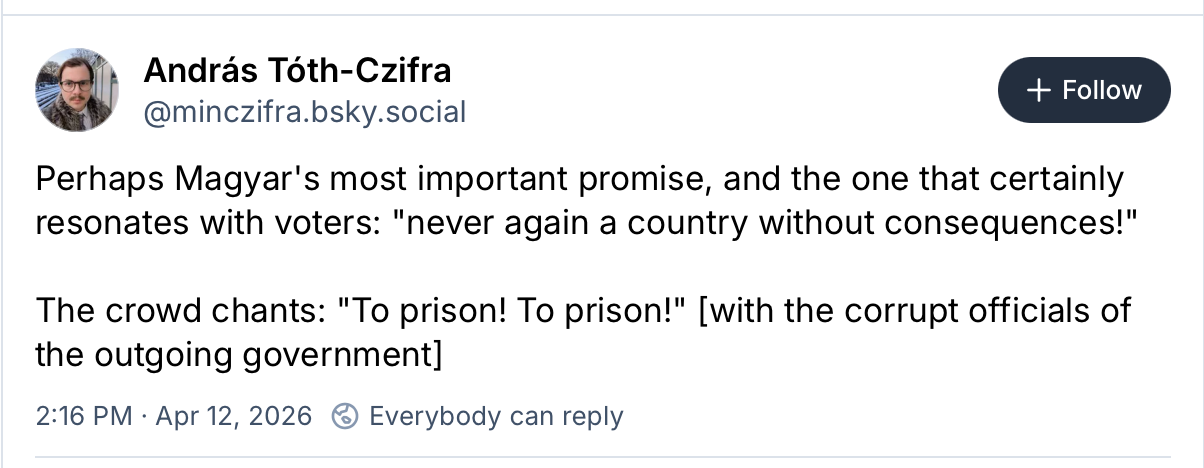
Last week Vance went to Hungary to try to stump for Viktor Orban, the authoritarian president there who as I write, has just lost the election after sixteen years as prime minister, during which he worked hard to spread authoritarianism around the world, including in the USA. The vice president's efforts were said to have been the opposite of helpful. Only yesterday, the inexperienced Vance failed to gain anything in his negotiations with a far more skilled Iranian negotiating team. The Trump Administration appears to have lost this war – had it won, it would be dictating terms, rather than unsuccessfully negotiating to return to the status quo of an open Strait of Hormuz. And of course the main justification after the fact for the war is Iran's alleged pursuit of nuclear arms, but speaking of soft power and the power of cooperation, Trump sabotaged the deal the Obama Administration struck with Iran. Soft power trumps the power of violence, over and over.
And then there's the case of Congressman and California gubernatorial candidate Eric Swalwell, exposed Friday by a detailed account in the San Francisco Chronicle of his alleged manipulation and sexual abuse of a staffer and by another report at CNN detailing accounts of sexual misconduct by more women. It's a sordid story or several of them, and one that is only too familiar. Two things are most striking to me. One is his apparent gambling on getting away with exactly the kind of actions that have in recent years terminated a lot of men's reputations and careers and sent some to prison (even if some have bounced back or escaped the most serious consequences).
The other is that while espousing Democratic and presumably lower-case democratic values, he allegedly used the power differential to bully and coerce young women, and counted on that inequality to keep them silent. Now he looks likely to pay for his abuse of power with a permanent loss of it. Democratic values in the sense I just employed it means a world in which the rights and voices of young women matter even when they're in conflict with a powerful man, a new world just emerging thanks to feminism. The soft power Swalwell had as allies, supporters and endorsers building possibilities of further political power is fast draining from him. By using coercive power, he has lost cooperative power.
The lesson flowers offer is that when you treat others well, when you meet their needs, you can enter into relationships that serve you as well as them. When you use violence or otherwise exploit and coerce to get what you want, you create adversaries, not allies, and they too often turn out to have power. In a world of increasingly equality over the past few centuries, cooperative power matters more, and violence, as Schell points out, has become an increasingly weak way to get what you want (though of course it's still necessary at times in self-defense).
We are increasingly coming to understand nature itself – Haskell's book is a fine exploration of this – as orchestrated by cooperation and symbiosis, not the Social Darwinist's vision of brutal competition for scarce resources. It's only one of many splendid books about this new vision of nature to appear recently. Forestry scientist Suzanne Simard, whose book Finding the Mother Tree was a hugely impactful account of how forests are essentially communicating cooperatives, a deeply interwoven whole, not a collection of lone competitors, has just come out with a new book I'm excited to start reading, When the Forest Breathes: Renewal and Resilience in the Natural World.
I want to step away from all the ugliness in the middle of this essay and end with an illuminating story the doctor, writer, and zen priest Clayton Dalton reminded me of, in a talk (now a podcast) titled "Bearing Witness in Gaza" he just gave at Upaya Zen Center. In the course of this talk that also covers his volunteer medical work in Gaza, Dalton recounts an ancient story of an ancient man with a curious beard who repeatedly came to listen to a Zen master talk. When the latter inquired about who he was, the former explained, in Kazuaki Tanahashi's translation, "I am not actually a human being. I lived and taught on this mountain at the time of Kashyapa Buddha. One day a student asked me, 'Does a person who practices with great devotion still fall into cause and effect?' I said to him, 'No, such a person doesn't.' Because I said this I was reborn as a wild fox for five hundred lifetimes."
He wanted to be freed from the consequence of his denial that we are all subject to consequences. The priest helped liberate him and then held a funeral for the aged fox they found in the mountains. Consequences in this sense could mean interrelatedness. I began by describing power as connection; we influence others; others influence us, and how those two forces dance together or fall apart into conflict arises from our actions and the understanding behind them. Dalton said that he has "found that something happens when you begin to perceive things in this larger, more inclusive way. I have found, sometimes to my surprise, that compassion rises up into this spaciousness, like water filling a well from below.”
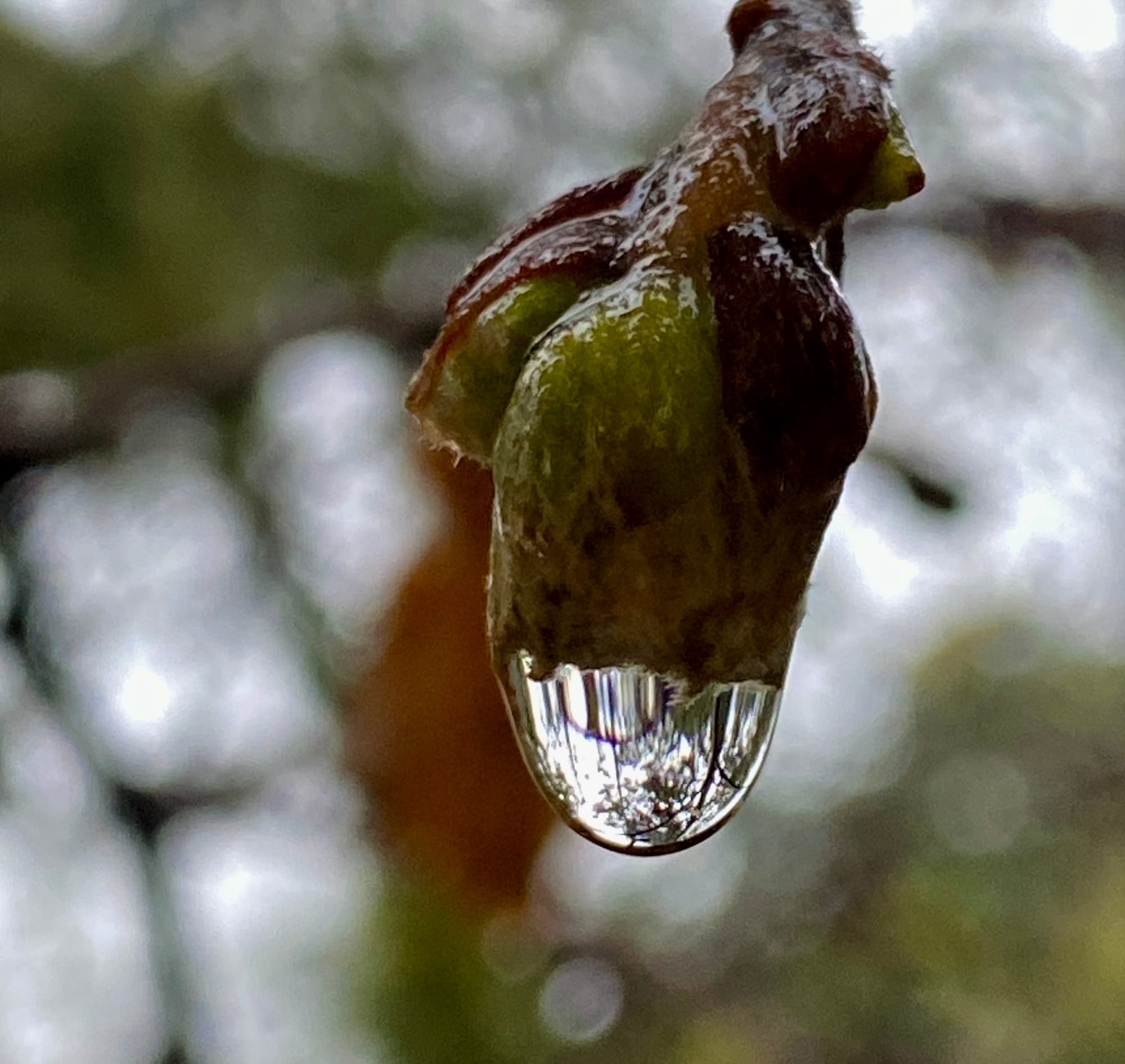
Zen master Dogen wrote a poem about seeing the moon in a dewdrop. In one interpretation, "the moon (Buddha-nature) is completely reflected in every one of the countless dew drops (all things) without discrimination, namely one in all, all in one." Elsewhere Dogen wrote, "The whole moon and the entire sky are reflected in dewdrops on the grass, or even in one drop of water." It is all connected. In my most recent book I quoted the scholar Judith Butler who has another explanation of why violence should not be conflated with strength or power: “In my experience, the most powerful argument against violence has been grounded in the notion that, when I do violence to another human being, I also do violence to myself, because my life is bound up with this other life."
p.s. I should have mentioned that in The Unconquerable World, Jonathan Schell is deeply influenced by the German Jewish philosopher and refugee Hannah Arendt's writings on violence and essentially reiterates her positions, with the addition of his own insights about nuclear weapons and the power of nonviolence and civil resistance. The book was treated shabbily when it appeared in 2003 just as the invasion in Iraq was starting and a lot of people had a lot of faith in violence; time has further validated his views.