If Fossil Fuels Are War, Renewables Can Bring Peace

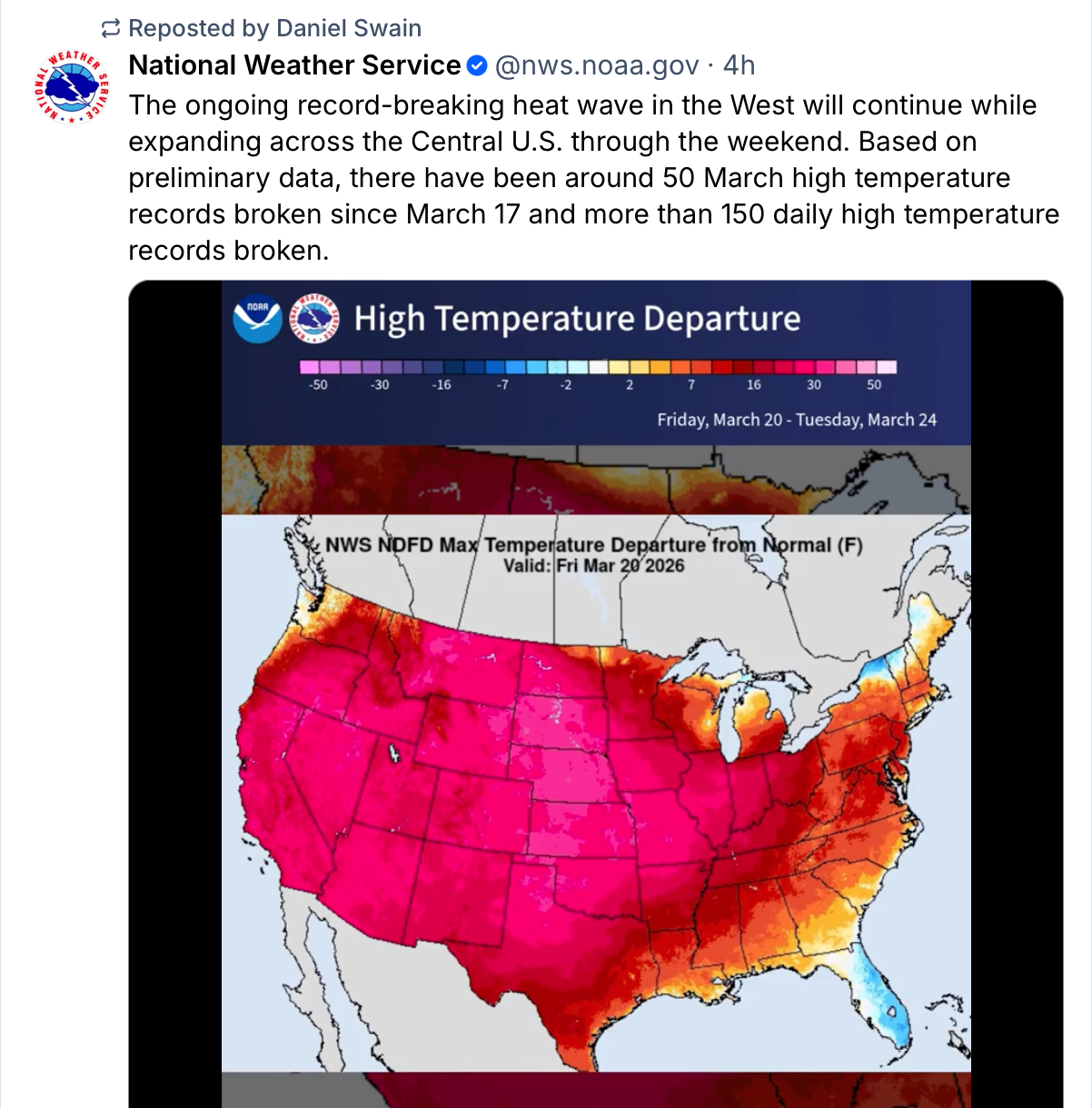
On one side of the world the US and Israel are pursuing an ill-conceived attack on Iran that has hugely impacted the flow of fossil fuel in the region. This is already having a grim impact on daily life in many nations, jacking up the price of oil and gasoline, and threatening the availability of fossil-fuel-based fertilizer for spring planting. On the other side of the world, beginning in California and the Southwest and now spreading across the continent, an unprecedented heat wave has produced shocking temperatures for mid-March, with dire implications for agriculture, wildfire, snowpack and water flow. These two things are related. The climate is a crisis because for far too long we've burned too much fossil fuel.
The Associated Press reports, "The war in Iran is exposing the world’s reliance on fragile fossil fuel routes, lending urgency to calls for hastening the shift to renewable energy. Fighting has all but halted oil exports through the Strait of Hormuz, the narrow waterway that carries about a fifth of the world’s oil and liquefied natural gas, or LNG. The disruption has jolted energy markets, pushing up prices and straining import-dependent economies. Asia, where most of the oil was headed, has been hit hardest, but the disruptions also are a strain for Europe, where policymakers are looking for ways to cut energy demand, and for Africa, which is bracing for rising fuel costs and inflation. Unlike during previous oil shocks, renewable power is now competitive with fossil fuels in many places. More than 90% of new renewable power projects worldwide in 2024 were cheaper than fossil-fuel alternatives, according to the International Renewable Energy Agency."
The war and the Iranian blockade of the Strait of Hormuz are pushing more people to recognize that fossil fuel is politically as well as environmentally devastating. Donald Trump never seems to think of consequences and the long game (sometimes he seems to imagine there will be none whether he's taking over the Kennedy Center or starting a war in the Middle East, perhaps because he imagines his is the only power that matters). But the longterm consequences of this war may be the opposite of what his fossil-fuel backers hope for: an accelerated energy transition. Of course, he's also fighting a war at home again renewable energy, slashing funding, withdrawing permits, and even considering bribing (with your money and mine) the French builders of US offshore wind farms to cancel. Here's a periodic reminder that in the summer of 2024 he told fossil fuel executives that if they gave him a billion dollars, he'd give them everything they want. They gave. They're getting.
As that Associated Press article notes, most new energy projects around the world are renewable, because it's now the best way to power anything that runs on electricity, and a related push is electrifying things from home appliances to construction equipment to industry. Bill McKibben noted in 2025, worldwide "people are now putting up a gigawatt’s worth of solar panels, the rough equivalent of the power generated by one coal-fired plant, every fifteen hours." What we call renewable energy is also decentralized energy. It's energy that can't be monopolized by cartels or corporations because sun and wind and hydro and geothermal power are far, far more widely distributed across the surface of the earth. Stanford climate engineer Mark Z. Jacobson long ago drew up transition plans for all fifty states and nearly every country on earth, making the point that different places have different mixes, but all have what they need.
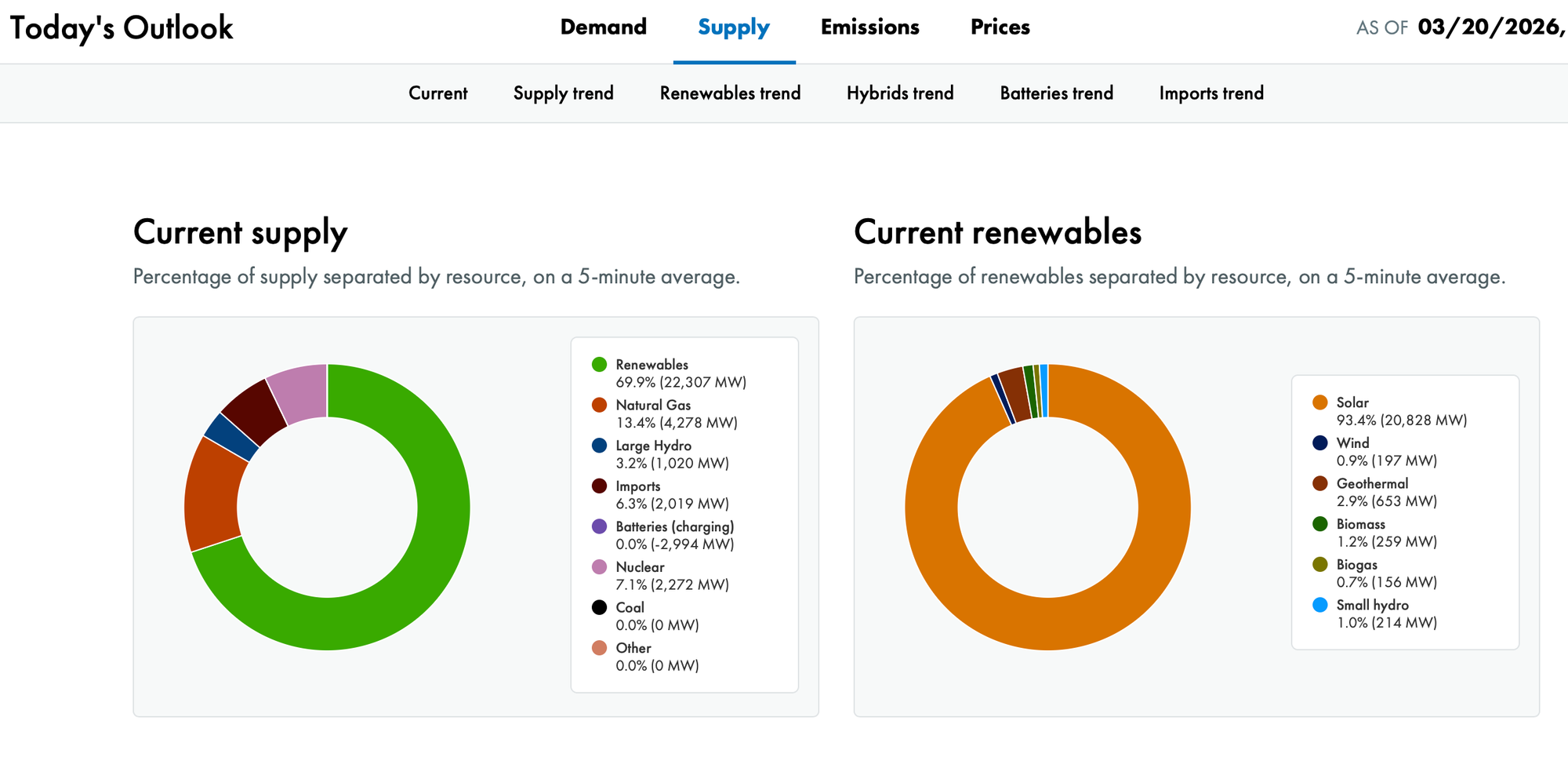
It's domestic energy, local energy, and it's also free energy since once you build the infrastructure in the form of turbines or solar panels and the distribution system, your fuel is sun or wind that is both inexhaustible and free. Solar is now so abundant in Australia that electricity will be free for three hours a day when production (and the sun) are at their height. California has addressed this midday surge with the biggest battery array outside China, which stores that electricity and then puts it back into the grid at other times. I like to say that means from now on the sun shines at night. Because one of the really annoying things we were often told by naysayers about renewables is that the wind doesn't always blow, the sun doesn't always shine. Yeah, but with storage the mix can work and does.
But I want to digress about Australia for a moment. One of the things that prompted me to found MeditationsinanEmergency.com was a 2024 query to some of my editors about a piece I was really excited to write and that, to my frustration, they didn't seem to get. That confirmed I needed my own platform. The query was about a movie, so they didn't recognize it as political commentary, but it was about a movie that was in turn about the violent struggle over fossil fuel. That is, it was about another installment of the dystopian sci-fi action films that began with Mad Max. I had written my editors: I saw Mad Max Furiosa last night, which is a hot mess, but what was really striking was its stranding in what I once heard called 'yesterday’s tomorrows.' The film is mired in its 1980s vision of the future, but the obsession with gasoline just felt like a throwback. There they were under the endless Australian desert sun bashing each other for gasoline, cutting gas lines, blowing up each other’s internal combustion vehicles, fighting for a moated refinery called Gas Town, and so forth. I mean, you could put enough solar panels across the Australian outback to power several earths. [The smaller, grayer UK recently estimated that it would take only 1% of its land base to meet its 2050 renewables goals.]
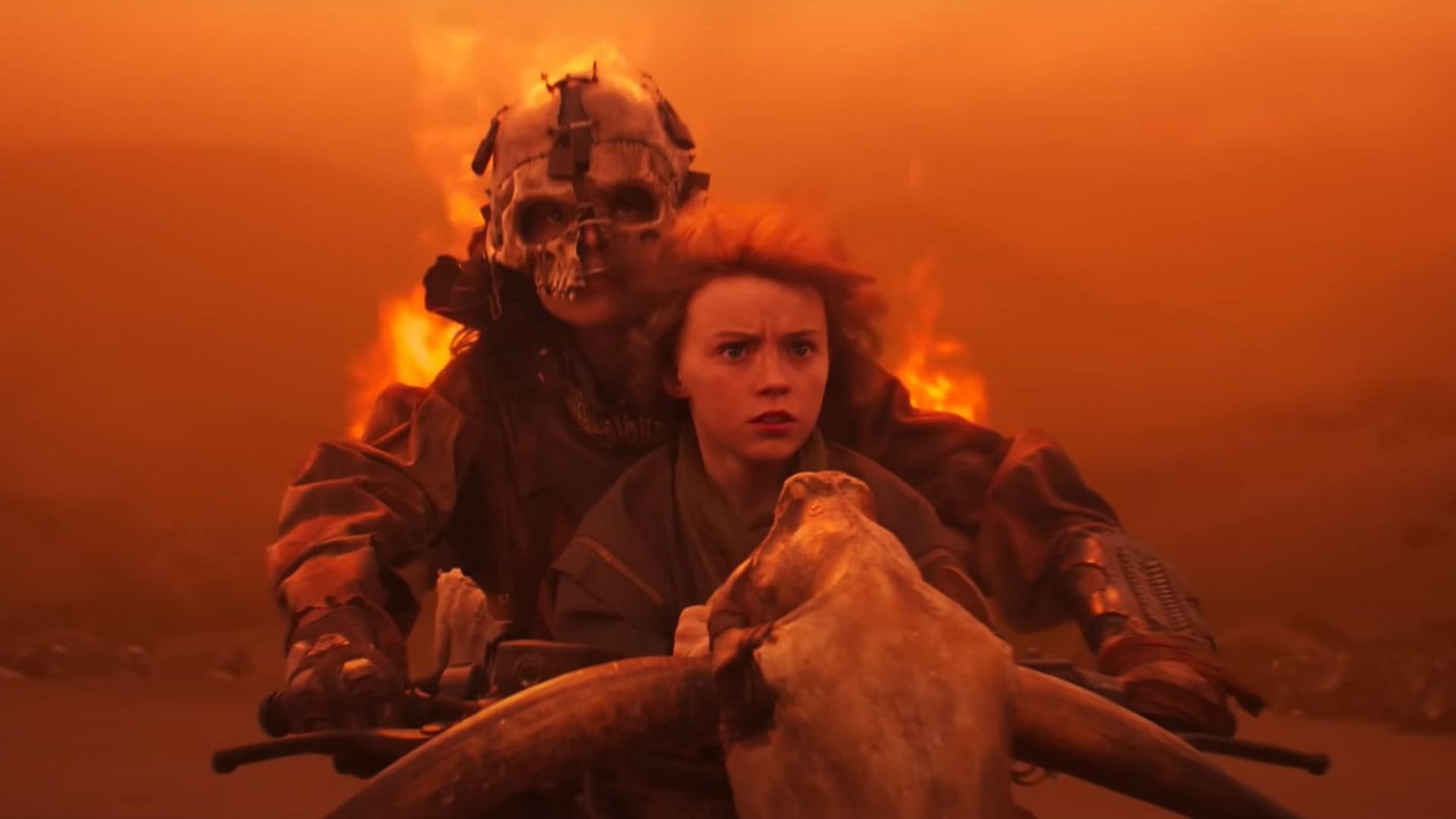
The amazing thing about renewable energy and an electrified world is that it’s just better in countless ways, starting with the fact that it means that almost all energy everywhere can be local, and the sunshine and wind are pretty much inexhaustible so there’s enough for everyone, and it’s all pretty clean and nontoxic, and the cars can be quieter; the film is full of roaring engines. Because we’re so focused on these technologies as a solution to climate change, most people don’t realize that they eliminate a host of other problems, and that would be true even if there was no climate chaos. Frederick Jameson famously said, “It’s easier to imagine the end of the world than the end of capitalism.” Apparently it’s easier, at least for director George Miller to imagine the end of the world than the end of the fossil fuel era; while over here in the real world we’re trying to accelerate the end of that era to forestall…well, not exactly the end of the world, but a good deal of devastation to it.
A striking thing about that movie and its predecessor, Mad Max Fury Road, is that somewhere in its imagined grim future, there's a feminist oasis where people have figured out how to live, apparently in peace and equality, in a garden environment – it's where the Furiosa character comes from and is trying to get back to – but George Miller doesn't seem to know how to make a movie about the kind of subtle complex trouble we get in paradise. So he focuses on ultra-violent vroom-vroom internal (and external) combustion misogynist hell. It makes me think about Ursula K. Le Guin's landmark essay "The Carrier Bag Theory of Fiction," which proposes that the first human tool was not a weapon, but a container, because gathering was actually more significant a food source than hunting. But, she points out, how the men killed the mammoth makes a more dramatic story than how the women gathered the oats, a more obvious story, and the kind of story we get too often.
"I said it was hard," she notes, "to make a gripping tale of how we wrested the wild oats from their husks, I didn't say it was impossible." The renewables revolution is maybe like the wresting wild oats story – it's hard to even get people to focus on it and its magnificent (but technically complex and incrementally achievable) implications – while there's a lot of mammoth-spearing drama and gore in any war. Maybe we're in the trouble we're in here in the USA – and dragging the rest of the world with us – because too many people weren't very good at listening to the pragmatic wresting-oats story from the lady candidate and got captivated by the old man's fantasies of more mammoth-bashing. Or, to extend the metaphor, didn't realize our diet is mostly those oats, not gobbets of mammoth flesh – that is, that our well-being depends on things like economic policy and environmental protection and not on, say, dramatic violence against our neighbors courtesy of ICE.
What the Mad Max franchise (which began only six years after the 1973 oil embargo) got right is that fossil fuel in its extremely uneven distribution throughout the world always seems scarce, and there's always violence over it. The climate movement is a peace movement in two ways. First, it's an endeavor to wind down the many kinds of political and social violence – human-on-human violence – that is fossil fuel. Wars are fought for the stuff, and at every stage from extraction to refining and transportation to use (aka burning it), it's environmentally devastating, with poor, indigenous, and nonwhite communities (such as in Louisiana's Cancer Alley or the Native peoples near the Alberta Tar Sands) bearing the brunt of it. Secondly, you can regard the climate crisis as a war we're fighting against nature – human-on-ecosystem violence – and the movement as an attempt to realign ourselves with what the planet can bear. A movement to make some degree of peace with nature.
Climate change is caused by many human actions, and the solutions are likewise manifold: change how we design our residences, towns and cities, transit systems, agriculture, land management, and overall consumption habits, including food. But the single biggest one is: get over our reliance on fossil fuels. Climate change is itself violence as fires, floods, extreme heat, drought, famine, sea level rise and other catastrophes that both take human life and devastate the natural world. (Environmental historian Rob Nixon published a book in 2011, Slow Violence and the Environmentalism of the Poor, about the way we need to see these undramatic forces that poison, contaminate, undermine, force relocation as violence.) It is violence caused by the powerful minority that has delayed and derailed the decades of efforts to do what the climate requires of us. People die of stuff like the current heat wave (and heat-wave deaths are one of the most undercounted ways we die of climate chaos).
Fossil fuel is historically tied to political violence and to the ugly geopolitics of the pursuit of the stuff. For example, the oil company BP began as the Anglo-Persian Oil Company, a British-controlled entity extracting Iranian oil in 1909. After huge profits went to the British government and shareholders, the Iranian parliament voted to nationalize the resources in 1951. Britain drew up plans to invade, but instead the US co-led a coup against the country's left-leaning prime minister, the monarchy was reestablished, the profits continued to flow to the West, and the Anglo-Persian Company morphed into BP. The 1979 revolution to overthrow the shah brought in the current government the US is attacking, and it too has devolved into a fossil fuel war, with attacks on oil infrastructure and a blockade of oil tankers. In the short term, this should produce huge profits for some fossil fuel corporations; in the long term it may – and may it – speed the transition away from the stuff.
The government of Spain has been outspoken against the attacks on Iran, perhaps because of its prime minister's left politics, but perhaps also because the country gets the majority of its electricity from renewables and is thus far less dependent on foreign fossil fuel than many other European countries. Meanwhile, from Ukraine to Cuba to Pakistan, countries are speeding the energy transition to achieve independence from the volatile and often brutal political economy of fossil fuel. (Trump is attempting to strangle Cuba, whose energy grid has collapsed, by shutting off the Venezuelan oil it depended on; China is supplying solar panels to help speed a transition.) In the US it's said to be producing a rise in interest in purchasing electric vehicles. Here's to peace on earth, all kinds of it, peace with nature, peace among human neighbors, and to the end of the fossil fuel era as a crucial part of that peacemaking.