Journalism Is Dead. Long Live Journalism
In some respects, this is a golden age of journalism. Right now, a host of brilliant, dedicated souls do fantastic work reporting and interpreting the news in independent newsletters, podcasts, magazines and even mainstream media. In other ways, journalism is in an age of slop and slime and decline. Corporate consolidation of news media has weakened and corrupted it. The Internet has undermined journalistic revenue and too often supported extremist sites, the spread of misinformation and disinformation, platforms for white supremacy, misogyny, and cults like QAnon (while at the same time allowing the rise of independent news production and a wide array of options for consumption as never before).
Local news has withered. As a 2020 editorial put it, "In the last 15 years...more than a quarter of the country’s newspapers have closed and 1,800 communities that had a local news outlet in 2004 were left without any at the beginning of 2020. Without local newsrooms, the basic work of reporting — gathering accurate information and demanding transparency and accountability from local governments and powerful business interests — vanishes. This loss directly imperils a functioning democracy, which requires an informed citizenry." When no one reports on local corruption, there's no public pressure to stop it.
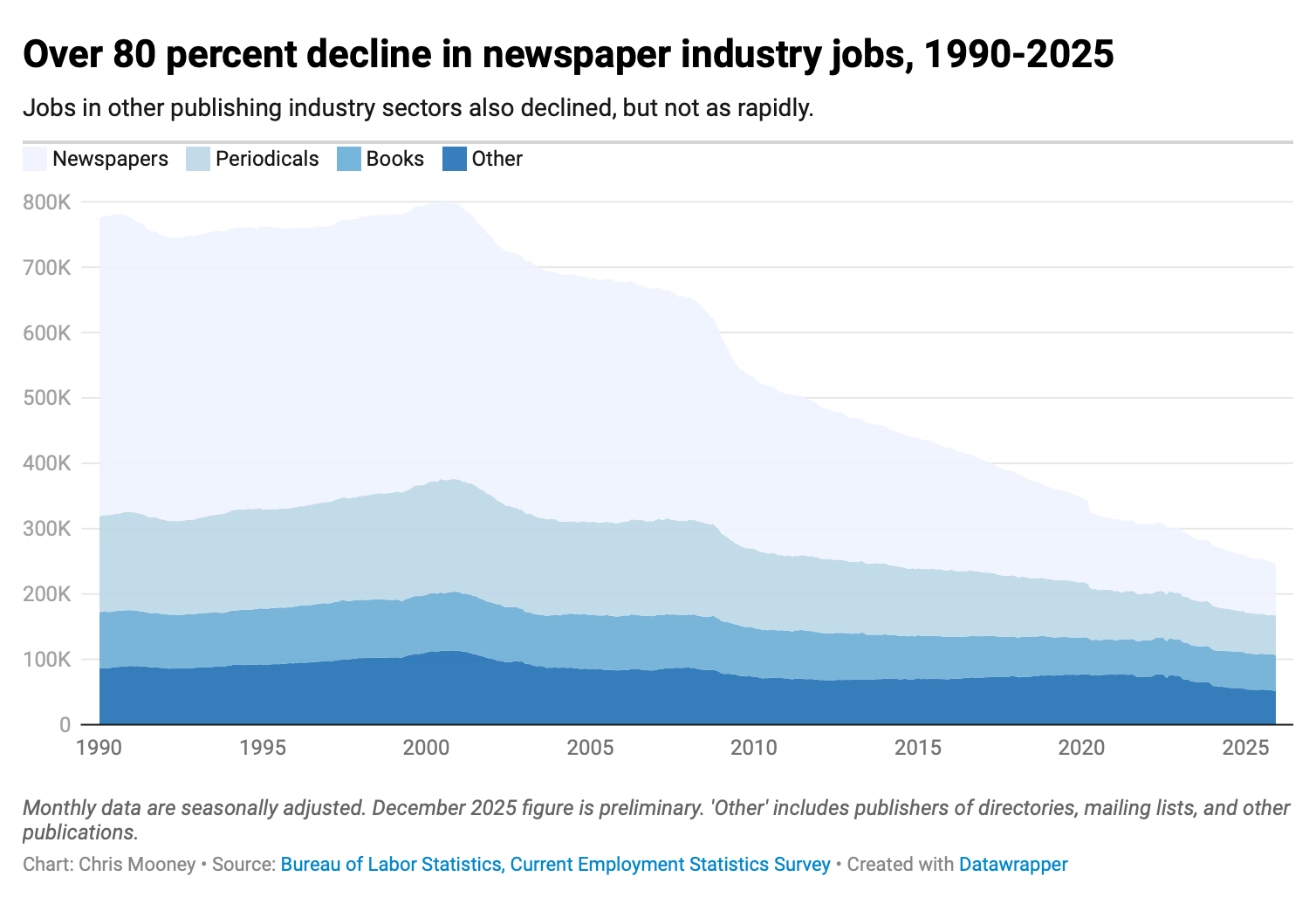
While I love the valor and insight of the people I rely on for information, and follow hordes of smart, informed journalists and experts on social media, I know that in the wake of the decline of local news, the public gets herded toward national outlets. A lot of us get our information from appalling sources – not just the right-wing media (Fox, NewsMaxx, conspiracy entrepreneurs like Alex Jones) but mainstream media that has been overtaken by the oligarchy. That includes both the Washington Post and Los Angeles Times which have been withered and corroded by their billionaire owners, with CBS now in the mix since Oracle's Larry Ellison (net worth $200 billion) and his son bought it and immediately turned it into a Trump-aligned misinformation machine.
The oligarch takeover also includes social media. The Ellisons just acquired control of Tik-Tok in the USA, which has reportedly been censoring anti-ICE posts. Musk owns Twitter, which he's turned into a cesspit of right-wing misogny, racism, and misinformation, and of course Facebook revenue made Mark Zuckerberg an oligarch). But also, over the years, many newspapers, radio stations, and television stations have been bought up by corporations whose interest is not in reporting the news but reaping the profits, and they have often squeezed and sabotaged journalistic integrity and service in the hopes of producing higher profits.
When an oligarch owns an information organization, he's too often inclined to make it serve his larger portfolio rather than the public and the truth; thus were endorsements of Kamala Harris suppressed at both the L.A. Times and the Washington Post. I write in the aftermath of Jeff Bezos's recent decision to fully enshittify the Washington Post by cutting a huge percentage of the staff after hiring a corrupt right-wing publisher who turned the paper's commentary into an almost exclusively conservative-to-nutty zone and skipped out right after the bloodbath. Many of the best people at the Post had already left. (I'm in particular a devotee of former Post columnist Greg Sargent, whose podcast The Daily Blast and reporting with the New Republic are essential reading for understanding the moment.)
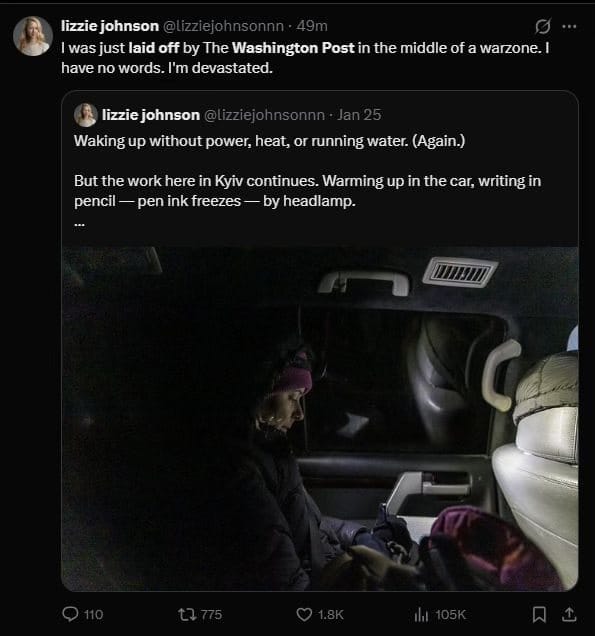
Bezos seemed to have much more benign intentions during the first decade he owned the Post, but like many other oligarchs, he's a windsock whose political views align with his financial pursuits and right now too many oligarchs are making nice to the Trump Administration in particular, while some are loud advocates for authoritarianism in general (there's a whole other conversation about how extreme economic inequality is devastating for democracy, which is after all about equality). I get the impression that a lot of very powerful people are operating on the assumption that authoritarianism is here for the long run. If and when it fails, watch them scramble to pretend they were never who they are right now, just as after the end of the Second World War lots of French people who were part of the collaborationist Vichy regime pretended they'd always been with the Resistance, just as after it became clear the Iraq War was an idiotic catastrophe, lots of people decided they hadn't actually supported it, though the record showed otherwise. Anyway, watch the windsocks when the weather changes, and beware of people without firm moral positions.
Getting your news from social media is routinely deplored, but social media is as good or bad as who you follow and how well you can evaluate your sources. Before Musk bought Twitter, I followed a lot of excellent people there – climate scientists and organizers, feminists, journalists, experts in their fields, elected officials. I do the same now on BlueSky and find it a fantastic way to get breaking news reported and critiqued, find links to reports and essays I might not see otherwise, and sometimes get to meet people far away. Most recently I had a moment on BlueSky with Minnesota Public Radio journalist Sam Stroozas (who I had thought of as Bathrobe Lady for this picture of her in a crowd facing and documenting ICE, having just rushed out of the house without getting dressed in her zeal to report).

I got myself into and then out of an argument last year when someone I used to know and was still friends with on Facebook posted some outrageous nonsense about how Putin was liberating Ukraine from Nazis, including Zelensky. I backed down when I realized I had encountered one of the myriad people who are simply not equipped to filter the deluge of information, misinformation, and disinformation pouring over all of us, and I was not going to straighten him out in that moment. When I was younger, most people had pretty much the same information diet from mainstream media. It was like eating the most basic meat and potatoes diet or maybe eating fast food – bland, generic, a bit overprocessed, limited in possibilities, but basically safe. Now you can go eat the equivalent of your garden-fresh organic vegetables from your favorite podcaster, read all sorts of gourmet foreign and special-focus news online, or gobble down the equivalent of carrion laced with strychnine from right-wing disinformation sources ranging from the Putin regime to random crackpots and hate groups to professional scammer and clickbait ventures often run from distant countries (and often aided by AI's talent for hallucination and distortion).
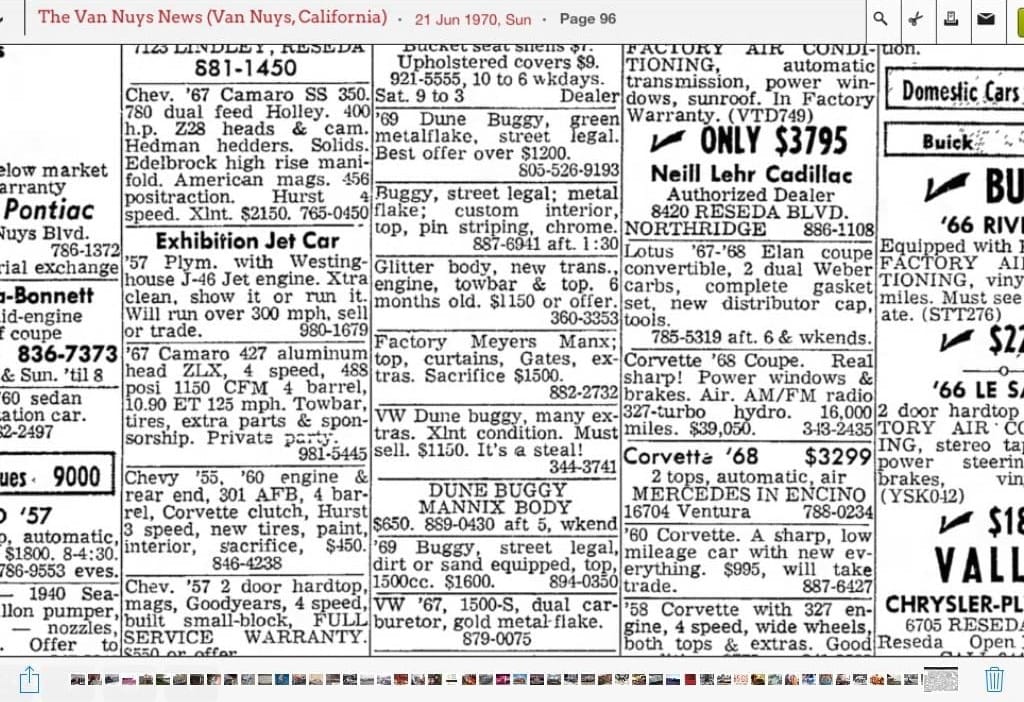
Silicon Valley created and abets this chaos, both by undermining the financial basis for traditional news by siphoning away its advertising revenue and audiences, and by creating tools and platforms where, over and over, from Facebook to Substack, the bosses insist they are defending free speech by not filtering out dangerous disinformation and hate speech. In the 1990s I watched San Francisco-based Craigslist undermine newspaper want ads – what we called the classified section – as it expanded. There's an argument to be made that Craigslist was a more convenient service, but the want ads in newspapers subsidized journalism. The revenue from Craigslist just subsidized Craig Newmark, who became a billionaire. It's ironic that what was once Columbia Graduate School of Journalism is now the Craig Newmark School of Journalism; it's a bit like a fox endowing an orphanage for motherless eggs. (He could have at least given the money directly to news reporting.)
Google has drained revenue from the news industry on a far more lethal scale, grabbing journalism's advertising revenue and serving up the information gathered by news organizations. And it just got worse: Tech Crunch reports, "Now that people can simply ask a chatbot for answers — sometimes generated from news content taken without a publisher’s knowledge — there’s no need to click on Google’s blue links. That means referrals to news sites are plummeting, cutting off the traffic publishers need to sustain quality journalism." How Google has sabotaged journalism's revenue is complex, but there's an excellent recent piece about that in the Atlantic here.
Three quarters of Google's revenue ($400 billion in 2025) comes from advertising, and after getting much of the world to use its search engine, it has corrupted the workings of that engine by promoting paid stuff first and pushing users toward its wasteful gratuitous unreliable AI offering, meaning the reliable results that got so many of us to use Google are no longer so reliable. Too, online platforms like Google and Facebook harvested our personal information as we used them, and sold it to advertisers. This allows advertisers to target our interests and prejudices, as anyone who just saw a an ad for something they recently searched for knows. There's no clear border between trying to sell you a hat or a vacation and trying to sell you a lie or a politician, as we saw in 2016, when both the Putin regime and Trump campaign targeted US voters with pro-Trump anti-Clinton propaganda in the form of social media ads. (Similar things happened with Brexit, while now-imprisoned former President of Brazil Jair Bolsonaro rose to prominence through Youtube's algorithms that push viewers toward extremist content. Google owns Youtube, so you can blame the corporation for the far-right president's destruction of thousands of square miles of the Amazon.) Privacy is essential to democracy; we need to be able to think and speak and act without Big Brother-style surveillance, and we've lost a lot of that privacy (though we can claw some of it back by being careful about our privacy settings; the Electronic Frontier Foundation has good instructions on that).
Lots of people, including me, who comment on the news and are often critical of major news outlets are nevertheless dependent on those outlets and a few others such as the nonprofit ProPublica for crucial reporting and investigative journalism (only too many stories on alternative and smaller sites turn out to be rehashes of someone else's reporting, some of them verging on plagiarism, though there's also another cycle whereby small, local outlets break a story and big national corporations take their lead from the locals, often without credit). The production of those stories requires money for salaries and expenses, and that money comes from advertisers and subscribers (and at the Guardian an endowment). I've often railed at the New York Times's editorial perspective, inflammatorily misleading headlines, and abysmal columnists. I'm also grateful that it employs some of the best reporters in the country and funds them going after stories for months to years. It's always worth remembering that institutions are made up of individuals whose competence, agenda, and integrity varies.
The impact of good reporting can topple politicians, send murderous cops to jail, prompt major reforms, expose environmental destruction, threats to public health, labor issues, human rights violations, and so much more. Julie K. Brown of the Miami Herald almost singlehandedly brought down Epstein in 2018 with a series of stories based on almost two years of research in the documents relating to his criminal cases, talking to key sources, and locating about 80 victims who she persuaded to trust her enough to tell their stories. Those stories launched the federal investigation and arrest of Epstein and led to the resignation of Trump's secretary of labor, Alex Acosta, who as U.S. attorney for Southern District of Florida had cut a sweetheart deal with Epstein in 2008 while illegally shutting out victims from their right to know. (She now unpacks breaking stories and background in the Epstein case in an independent newsletter.) You can't comment on a story unless there is a story, and a lot of stories are there because a journalist went out and got them. Marisa Kabas is an extraordinary independent journalist who at her one-woman The Handbasket often gets major scoops and builds stories from information garnered from her wide network of sources, including insiders and experts. But a lot of our essential news still comes from journalists backed by the resources of major mainstream outlets.
If you're someone like me who has a lot of time to sift through it all and some training in sifting you can be gloriously well-informed. If you just read the most successful of the new-form independent media, Heather Cox Richardson's newsletter, you'd be well-informed on the central issues in the USA. I've watched her rise in awe since she started writing her Letters from an American on Facebook in the fall of 2019. One reason is simply her reach, with 2.7 million direct subscribers and 3.6 million followers on her Facebook page, plus huge audiences for her streamed live conversations. That puts her at a scale comparable to a major newspaper (the Washington Post has been hemorrhaging subscribers; a year ago, its daily online readership was estimated to be 2.5-3 million; I suspect she's bigger than the Post).
Another reason for my awe is, while many news outlets seem to operate on the basis that the American public is shallow and needs lots of juicy gossip, lifestyle content, short articles and dumbed-down news, Heather has demonstrated that there is a significant audience for thoughtful, longform, deeply contextualized news summaries and interpretations. She doesn't just offer context; she offers a historian's deep context going back to the founding of this country. Perhaps the commentator most akin to her is Josh Marshall who has, at Talking Points Memo, long written deeply informed and contextualized essayistic commentary on current events.
A lot of mainstream news outlets manufacture versions of objectivity that amounts to decontextualizing the topic at hand so deeply that the remaining fragments don't make sense unless you have an excellent grasp of the background yourself. Context is seen as bias. Specifically, they're too often afraid to say "this government official said this but he/she has a history of lying" or "these people are losing their homes/jobs/healthcare because of economic decisions made by this party." They pander to extremism when they pursue other forms of the appearance of neutrality and objectivity by normalizing outrages, downplaying destruction, and creating false equivalencies. They've long seemed to feel obliged to do "both-sides" stories in which some minor infraction by the Democrats is equated to major crimes and outrages by Republicans, or to call the country polarized as if there was symmetry between the Democrats trudging along as usual while Republicans go to war against the rule of law and the bill of rights. (For example in September of 2024, the New York Times ran a story suggesting that economists "had questions" about both Trump's and Harris's policies to address to the housing crisis, when Trump's outrageous non-solution was mass deportations, aka the current hideous and often illegal ICE pogroms.)
So that's some of the problem. And yet while I can't call them solutions until they reach far more people, there is so much good journalism being done right now (even the Wall Street Journal, which I access through my public library, is doing some tough reporting on the administration now, and the New York Times seems to have somewhat corrected course after being the Trump-normalizing Joe-Must-Go paper in 2024). One anomaly is the left-leaning Guardian, which is a major newspaper covering domestic and global news, but based in London and without the fears so much of the US press seems to have of the Trump Administration – and likewise without fear of being seen as having a political position, which every publication has but some twist into pretzels to pretend they don't. (Full disclosure; I've long written for the Guardian, but I write for it because I think it's a great paper and not the other way around.) I get most of my climate news from alternative sources including Bill McKibben's and Emily Atkins's newsletters, Christiana Figueres's Outrage and Optimism podcast to Assaad Razzouk's weekly good climate news lists on Bluesky and climate scientist Katharine Hayhoe's informed posts there.
My brilliant climate journalist/fossil fuel industry analyst friend Antonia Juhasz writes on those topics for Rolling Stone, which like many magazines – Mother Jones, Wired, the New Republic, the New Yorker – often seems bolder and fresher in their takes than mainstream news sources. Jessica Valenti's Abortion Every Day is the smartest, fiercest, best source on reproductive rights and wrongs. Cory Doctorow at Pluralistic and Brian Merchant at Blood in the Machine offer valuable critiques and reports on the tech world. Tobias Barrington Wolff, Jay Kuo, Dahlia Lithwick at Slate, and Chris Geidner at his newsletter Law Dork are among the legal commentators who help me understand what's going on in the courts and what the law says and means. I'm a huge fan of Anand Giridharadas's The Ink, which includes video conversations, a book club, and guest voices, and Wajahat Ali's newsletter The Left Hook; both survey US politics from a progressive viewpoint. Hyperlocal news sources and the news reported by local public radio stations remain good sources of information. There is so much good stuff – if you have the time to find it and the skill to sift the wheat from the chaff.
I don't know where we go from here. I think the siloing of voices (including mine here) into solo newsletters is not an ideal solution, not least because it's just too much for most people to sort through and too expensive to subscribe to more than a handful. I hope that we find ways to aggregate into magazine-communes of sort with likeminded writers (the UK's great Carole Cadwalladr, a fierce critic of and reporter on tech, has founded a collective online newsletter recently, Broligarchy; maybe that's the model; Talking Points Memo and The Ink are also collectives with a strong central voice). I hope that the reach and impact of these alternative voices and sources reach more readers and subscribers I hope that the oligarchs and Epstein class don't completely destroy mainstream media. I hope that we wrestle forms of social media into existence that aren't corrupted by billionaire owners and advertising-driven violations of our privacy.
Something striking about our moment is: everything has been destabilized since January 20, 2025, and a lot of it was pretty damn shaky or rotten before. We are in the mess we are in because of parts of our society, including the news media, that were not what they should be before the current rampage (I believe that a truly informed public could not have elected Trump in 2016 or 2024). So while there are ways in which we might want to return to the world before Trump's second term, there are lots of ways in which we should and must not. We are going to have to rethink what this country should be, what our politics should be, and how we understand the world around us if we are to make a more perfect (or just functional) union, and good journalism that supports an informed public has to be at the heart of that project.
p.s. This is the longest essay-post I think I've published here; I peppered it with links in case any reader here wants to add to their news diet.
One more thing that matters: this newsletter is on the Ghost.org platform; a lot of newsletters I've recommended above are on Substack's platform. While I admire these individuals, Substack is problematic in ways that have been reported on repeatedly: here's a piece by Karl Bode noting "For several years Substack has been accused of coddling white supremacy and fascist ideology for cash. And despite several major scandals and a mass defection of ethical authors, there's little serious indication that's going to change."
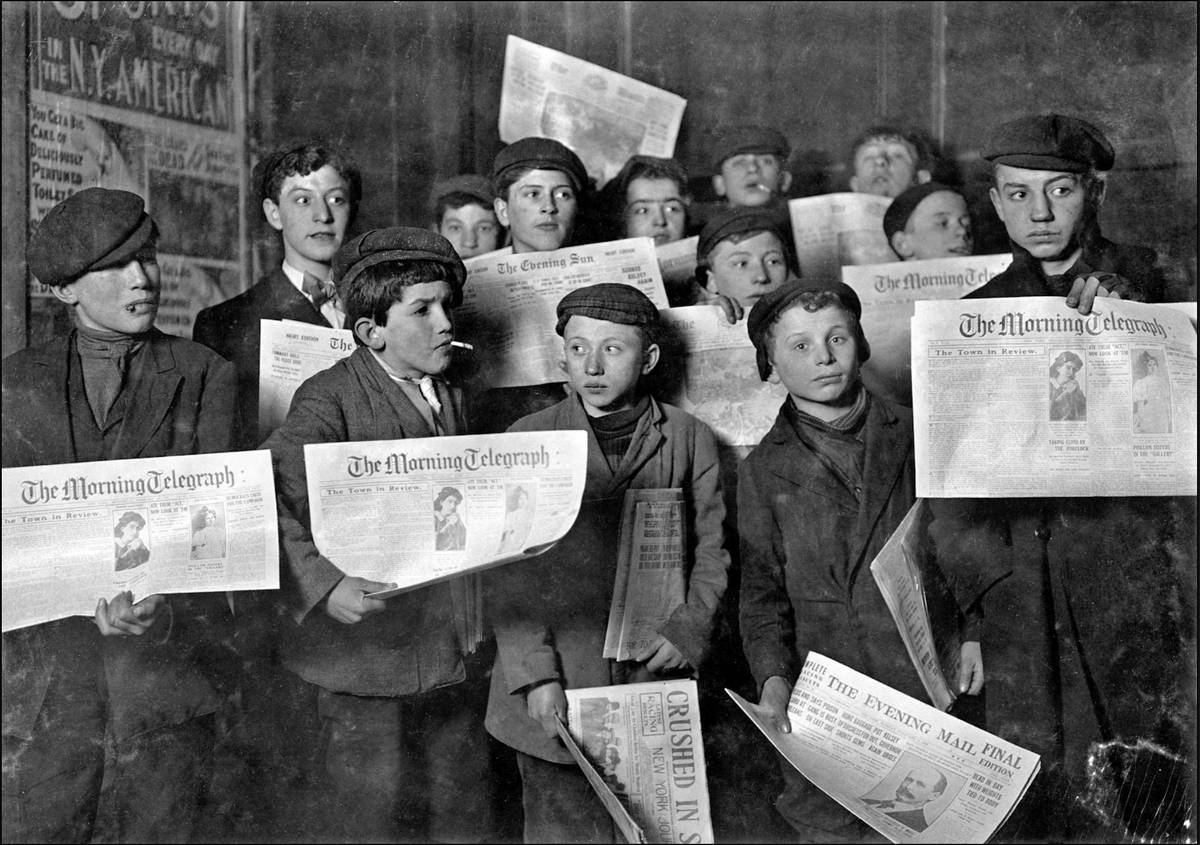
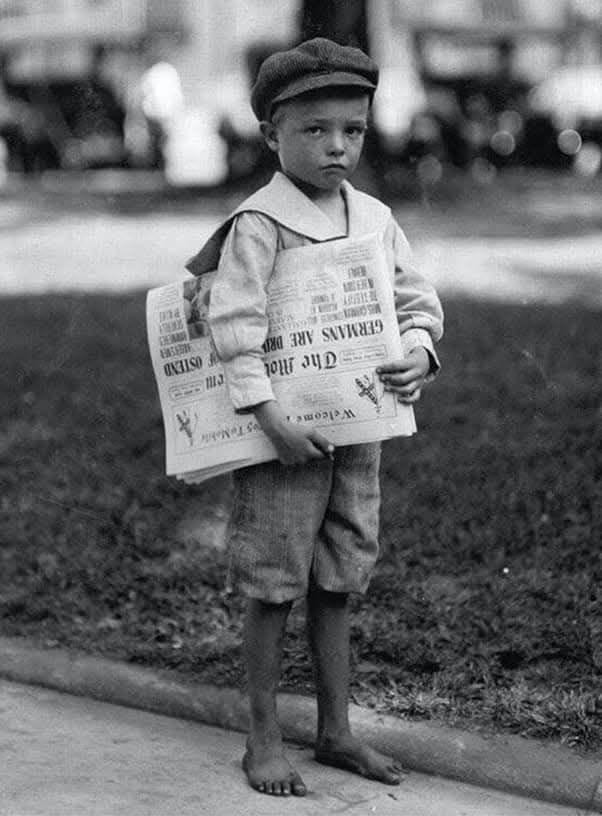
The photographs of newsboys that begin and end this post are by Lewis Hine, who quit his work as a schoolteacher to photograph child labor around the country for the National Child Labor Committee, which sought to reform the system that allowed the exploitation of the very young.