Notes on Violence and Voice

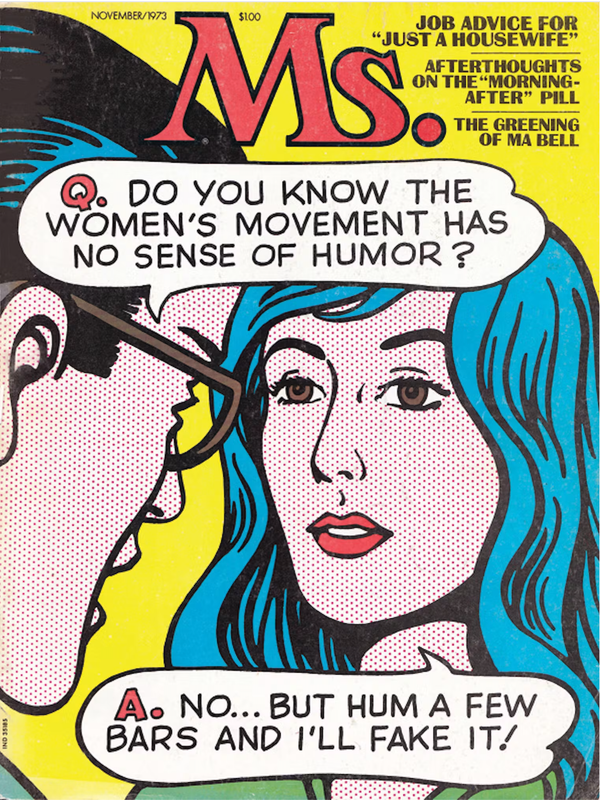
Here are two short pieces about political violence and sexual violence. The first I wrote yesterday as a social media post that I've revised and improved here. The second is an excerpt from my 2020 book Recollections of My Nonexistence, and it's a meditation on the way that all the gender violence and sexual violence is also an attack on the victims' voice – the voice with which to say no, to exercise your right to determine what will and will not happen to you, often followed up by various ways punishing you if you try to speak up (including murder; there's a case about that in the news right now involving an L.A. rapper and a murdered fourteen-year-old girl). That silencing is underwritten by the way the society as a whole has long refused to hear victims, using all the tricks in the arsenal of inequality. Abusers count on that social support to get away with their crimes. This inequality is changing now, imperfectly, incompletely, but profoundly thanks to feminism and other movements for rights, equality, and justice.
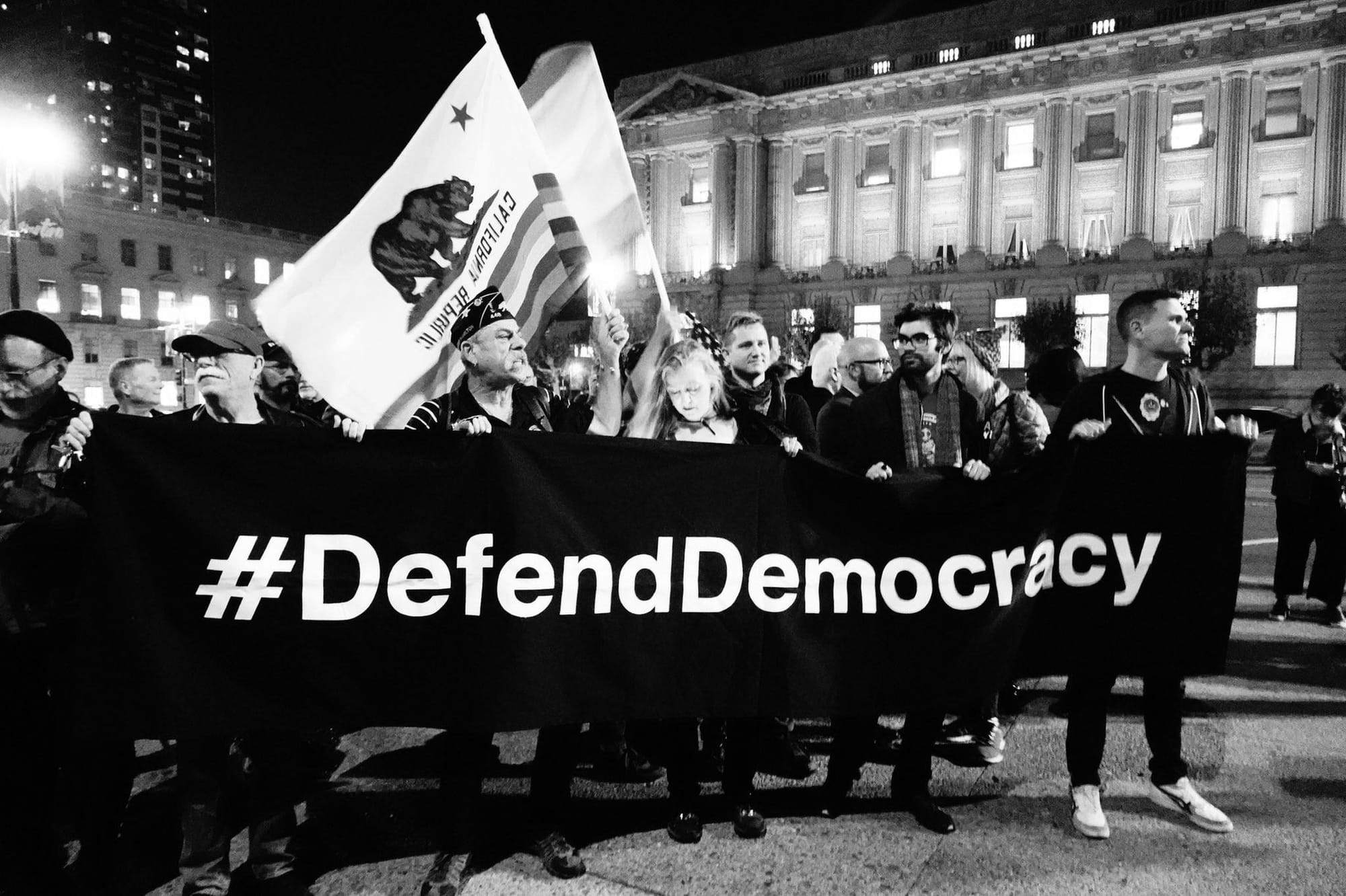
I should add that at the heart of the second piece is the idea of equality of voice, and yesterday the Supreme Court further dismantled the Voting Rights Act that was created to give Black voters equality of voice in our democracy, to make it come closer to being a democracy, and their action takes us backward, in the other direction.
1: On the Myth of Violence's Utility
Last weekend, the young would-be assassin (who never got near the White House Correspondents Dinner where journalists, Trump, and a lot of top administration officials were schmoozing) seems to have made a mistake common to a lot of us and maybe especially to young men: the belief that violence, because it is direct, immediate, effective in its specifics, is effective more broadly. I get the frustration with all the slow, nonviolent means of social change, and I get why in a culture saturated with movies in which manly men achieve their goals through direct hands-on or gun violence people have such a devout belief in it.
But the backlash is often more impactful than the deed itself, and in the recent Hidden Brain interview with legendary nonviolence scholar Erica Chenoweth, Chenoweth notes that both protestors and regimes often seek to provoke violence in their opponents because it delegitimizes them and weakens support. For protestors, sometimes it's the civil-rights tactic of exercising legal rights and letting the world see how this leads to brutality. For regimes, it's too often agent provocateurs, staged events, or just lies about the opposition (see: the right's endless pretense there is an organization called Antifa that is committing terrible violence).
Only too often a violent act by a tiny minority is used by the regime to justify bringing down state violence on the nonviolent majority. The right is very good at blaming any act of violence on all of us, and corporate media is very good at buying into that.
Chenoweth says research shows that "the non-violent campaigns were twice as likely to have succeeded as their violent counterparts. And that the rates of success for non-violent campaigns had actually increased over the latter half of the 20th century and into the beginning of the 21st. So, in other words, non-violent resistance was working much more than skeptics like myself would have expected. At the same time, that doesn't mean that it worked all the time. We found basically that about around half of the cases that we studied had succeeded and about 25% of the cases of armed resistance had succeeded. "
One thing that is not enough acknowledged is that virtually all progressive-to-left movements have renounced violence, in most cases on principle, but also it didn't work when it was tried in the 1960s-1970s. Mark Rudd, who was a member of the Weather Underground and then a fugitive for several years as a result, has been the most forthcoming about the dismal consequences of that group's attempt to use violence. What he said in a 2004 interview still rings true: "On the one hand, it isn’t easy to know what the right thing to do is when your country is murdering millions of people, and on the other, in hindsight, the consequences of our revolutionary violence line were terrible. Property destruction holds us back since it plays into the government’s hands allowing them to characterize us as terrorists.... Not only does this play into the corporations’ or the government’s hands, but it sets us up for defeat. The future of our movement is that we have the potential to build a political majority in this country. And property destruction or any other acts which are not nonviolent work against building that majority." Rudd points toward something really important: violence seems effective because it's very direct, but it's often ineffective. (I wrote about that a little while ago here in the essay "Weak Violence, Strong Peace."
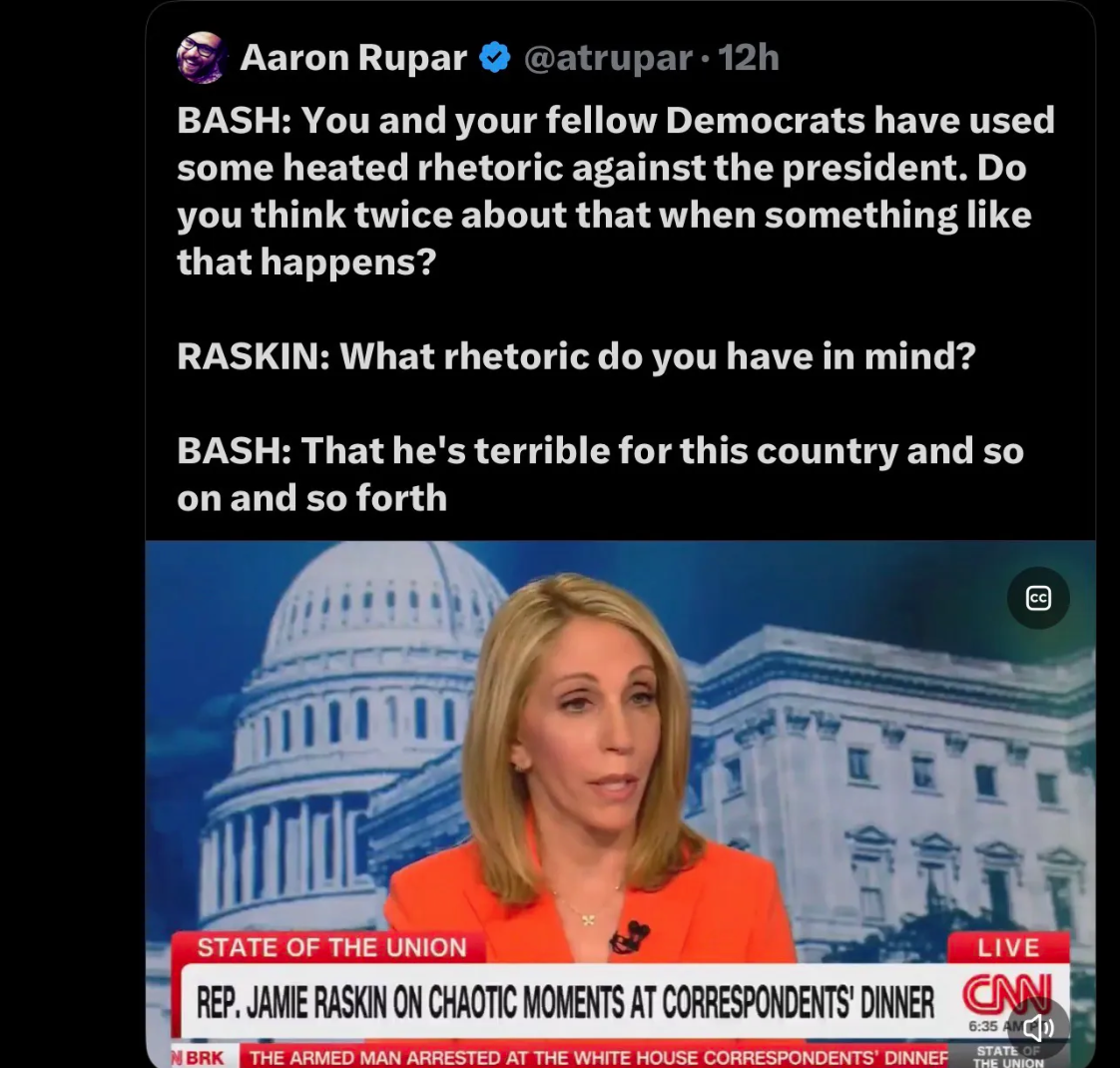
The minor incidents of what gets called left violence in recent years are usually by individuals or small groups with little or no connection to movements (and, see: Antifa, are otherwise often fiction; speaking of that, it's noteworthy how much higher the population of eco-terrorists is in Hollywood movies than in real life). Indivisible has constantly stressed its commitment to nonviolence as, I would imagine, protection against accusations of terrorism, and as an invitation to everyone who doesn't want to be around violence, as well as out of genuine principle.
Right-wing provocateurs actually committed violence, including murder, during the 2020 summer of Black Lives Matter protests after George Floyd's murder to try to implicate BLM and antiracists. More right-wingers drove cars into protests and somehow that got downplayed too. Here I'll add that I don't necessarily see property destruction as violence, though it routinely gets conflated with violence against human beings. I wrote a while back that the firefighters break down the door to save the kids, while the husband breaks the chair to demonstrate that he can break the wife: property destruction can mean a lot of different things.
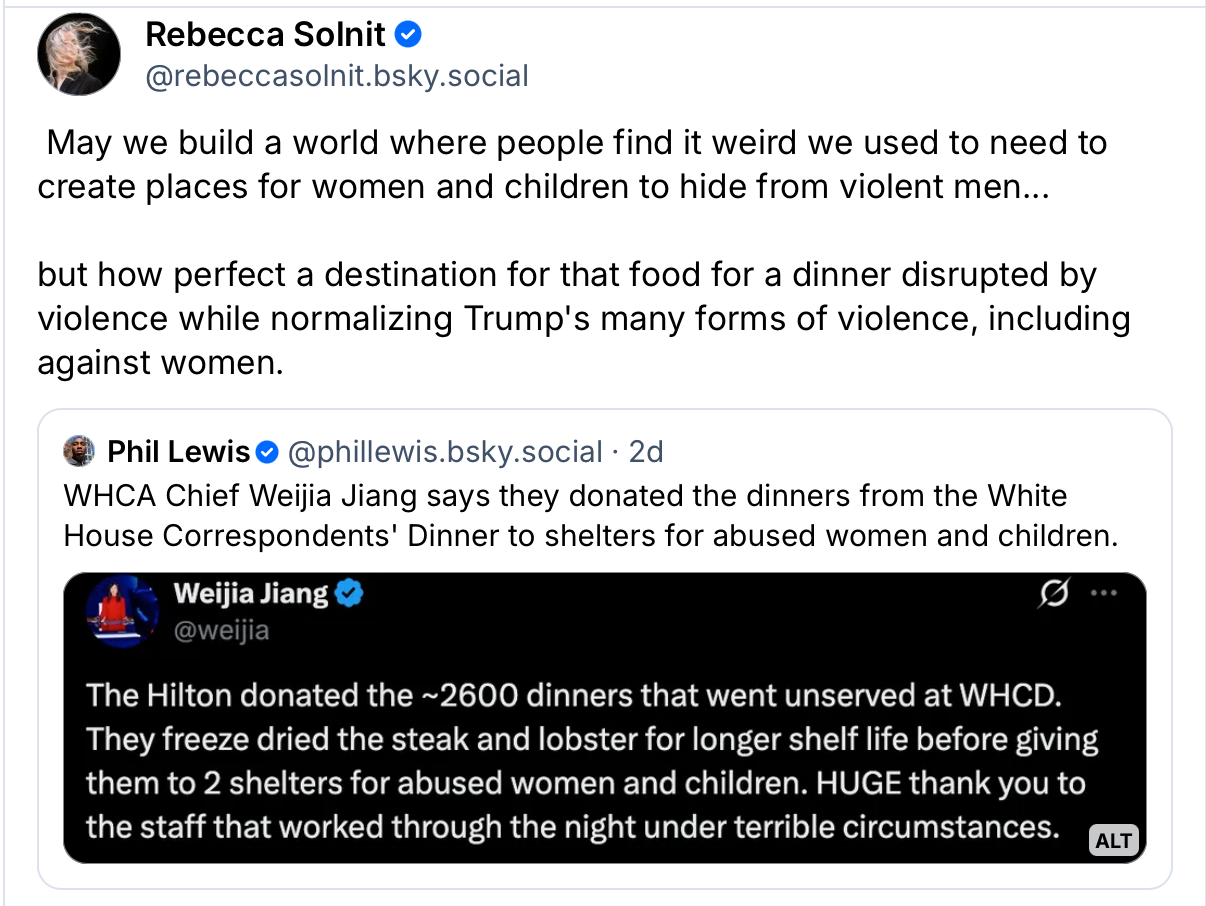
As for the Hilton incident, as Rudd points out, violence by the state is legal but illegal when we do it. And as both he and Chenoweth point out, our strength is not in violence but in mass movements. It's beautiful that nonviolence is both a moral principle and an effective tactic.

2) Toward a Democracy of Voices
It took me ten years and dozens of feminist essays from that
morning I wrote “Men Explain Things to Me” [in 2008] to realize that
I was not talking and writing, after all, about violence against
women, though I was reading about it incessantly. I was writing
about what it means not to have a voice and making the case for a
redistribution of that vital power. The crucial sentence in “Men Ex-
plain Things to Me” is “Credibility is a basic survival tool.” But I was
wrong that it’s a tool. You hold a tool in your own hands, and you
use it yourself. What it does is up to you.
Your credibility arises in part from how your society perceives
people like you, and we have seen over and over again that no mat-
ter how credible some women are by supposedly objective stan-
dards reinforced by evidence and witnesses and well- documented
patterns, they will not be believed by people committed to protect-
ing men and their privileges. The very definition of women under
patriarchy is designed to justify inequality, including inequality of
credibility.
Though patriarchy often claims a monopoly on rationality and
reason, those committed to it will discount the most verifiable, co-
herent, ordinary story told by a woman and accept any fantastical
account by a man, will pretend sexual violence is rare and false ac-
cusations common, and so forth. Why tell stories if they will only
bring forth a new round of punishment or disparagement? Or if
they will be ignored as if they meant nothing? This is how preemp-
tive silencing works.
To have a voice means not just the animal capacity to utter
sounds but the ability to participate fully in the conversations that
shape your society, your relations to others, and your own life.
There are three key things that matter in having a voice: audibility,
credibility, and consequence.
Audibility means that you can be heard, that you have not been
pressed into silence or kept out of the arenas in which you can
speak or write (or denied the education to do so— or, in the age of
social media, harassed and threatened and driven off the platform,
as so many have).
Credibility means that when you get into those arenas, peo-
ple are willing to believe you, by which I don’t mean that women
never lie, but that stories should be measured on their own terms
and context, rather than patriarchy’s insistence that women are
categorically unqualified to speak, emotional rather than ratio-
nal, vindictive, incoherent, delusional, manipulative, unfit to be
heeded— those things often shouted over a woman in the process
of saying something challenging (though now death threats are
used as a shortcut, and some of those threats are carried out, nota-
bly with women who leave their abusers, because silencing can be
conversational or it can be premeditated murder).
To be a person of consequence is to matter. If you matter, you
have rights, and your words serve those rights and give you the
power to bear witness, make agreements, set boundaries. If you
have consequence, your words possess the authority to determine
what does and does not happen to you, the power that underlies the
concept of consent as part of equality and self- determination.
Even legally women’s words have lacked consequence: in only a
few scattered places on earth could women vote before the twenti-
eth century, and not so many decades ago, women rarely became
lawyers and judges; I met a Texas woman whose mother was
among the first women in their region to serve on a jury, and I was
an adult when the first woman was appointed to the U.S. Supreme
Court. Until a few decades ago, wives throughout much of the
world, including the United States, lacked the right to make con-
tracts and financial decisions or even to exercise jurisdiction over
their own bodies that overrode their husbands’ ability to do so; in
some parts of the world, a wife is still property under the law, and
others choose her husband. To be a person of no consequence, to
speak without power, is a bewilderingly awful condition, as though
you were a ghost, a beast, as though words died in your mouth, as
though sound no longer traveled. It is almost worse to say some-
thing and have it not matter than to be silent.
Women have been injured on all three fronts— as have men of
color and nonwhite women doubly so. Not allowed to speak or pun-
ished for speaking or excluded from the arenas— courts, universi-
ties, legislatures, newsrooms— where decisions are made. Mocked
or disbelieved or threatened if they do find a place in which to speak,
and routinely categorized as inherently deceitful, spiteful, delusional, confused, or just unqualified. Or they speak up and it is no different than remaining silent; they have told their stories and nothing happens, because their rights and their capacity to bear witness don’t matter, so their voices are just sounds that blow
away on the wind.
Gender violence is made possible by this lack of audibility, cred-
ibility, and consequence. We live inside an enormous contradic-
tion: a society that by law and preening self- regard insists it is
against such violence has by innumerable strategies allowed that
violence to continue unchecked; better and far more frequently
protected perpetrators than victims; and routinely punished, hu-
miliated, and intimidated victims for speaking up, from workplace
harassment cases to campus rape cases to domestic violence cases.
The result makes crimes invisible and victims inaudible people of
no consequence.
The disregard for a woman’s voice that underlies sexual violence
is inseparable from the disregard afterward if a woman goes
to the police, the university authorities, her family, her church, the
courts, to the hospital for a rape kit, and is ignored, discredited,
blamed, shamed, disbelieved. They are both assaults on the full hu-
manity and membership of a person in her society, and the devalu-
ation in the latter arena enables the former. Sexual assault can only
thrive in situations of unequal audibility, credibility, and conse-
quence. This, far more than any other disparity, is the precondition
for epidemic gender violence.
Changing who has a voice with all its power and attributes
doesn’t fix everything, but it changes the rules, notably the rules
about what stories will be told and heard and who decides. One of
the measures of this change is the many cases that were ignored,
disbelieved, dismissed, or found in favor of the perpetrator years
ago that have had a different outcome in the present, because the
women or children who testified have more audibility, credibility,
and consequence now than they did before. The impact of this ep-
ochal shift that will be hardest to measure will be all the crimes
that won’t happen because the rules have changed.
Behind that change are transformations in whose rights matter
and whose voice will be heard and who decides. Amplifying and
reinforcing those voices and furthering that change was one of the
tasks to which I put the voice I’d gained as a writer, and seeing that
what I and others wrote and said was helping to change the world
was satisfying in many ways to me as a writer and as a survivor.
One more thing about that abominable dinner.