Terminology, Clarity, and the Question of What Is the Left?
I often say that spoken and written are two different languages with their own grammar and their own difficulties and invitations. Anyone who's ever transcribed a conversation or an interview learns that most of us speak in phrases, rather than sentences, phrases whose intention is clarified by pauses, inflections, and other auditory means that don't translate to the page). Most people are more fluent in spoken, but as a kid who didn't talk much but read all the time I am in some ways more at home in written, and I feel that my fingers are smarter than my mouth. That is, I trust my ability to write what I mean more than to say it. Saying it I often get flustered (and my habit of drawing a lot of things together is a sort of collage process that works better on the page than in the air; answering a complicated question I sometimes get tangled up in all the threads I'm trying to draw together).
I love being a writer, not least because I have hours to years to try to get the words and their meanings right, and I can see them on the page, reread, revise, fact-check, fine-tune, again and again until it feels like I've said what I mean. Which is why it came as an uncomfortable surprise when I reached the stage at which that my publishers expected me to do interviews in person, onstage, and on radio and for print (podcasts didn't exist yet). Extemporizing aloud doesn't allow for this time and process to get it exactly right, and whatever you blurt out under pressure may follow you around forever (some pre-recorded interviews allow for second takes, which I make use of with gratitude, but with live interviews, you have one chance, and you are generally not supposed to pause for more than a few seconds, no matter what gets thrown at you). The best interview draws you out, helps you find the deepest meanings and greatest possibilities; the worst tries to nail you with loaded and intrusive questions, even accusations, and mischaracterizations. I've gradually learned how to push back when I'm not too flustered or off-guard. Most interviews are somewhere inbetween. But also for a lot of interviewers, success is if they get you to say something spicy, controversial, over-share, and so forth.
I've been doing media interviews for my new book, The Beginning Comes After the End, for a month now, and it's been a lot, especially the three-day event that was the New York Times interview that appeared online this weekend as print, audio, video, and photography (gift link here and below). It was a wonderful opportunity to say what I believe matters, what's true, what's possible. It was also a tightrope to walk to try to get it all right (and look nice in the pictures and video and even clean up the house because the video was filmed in it).
In this New York Times thing, I got to say something I was very glad to get out into the world, in an answer to whether Gavin Newsom or Zohran Mamdani was the hero we needed: "One of the great weaknesses of our era is that we get lone superhero movies that suggest that our big problems are solved by muscly guys in spandex, when actually the world mostly gets changed through collective effort. Thich Nhat Hanh said before he died a few years ago that the next Buddha will be the Sangha. The Sangha, in Buddhist terminology, is the community of practitioners. It’s this idea that we don’t have to look for an individual, for a savior, for an Übermensch. I think the counter to Trump always has been and always will be civil society. A lot of the left wants social change to look like the French Revolution or Che Guevara. Maybe changing the world is more like caregiving than it is like war. Too many people still expect it to look like war."
And I said something I was less happy about. I replied to another question with Newsom in it, "I’m watching the left gear up to attack Gavin Newsom just in case he’s the nominee in 2028, and it makes my heart sink, because I watched people tear down Al Gore, I watched people tear down Hillary Clinton, I watched people tear down Joe Biden and Kamala Harris. There are definitely major things to critique about every one of them, but at the moment, when the job is to defeat the other guy, we defeat ourselves." That's something I would not have written or, having written it, would have revised and qualified and cleaned up, but you don't get to do that in an interview. I'm now seeing moderates use it to blame progressives and the left for lots of things, and leftists assert that I meant there should be no critiques, though clearly I said there should be. Somewhere else in the interview I did manage to say, "the left is a lot of different things, not a monolith."
I've been watching Newsom since his political career began, and there's a lot to criticize about the man. Like his flirtations with right-wingers like Charlie Kirk (there's a big difference between reaching across a divide and normalizing hate and lies – I mean if you meet a fascist halfway you're halfway to being a fascist). He's said terrible things about trans people and been both good and bad on climate stuff. But never mind Newsom, though he clearly wants to be president and will likely run, and will undoubtedly be better than JD Vance or whoever the Republicans field in 2028. I did mean it about seeing Democratic candidates for president sabotaged by campaigns so demonizing them and attacking and shaming and harassing anyone who supports the candidate that it dampens down the willingness to campaign or vote for the only person who'll defeat the Republican in question. I believe it's played a role in the defeat of the Democrats in multiple races since Al Gore in 2000.
The counterfactual of an Al Gore presidency is – well it's hard to imagine how different the state of the earth in regard to climate action might have been, and entirely likely there would've been no 9/11 (because the Bush Administration relaxed the anti-terrorism efforts of the Clinton Administration), and no Afghanistan and Iraq quagmire-wars. But also no appointment of John Roberts and Samuel Alito to the Supreme Court, and therefore no Citizens United decision in 2010 unleashing the tsunami of dark money in electoral politics (or to go further, "Chief Justice Roberts has voted to dramatically change the law of affirmative action, abortion, gun rights, separation of powers, free speech, the establishment clause, and the free exercise of religion, among many other examples" writes one scholar of the court) . Had there been no Donald Trump electoral college victory in 2016, there'd be no Gorsuch, Kavanaugh, and Coney Barrett and no overturning of Roe vs. Wade and a bunch of environmental legislation. Maybe there'd be a chief justice with enough principle to oust the utterly corrupt Clarence Thomas.Of course Gore would have done many things I would not have liked or supported, but as an activist said to me in 2012, you're choosing who you're going to fight with, not who you absolutely agree with. All that prompted me in 2016 to coin my most widely circulated freestanding sentence ever: "Voting is a chess move, not a valentine."
But it's risky to offer even mild criticism of the left, because people elsewhere in the political spectrum are so eager to turn your equivalent of a tap on the shoulder into their punch in the face, to amplify modest disagreement into blanket condemnation. As for that shorthand term "the left," it groups together some radically different coalitions and orientations. A couple of years ago, I wrote an essay addressing the shortcomings of the word: I said to a man working for Elizabeth Warren’s presidential campaign, at a point when he and the campaign were dealing with a lot of attacks from people who considered themselves the true left, “It’s as if we called fire and water by the same name.” Perhaps the left/right terminology that originated with the French Revolution has, more than two centuries later, outlived its appositeness. (In the French National Assembly of 1789, the royalists members sat to the right, the radicals to the left, and thus the terms were born.) The left I love is passionately committed to universal human rights and absolute equality and often is grounded in rights movements, including the Black civil rights movement.
I sometimes think of the current US version as a latter-day version of Jesse Jackson’s Rainbow Coalition. I’d argue that because of its intersectional understanding of both problems and solutions, this left is more radical—radically inclusive, radically egalitarian—than those who treat race and gender as irrelevancies or distractions (including the men, from Ralph Nader in 2000 on, who’ve been dismissive of reproductive rights as an essential economic justice as well as rights issue). Perhaps it’s seen as less radical because bellicosity is often viewed as the measure of one’s radicalness.
[This is part of why it was a joy to say in the New York Times that maybe changing the world is more like caregiving than war.]
Likewise, this rainbow left often has radical aims but is pragmatic about how to realize them. This might be because it includes a lot of people for whom social services and basic rights are crucial to survival, people who are used to compromise, as in not getting what they want or getting it in increments over time. All or nothing purity often means choosing the nothing that is hell for the vulnerable and I-told-you-so for the comfortable.
That’s the Rainbow Coalition-ish left; the other left has some overlap in its opposition to corporate capitalism and US militarism, but very different operating principles. It often feels retrograde in its goals and its views, including what I think of as economic fundamentalism, the idea that class trumps all else (and often the nostalgic vision of the working class as manly industrial labor rather than immigrants everywhere from nail salons to app-driven delivery jobs to agricultural fields). This other left is often so focused on the considerable sins of the United States it overlooks or denies those of other nations, particularly those in conflict with the USA, decrying imperialism at home but excusing it abroad.... It tends to rage against Democrats more than Republicans. If the word left means two opposing things, it's a useless or confusing word, but one that everyone keeps using. Including me in that interview.
Meanwhile I'll struggle to use language with clarity, precision, and accuracy, and I believe that's crucial to all our work in this world, whether it's telling one other person what's going on in our hearts or going on the radio to describe the world as it is and could be. But also we're in opposition to a regime led by people who have to lie about everything because what they're doing is so destructive and often so illegal and shameful, and who lie without compunction, catastrophically degrading language itself as well as accountability. Hannah Arendt famously said, "The ideal subject of totalitarian rule is not the convinced Nazi or the convinced communist, but the people for whom the distinction between fact and fiction no longer holds.”
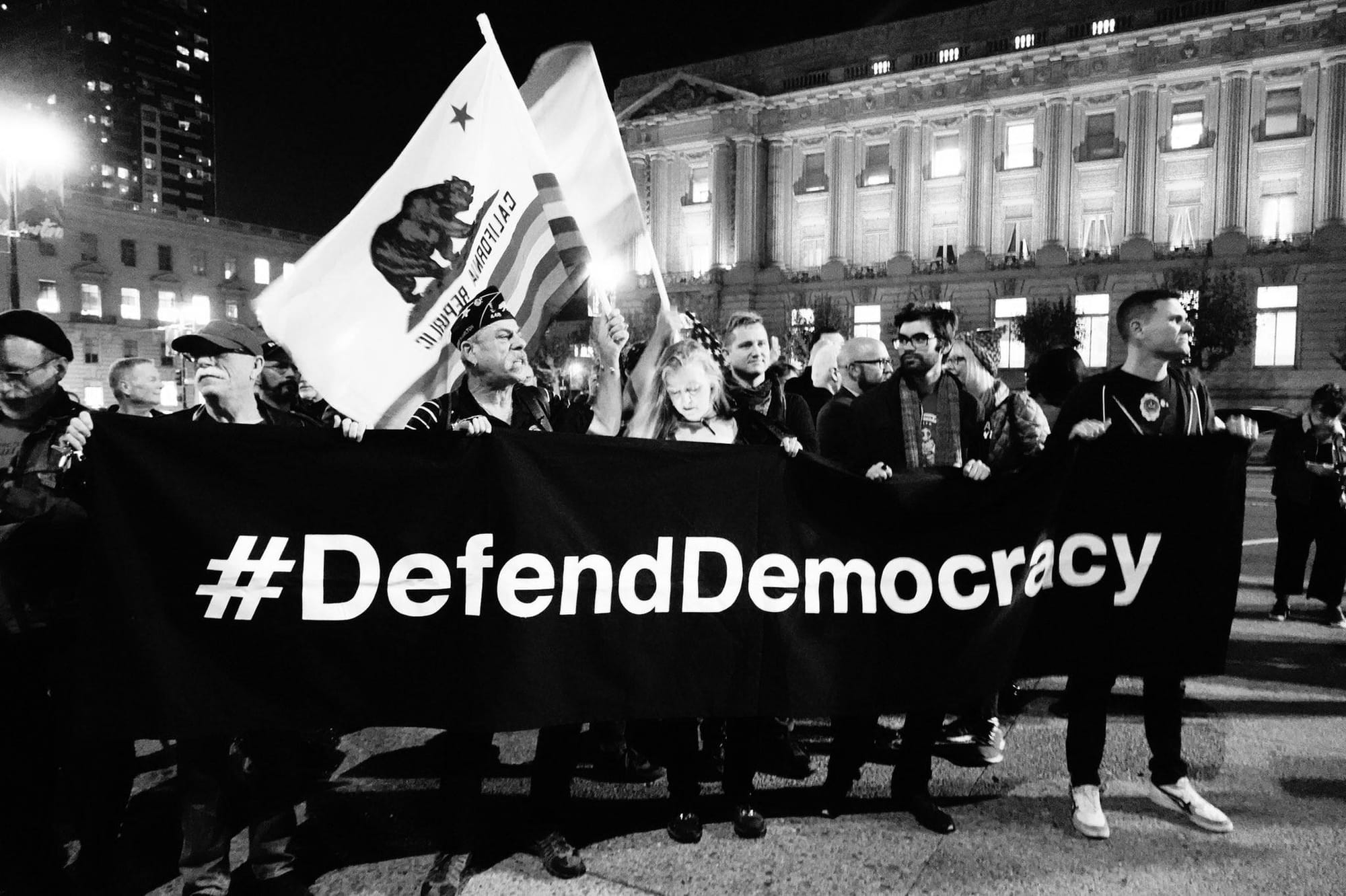
Being a person who makes that distinction in what you say, being a person who cares about that distinction, is an essential part of resistance to totalitarianism and to the Trump regime. Aauthoritarians see facts, truths, history, science as enemies to be defeated, so that they can be the only source of information, the only determinant of truth. But also those lies mock accountability, including to the facts; the lies are aired as a kind of power over the truth and the listeners. Those things--facts, truths, history, science--are democratic by nature, but they need to be defended as part of the defense of democracy. The science of immunology or climate chaos, the economics of immigration, the history of racism and indigenous dispossession are not only true if convenient to the powers that be. They're true regardless, and protecting and asserting these truths is a crucial part of our work.
p.s. I do interviews because it's a duty of sorts, to the publishers and to participating in shaping the conversations about who we are and what's possible. Sometimes also it's a pleasure. Like, tomorrow at 7pm Atlantic/4pm Pacific, I'm talking with one of my heroes, dear friends, and longtime allies in climate work, Bill McKibben, online, and you're invited, if you're so inclined.

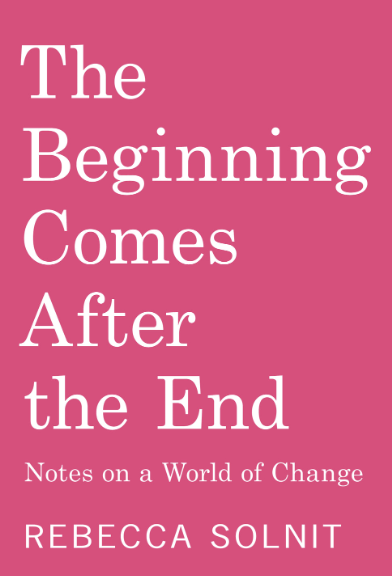
My wonderful publishers are offering Meditations in an Emergency readers 30% off the new book at this link. https://www.haymarketbooks.org/books/2617-the-beginning-comes-after-the-end?discount_code=BEGINNING
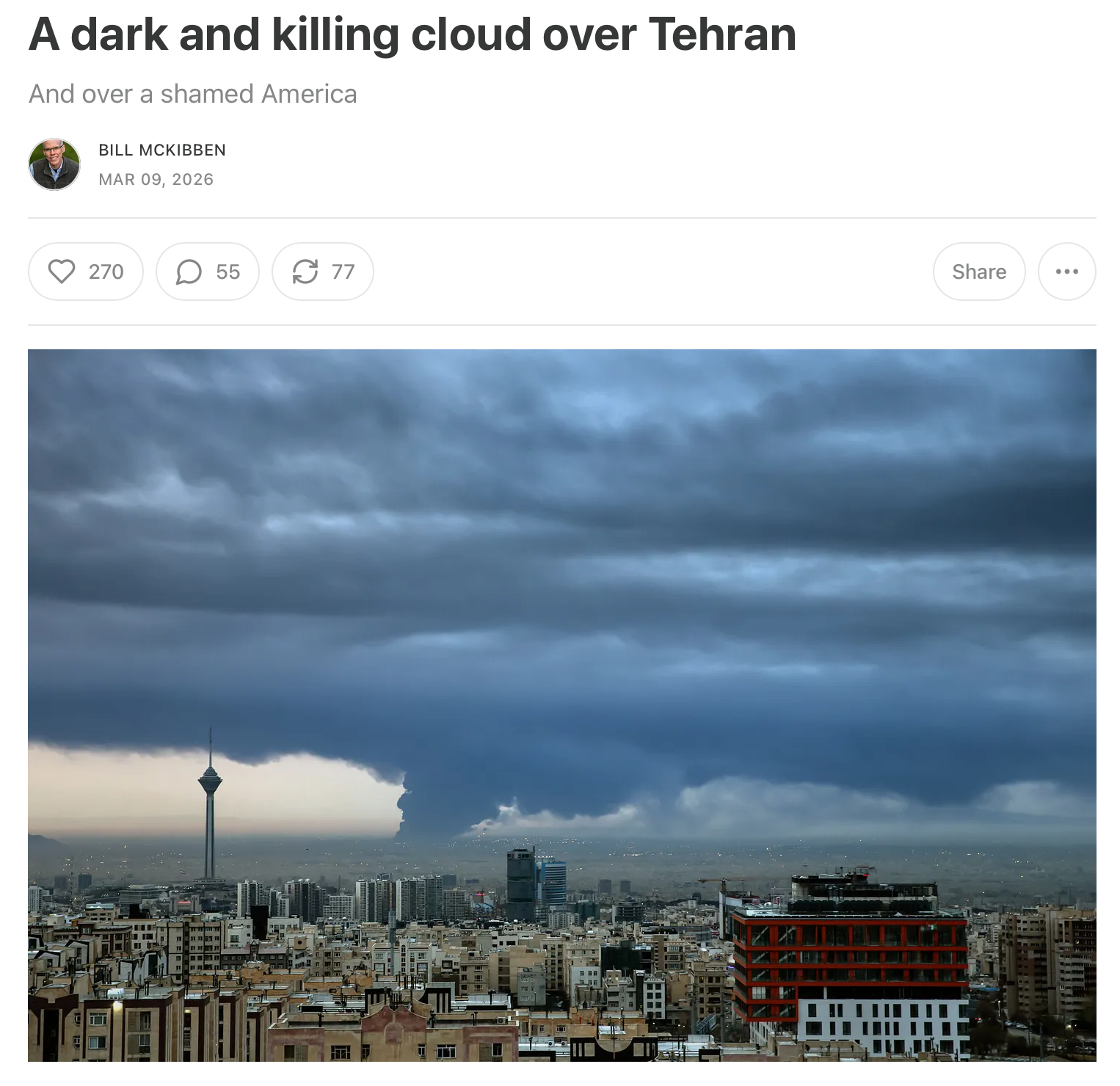
p.p.s. Like most or all of you, what's happening to and in Iran is heavy on my heart. I'm still figuring out what to say about it. In the meantime, here's what Bill McKibben said: "the U.S./Israeli force mounted another series of strikes, these on oil storage sites across the vast city of Tehran. The effect was astonishing—a cloud of truly toxic smoke—and I think it needs more notice than it’s been getting, even amidst all the other horrors of this war. This was in essence chemical warfare, even if the chemicals were the (easily anticipated) result of “normal” bombs. And it affected an almost entirely civilian population, that will be paying the price for decades to come. If we’re going to do this we should at least have to look at it." https://billmckibben.substack.com/p/a-dark-and-killing-cloud-over-tehran