"Past Performance Is Not Indicative of Future Results": On Immigration and Assumptions

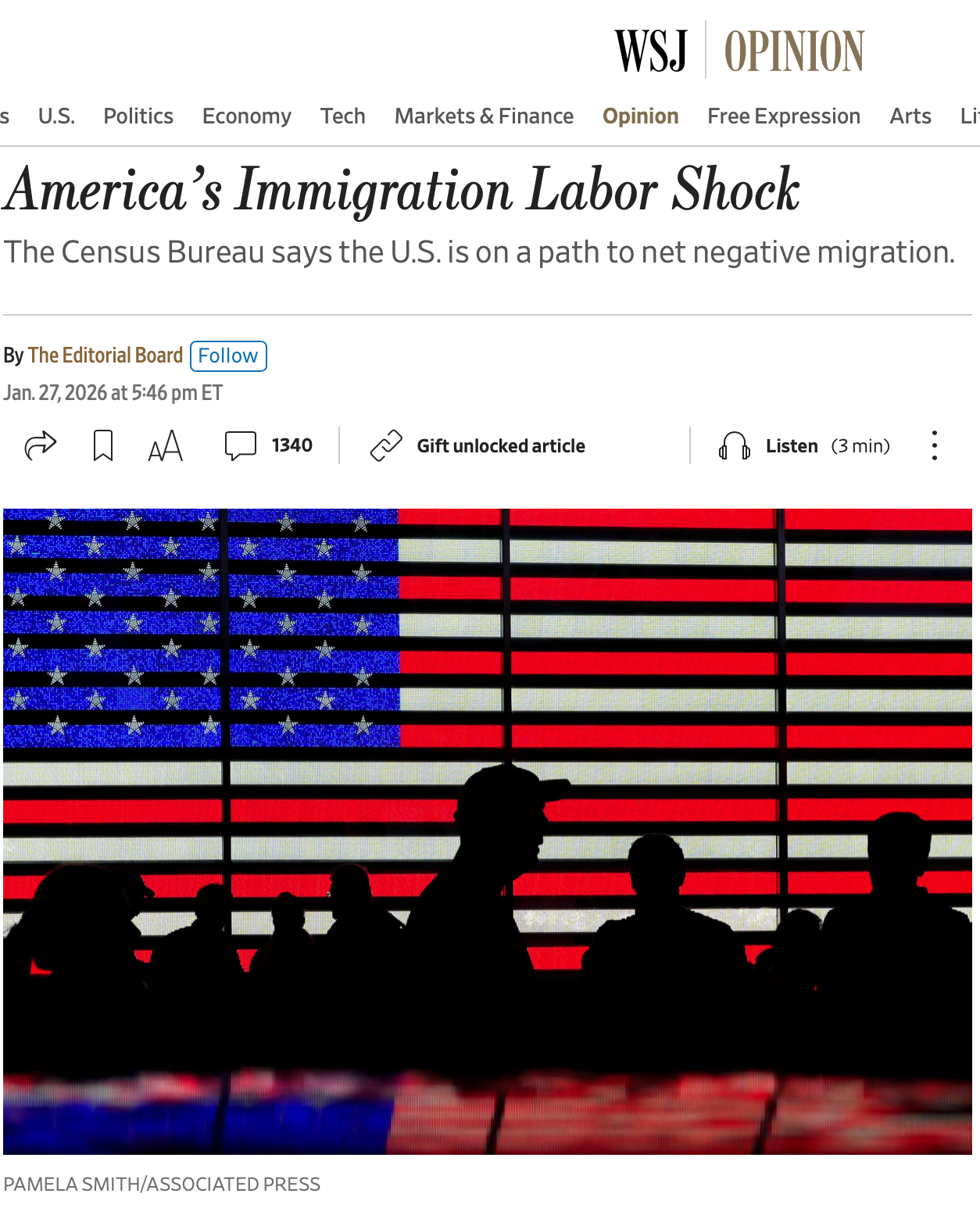
This morning the Wall Street Journal ran an editorial warning about the consequences of the persecution and deportation of immigrants and its impact on the overall labor force: "The Census Bureau reported Tuesday that U.S. population growth slowed significantly in the past year amid lower levels of immigration. Restrictionists will cheer the news, but a flagging labor force won’t make America more prosperous." That's bad news for business, but maybe it was also trying to cheer its conservative readers up with this sentence: "If this trend holds, Democratic-run states will likely lose at least a half dozen Congressional seats after the post-2030 Census reapportionment, as well as the federal funds tied to population."
Trends do a lot of things, and hold is only one of them, and they do not hold forever. 2030 is shockingly only four years away, but by 2030:
– more states could be run by Democrats and elect Democratic representatives as the tide turns against Trumpism (note that Virginia and New Jersey just elected Democratic governors to replace Republican ones, as Arizona did a few years back);
– the attack on immigrants could end when Trump does or when the dire consequences and revolting cruelty become obvious to enough people, and we're certainly seeing a watershed moment in that regard right now;
– maybe the brutalities of Republican-run states will send more people to safer, healthier places that protect their rights, including reproductive rights and trans rights, swelling the populations in blue states.
Trends hold when beliefs, values, and systems hold; when systems break and beliefs and values change, so do trends.
One of the axes I grind regularly is about and against habits of thought and unquestioned assumptions that interfere with clear perception. One habit I see all too often is the assumption that the future will be an extension of some obvious force in the present: that force will continue to enlarge in power and impact or just stay steady. Thus we get the idea that Trumpism will just become an all-encompassing force of authoritarianism and there's nothing we can do about that (because these assumptions are often coupled with a sense of inevitability, even though "evitable" is what these situations usually are, and that often comes with the proposition that there's a point past which it's "too late" to do anything, even as we see revolts against authoritarian regimes in Bangladesh, Syria, and other places in recent times, and one going on in Iran right now).
In fact, again and again the forces that matter, sometimes to the point of revolution or transformation, were nonexistent or overlooked or dismissed a few years or decades before: who would have assumed that the modest nonviolent movements for human rights and freedom in the East Bloc would topple several totalitarian regimes and bring down the Berlin Wall in the fall of 1989? Who knew the indigenous Zapatista army was building in the Lacandon Jungle of southern Mexico that would burst onto the scene in a dramatic invasion of San Cristobal de las Casas as 1993 turned into 1994? Who foresaw that the twenty-first century renewable revolution would, as it made wind and solar powerful affordable adaptable energy-generation systems and brought large-scale battery storage on board, make it possible to leave the age of fossil fuel behind?
Pendulums swing; surprises erupt; public opinion shifts; the kind of campaigns that are initially dismissed or sneered at or attacked nevertheless often continue until they prevail – the sheer modesty and marginality of the movement to abolish slavery in the 1830s and 1840s is one striking example. In those decades, mainstream opinion was scornful and dismissive of the movement and goals, and a few decades later mainstream opinion was that slavery must be abolished. Things change.
My absolute favorite "Letter from an American" by Heather Cox Richardson was the one noting that early in the 1850s it looked like the trend was toward a more pro-slavery elitist United States and at the end of that decade the country elected the anti-slavery Lincoln and geared up to fight and win the Civil War against the pro-slavery minority. I wrote in Hope in the Dark, "Cause and effect assumes history marches forward, but history is not an army. It is a crab scuttling sideways, a drip of soft water wearing away stone, an earthquake breaking centuries of tension."
As for margins, while looking for a quote by Howard Zinn I came across this passage by bell hooks: "The entirety of my intellectual and creative project is this: marginality [is] much more than a site of deprivation; in fact I was saying just the opposite, that it is also the site of radical possibility, a space of resistance.” Margins and the marginalized are often disparaged and dismissed even while they are the fertile grounds in which so much originates and evolves that will move into the mainstream to transform it (the mainstream will usually deny that this happened, often by pretending that this new way of seeing the world, this shift in values was always their position or they got there all by themselves; often they truly did not see the margins and the marginalized with whom the trajectory of change began). And here's the Zinn quote: “As this century draws to a close, a century packed with history, what leaps out from that history is its utter unpredictability.” He wrote that in 1988, before so much wild transformation took place.
The US has a negative birth rate as does much of the global north (replacement rate is 2.2 births per woman; the current rate is 1.6 per woman, meaning with zero immigration the population would be rapidly aging and declining, as it is in South Korea, Japan, and many European countries). Immigration brings in young people who will work hard for decades and keep the economy going. As you all know immigrants do the jobs that the US-born population doesn't want, notably in the agriculture/food industries; decimating and terrorizing that population is already having a dire effect on those and other industries, including construction and healthcare (from the immigrant doctors at the high end of the pay scale to the home healthcare workers and nursing home attendants and hospital cleaning/maintenance staff at the low end).
[Here's an excellent example of trends not continuing and of bad predictions based on the future being just like the present only more so: In the 1960s racist fearmongering about "the population bomb" assumed that early 1960s high birthrates (mostly in the global south) would continue and produce famines even as population growth was in steady decline and agricultural yield was exploding. That idea stuck and people still air it, even while what you could call "the population implosion" is talked about as exactly the opposite crisis – not a shortage of resources but a shortage of labor in an aging population. And of course when it comes to resources, the problem never was overall population but consumption rates since some human beings use hundreds of times more than others.]
Strikingly, the white nationalists want white women to have more babies, but through coercive, abusive methods – economic inequality, lack of access to reproductive care – rather than making it easier for everyone to start a family, since economics are what prevents quite a lot of people from becoming parents. It's another misjudgment, just like their misjudgment of human nature in Minneapolis; they assumed that people not under attack would be too cowed or selfish to care about those who were and could not imagine that tens of thousands of Minneapolitans would be willing to upend their daily lives and even risk their lives for their neighbors.
I hope the grim impact of terrorizing and driving out/keeping out this crucial portion of the workforce breaks the decades-long trend by politicians and mainstream media of portraying immigrants as an evil and burdensome. As I've written here before, though, I don't want immigrants and refugees valued just for their labor; I am as so many of you are moved by the solidarity with the neighbors in Minneapolis as people not under attack by ICE put their lives on the line – and in two cases lost their lives – to stand with the immigrant and BIPOC populations who are under attack. This solidarity, care, and even love that reaches across cultural and ethnic lines is unfathomable to many on the right, which is why they see it as rage, madness, or a conspiracy that must be backed by some powerful interest pouring money into it (I wrote about that in my last essay here and since then have seen many more examples of that incomprehension).
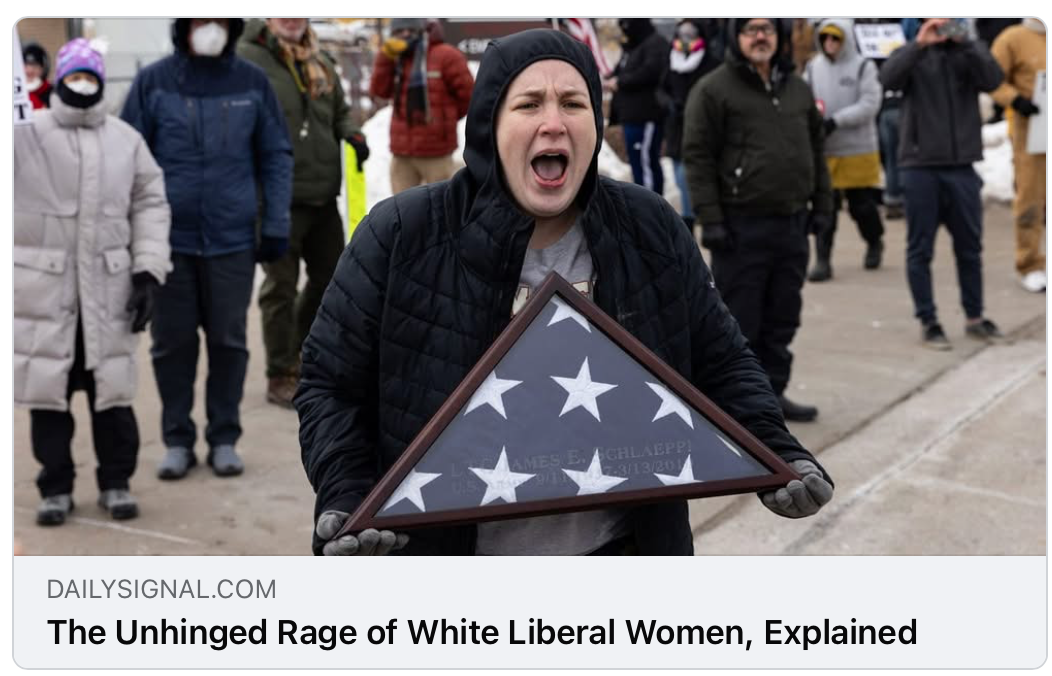
Here's a spectacular example from a Heritage Foundation-backed outlet: "Agatha Christie never spun a mystery as perplexing as that of white liberal women going all in on protecting criminal illegal immigrants. Screaming, screeching, blowing whistles, cursing like sailors with Tourette’s who just hit their thumb with a hot hammer. The other day, a poor Immigration and Customs Enforcement agent tried to explain to horn-honking protesters, 'We’re here to arrest a child sex offender. … That’s who you guys are protecting.' He may as well have been speaking Sanskrit." The incident mentioned took place in Minneapolis: perhaps the women were trying to defend the elderly US citizen of Hmong descent who ICE dragged from his home into the bitter cold almost naked with the claim that they were looking for a sex offender at that address, but the person they were seeking had moved out years earlier.
Adam Serwer described the opposite worldview in the Atlantic: "If the Minnesota resistance has an overarching ideology, you could call it 'neighborism'—a commitment to protecting the people around you, no matter who they are or where they came from. The contrast with the philosophy guiding the Trump administration couldn’t be more extreme. Vice President Vancehas said that 'it is totally reasonable and acceptable for American citizens to look at their next-door neighbors and say, "I want to live next to people who I have something in common with. I don’t want to live next to four families of strangers."'Minnesotans are insisting that their neighbors are their neighbors whether they were born in Minneapolis or Mogadishu. That is, arguably, a deeply Christian philosophy, one apparently loathed by some of the most powerful Christians in America." That this kindness, generosity, solidarity, love is incomprehensible to the far right is both not surprising and deeply disturbing. Perhaps it will change.
There's a wry old joke that war is how Americans learn geography; this uncivil war against good people inside the country may be – and may it be – how people learn that immigrants (and refugees) are a necessity and blessing to this country. The good people of Minneapolis and all who stand against ICE already know it.
p.s. The Prime Minister of Spain agrees with me: "The West needs people. Currently, few of its countries have a rising population growth rate. Unless they embrace migration, they will experience a sharp demographic decline that will prevent them from keeping their economies and public services afloat. Their gross domestic product will stagnate. Their public health care and pension systems will suffer. Neither A.I. nor robots will be able to prevent this outcome, at least not in the short or medium term. The only option to avoid decline is to integrate migrants in the most orderly and effective way possible." https://www.nytimes.com/2026/02/04/opinion/spain-migrants-europe.html