Visions of Life / Agents of Death: On Love Thy Neighbor and Love Thy Nature
Donald Trump's world is a dead and lonely world, a world in which everything is for sale and nothing really means anything and no one else matters. Earlier this year, he pressed Nobel Peace Prize winner María Corina Machado into giving him her gold medal, because he does not comprehend that the medal is merely a symbol (a big shiny gold one to be sure) of honor, and to acquire it as he did is dishonorable. He confused a dead object with living respect, which cannot be extorted or bought. This grasping is evident in his dismissive words about the people who have already been killed in his newest war and those who might be.
It's evident in everything he does, and it leads to his inability to understand the limits of his hypermaterialist worldview. He acquired control over the building that housed the John F. Kennedy Center for the Performing Arts, thinking that he was thereby acquiring the prestige and the power over our arts and culture. But the Kennedy Center is not just a building you can grab and slap your name on. It's a system, a series of events and interactions, a whole network of relationships and principles and feelings, the feeling of performers who no longer want to appear there, of audiences who no longer want to buy tickets there, of employees who no longer want to work there. It's a system of relationships, not an alienable object. He has been forced to shut the building down while pretending it's for renovations rather than because the life in it has fled, and what he holds is a corpse.
He does not understand that the rules that apply to the acquisition of inert objects do not apply to the matters of the spirit and society. He cannot comprehend how honor and culture and admiration and community work or that the goods of the spirit can be inexhaustible – you do not run out of love through loving the way you might run out of cookies by giving away cookies, but also you cannot grab love or admiration or prestige the way you can grab a cookie. Which is also why he cannot understand the limits of power. The building is an object you can control, but the will of the people is something you cannot control through brute force.
This deadness, this disconnection, is at the heart of the main thing he would like us to shut up about and forget, the Epstein files. It's behind the grotesqueness of his desire to develop Gaza as a resort for an international elite. It was the thinking when he alternately insisted he wanted to buy or invade Greenland, with utter disregard for its indigenous inhabitants and government. Greenlanders said repeatedly that it is not for sale, and they do not want to be annexed or invaded and in the spring of 2025 did a very brisk job of whittling JD Vance's planned triumphalist visit down to a pathetic touchdown on the US airbase there. The fact that we already have that air base and have since the Second World War is part of why the now-abandoned claim that the US needs Greenland for national security was a bad joke.
It's an added insult that the former hotel and golf course developer not only treated Greenland as real estate, but real estate that Denmark can sell, saying at Davos, "And all we're asking for is to get Greenland, including right, title and ownership, because you need the ownership to defend it. You can't defend it on a lease." Greenland belongs to its indigenous people, not Denmark, and the idea that their homeland can be sold by others is insultingly oblivious to what the place is and means.
The threats to grab Greenland sabotaged something far more important if far less material: the US’s former good relations with most European nations and the role of NATO in global stability. The age of unshakeable alliance has been shaken up and broken down. But as with the Nobel medal, Trump craved what he perceives as a material possession and fails to understand the immaterial—in this case that political power comes through relationships and alliances and the trust that underwrites them, not just through autonomous power and possessions. In response to Stephen Miller’s Greenland comments, Danish parliamentarian Rasmus Jarlov said, "I hope he’s kept away from young women, because that’s the mentality of a rapist. You can’t defend yourself, so I’m going to take you." It was a fiercely brilliant comment, recognizing the parallels between state violence and personal violence.
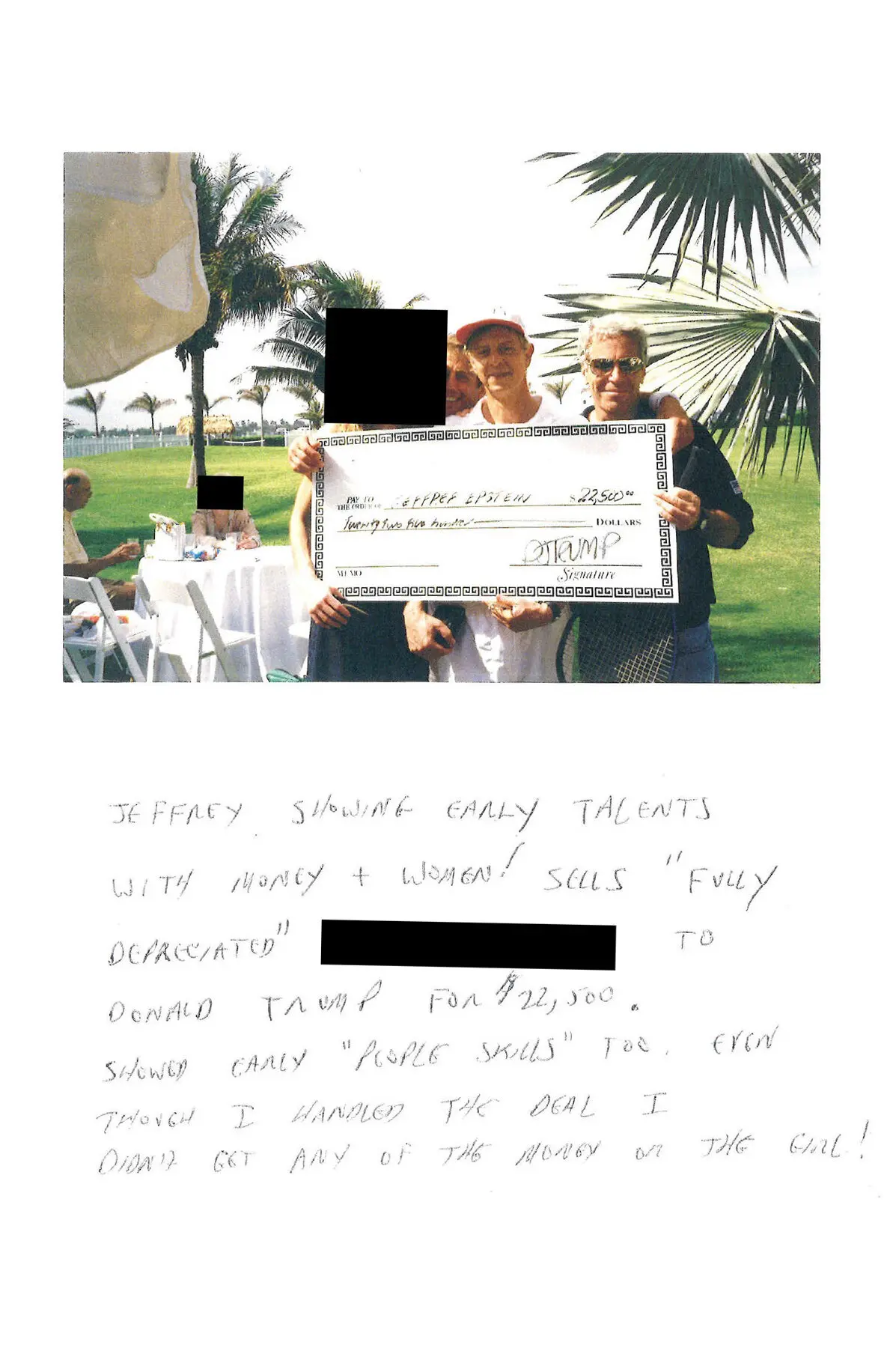
The Epstein case is about the treatment of women and girl-children as commodities to be exploited with utter disregard for their needs, desires, dignity, humanity, the insistence on no connection, no relationship, no empathy, and the treatment of the whole gender as somehow less than human. It is not a coincidence that Jeffrey Epstein was a financier: he seemed to find satisfaction in the transformation of young female human beings into property without rights and agency. He even joked about Trump selling a "depreciated" woman to him.
Elon Musk, who has turned the AI feature on his social media platform into a vengefully misogynist pornography generator, said, "The fundamental weakness of Western civilization is empathy," and the radical right rails against it. (A new scientific study demonstrates that using X/Twitter with the right-biased algorithmic feed "increased engagement and shifted political opinion towards more conservative positions, particularly regarding policy priorities, perceptions of criminal investigations into Donald Trump and views on the war in Ukraine.") Empathy is the sense of an emotional connection to others, of care that extends beyond the self, usually underwritten by a sense of connection and identification, of non-separation.
The history of this country is, at its best, a broadening and deepening of who matters, with the end of slavery, the beginning of rights for women, movements for racial justice and disability and LGBTQ rights, the very recent public recognition of the profound wrongness of the genocide and dispossession of the indigenous peoples of the Americas. The Trump Administration is all about trying to run the process backward to make women and BIPOC people less equal again, to erase the "certain inalienable rights" that undocumented immigrants and refugees share with the rest of us, to make gender back into airtight boxes, to reinstate the inequality behind colonialism.
You can imagine Trump as Gollum with some of Sauron's powers, but to his credit, Gollum understood the One Ring was only as good as the powers that went with it. (While I'm at it with the Middle Earth analogies, let's call Silicon Valley's overlords orcs who think they are hobbits.) Trump wants the shiny stuff, whether it's the cheap molded glitz he glued to the walls of the Oval Office or the Purple Heart medal given to someone else entirely, wants the election victory whether or not he got the votes, the praise even when it's extorted and insincere, the utter farce of the peace award from FIFA, the international soccer federation. The poet W.H. Auden wrote of the Lord of the Rings trilogy, "Evil, that is, has every advantage but one – it is inferior in imagination. Good can imagine the possibility of becoming evil – hence the refusal of Gandalf and Aragorn to use the Ring-but Evil, defiantly chosen, can no longer imagine anything but itself. Sauron cannot imagine any motives except lust for domination and fear so that, when he has learned that his enemies have the Ring, the thought that they might try to destroy it never enters his head, and his eye is kept toward Gondor and away from Mordor and the Mount of Doom."
Auden outlines one of our strategic advantages: they routinely fail to comprehend motives that are not selfish. So the idealism, the altruism, the commitment to ideals and principles, that motivates the resistance is seen as a cover-up for the real motives, which helps them cast progressives as criminal or delusional, but also made them unprepared for the heroic solidarity in city after city. JD Vance said in an interview last year, "I think a lot about this question of social cohesion in the United States.... And I do think that those who care about what might be called the common good, they sometimes underweight how destructive immigration at the levels and at the pace that we’ve seen over the last few years is to the common good. I really do think that social solidarity is destroyed when you have too much migration too quickly." He has since expressed versions of that view, even as the extraordinary solidarity in Springfield, Ohio (where Somali refugees are under attack), Minneapolis, and Los Angeles, among other places, demonstrates that in fact a lot of us are so capable of that empathy across racial and cultural difference that we will stand up for and with our neighbors and even risk our lives and our freedom. Jesus said, "Love thy neighbor" without qualifications about whether your neighbor was aligned with you ethnically or religiously.
We are in a tremendous conflict of worldviews now, and that underlies many of the most urgent political struggles in this moment. In one worldview in which even rivers and mountains are alive, in which everything has rights and is entitled to respect, widely shared (with wide variations) by indigenous peoples across the world, in which the connections between humans and between human and nonhuman life matter. Trump, on the other hand, perfectly embodies the worldview of extreme capitalism in which everything is essentially dead: a commodity to be owned, exploited, destroyed at will. If even rivers are alive in the one view, even human beings can be and only too often have been reduced to commodified disposable objects in the other, as the Epstein files only too grimly document.
Each of these individual struggles matters – over the Epstein files and justice for the victims, the rights of immigrants, and refugees, over the rights of those currently being bombed by the US government, over the protection of the nature from which we were never separate. Underlying them is this broader struggle of ideas and values. Margaret Thatcher famously said "there is no such thing as society," meaning we're each on our own or should be and owe nothing much to each other and the common good. The antithesis of that might be the new scientific work reaffirming the old indigenous worldviews, recognizing that even in the absence of human beings there such a thing as society. For example, Suzanne Simard and other scientists have demonstrated that a forest is not a collection of isolated individuals competing with each other but a community of beings exchanging resources and information whose relationships are often symbiotic.
Among the consequences of this emerging – and re-emerging – worldview are the growing legal field of the rights of nature and the granting of personhood to rivers from New Zealand to Canada to Colombia and Peru. Underlying the rights and respect is a vision of interconnection and relationship, of aliveness, that stands in stark contrast to the alienation and deadness of extreme capitalism's worldview and the will to divide and disconnect of white supremacy and patriarchy. It is not only an indigenous worldview: Reverend DeWayne Davis, a minister at Minneapolis's Plymouth Congregational Church, declared to a reporter that the hundreds of clergy witnessing and standing up to ICE in the city's streets “didn’t do all that because we are heroes and saviors. We did it because we understand the meaning of our faith: that we are all connected. We join together. We are a part of a people, a body of humanity that is made in the image of a loving and beautiful God that wants all God’s children free.”
The reverend spoke of human inseparability much as Martin Luther King famously did when he declared, "all life is inter-related. All men are caught in an inescapable network of mutuality, tied in a single garment of destiny," and King was right that it's all life, not just human life. Maybe in this day and age, love thy neighbor should also be love thy nature. After all we are all neighbors to nature; we live in a grand neighborhood called the biosphere, the realm of life on earth, and we depend on it. We are it and it is us, from our gut biome to what we eat, drink, and breathe. Love in this case should manifest as active care.
The United States government has launched wars on Venezuela and Iran,on immigrants and trans kids and women's rights, but its biggest war and its most impactful in the long run is the war against nature. Climate science is the study of the interconnection of all the organic and inorganic systems on earth. Denying this interconnectedness is essential both to the right-wing ideology of isolated individualism and to the perpetuation of the fossil fuel industry and its devastation of the climate. In that light, Greenland has long been under attack by the United States, because runaway climate change is threatening the stability of the ice sheets, climate, and traditional life ways of the island. As climate organizer and journalist Bill McKibben recently remarked, "there’s only one truly vital strategic asset in Greenland, one thing that could change the world. And that’s the ice that covers almost all its landmass." Were all its ice to melt, global sea levels would rise 24 feet. The US both produced a lot of historic climate emissions and now, under Trump, has left the global agreements to do something about the crisis and dismantled much of the legislation and funding to address it domestically.
All these war are related; they all come from the same ideology of isolation and mentality of commodification. The oil wars come in part from the refusal to see that we must exit the age of fossil fuel, that renewables already provide cleaner, cheaper, more universally available options. Sun and wind are also a solution to the constant strife of the age of fossil fuel, because you cannot steal sunlight and wind and you do not need to, because they are so widely distributed across the planet. In 1953, the US and UK overthrew the democratic regime in Iran, which had nationalized Iran's vast fossil fuel resources, and installed a monarch, whose main job was to let Britain continue profiting from the oil. The current regime rose to power by overthrowing the Shah in 1979. If and when we transition away from fossil fuel, these kind of sordid resource wars will largely come to an end (I know someone is going to pop up to say something about the minerals used for renewables, so read the footnote here first).
Meanwhile, the wars against immigrants and refugees ignore that in many cases these are climate refugees and unchecked climate chaos will produce far more of them; this too is about nature. The war against trans people insists on outdated notions of biological sex in which there are exactly two of them and they are strictly segregated into airtight boxes; contemporary science recognizes that sex has many determinants that vary widely from individual to individual in our species and that across the animal kingdom there are far more possibilities. The war against women insists that women are a kind of nature men should be able to control.
I believe these wars will all fail in the long run --not inevitably, not without heroic effort, but most likely – because they are more and more the manifestations of an old worldview that is increasing not just unpopular but not how we understand ourselves and our world. They benefit the few and not the many, which is why all these are connected to issues of rights and democracy and the environment. I believe that the climate movement is a peace movement, because industrial capitalism has fought a war against nature, seen it as something to conquer, own, manipulate, replace, has refused to recognize the ways we depend on it and the ways its complex interconnections cannot be dismissed and destroyed.
The poet Diane DiPrima wrote "the only war that matters is the war against the imagination." How we imagine the world is how we live in the world and how we act toward others, human and otherwise. It doesn't end in the imagination but it begins there, which is why at the root of all the other battles is a battle of ideas.
Footnote re the stuff used to make renewable energy and battery storage: studies show that it will require hundreds of times less extraction than fossil fuel does; that much of it is almost endlessly recyclable so that when we stockpile enough we can largely stop; and tons of great research is being done on using more common and less impactful materials for batteries. Of course all extraction should be done with respect for local communities and ecologies, but this transition will let us wind down the fossil fuel industry, which is destructive at every stage from extraction to transportation and processing to its use--by burning--and its emissions.
p.s. Dear Readers, publication day for my newest book was Tuesday and I've been really busy for the past three weeks with publicity-related activities. I usually put out a new essay at least once a week and I'm a bit dismayed it's been almost two weeks. Bits and pieces of book tour (the schedule is here) continue through much of this month, but I'll always be back. Thanks for your patience. This book, in which many of the ideas in this essay are explored more thoroughly.