Weak Violence, Strong Peace: Who We Are in This Crisis
It's getting more extreme out there, especially in Minnesota where the unaccountable army of the Trump regime has, in the wake of its murder, beaten up employees, ripped civilians from their cars, kidnapped people who are in every way outside their mandate, knocked on doors demanding to know where the Asian neighbors live, and generally spread terror. Their prime target is brown and Black people, especially Somali immigrants, but they murdered a white woman who had shown up in solidarity. The claim that they are after immigrants and refugees who are criminals faded away long ago, and they are now assaulting and kidnapping citizens, people with spotless records, Native Americans, and anyone who gets in their way. As Heather Cox Richardson put it Tuesday, "the agents’ mission increasingly looks as if it is to frighten opponents of the administration into submission. But instead of submission, they appear to be sparking deeper and deeper opposition."
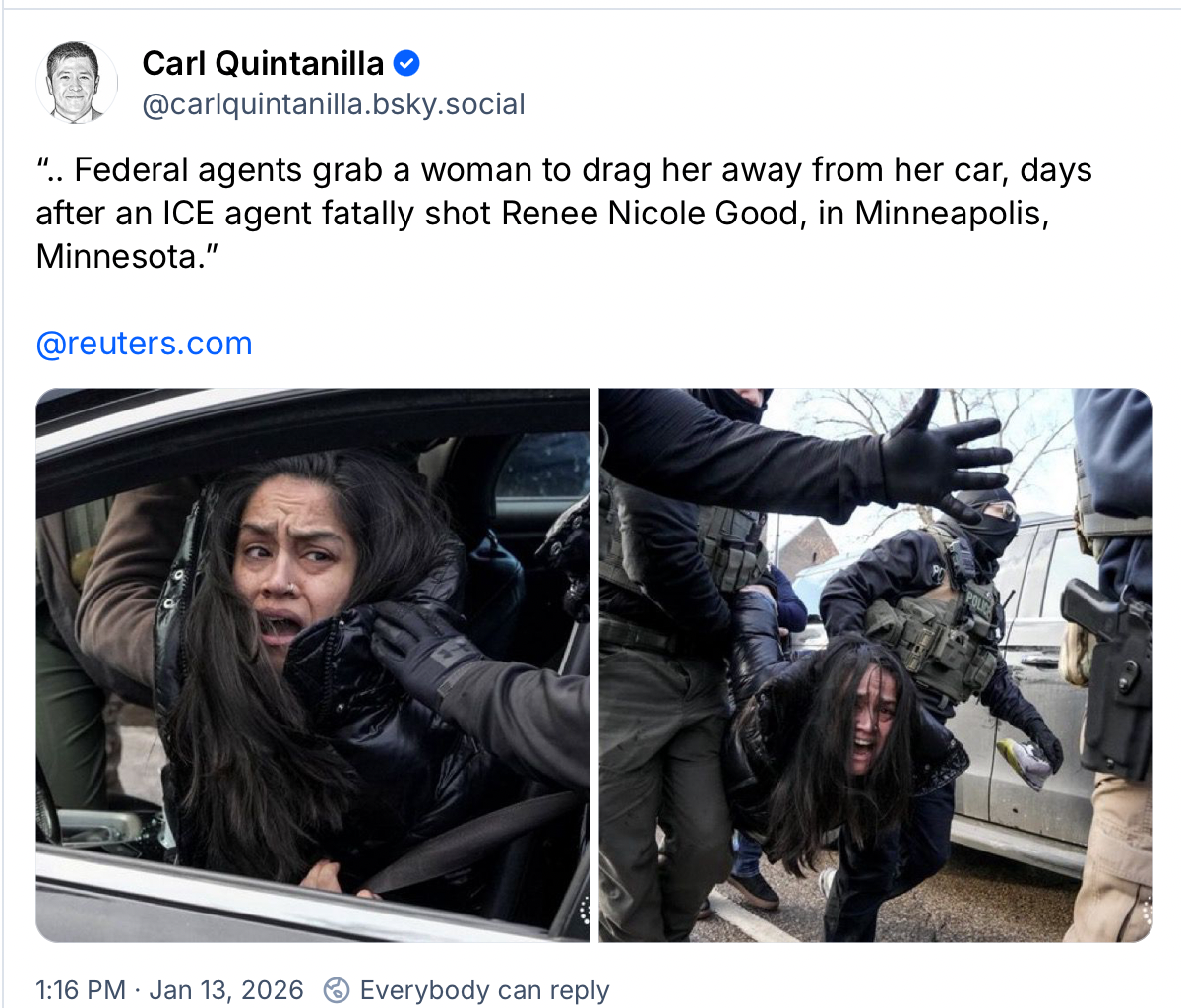
Some of the things ICE employees have been quoted as saying suggest they consider the shooting death of Renee Good a lesson that the rest of us should have learned, an instruction to be afraid, to submit, to stay uninvolved. Beneath that is the usual assumption of elites and authoritarians, that human nature is essentially cowardly and selfish, that it pursues its own interests but does not take risks for the greater good. Even a lot of moderates when they limit their focus to "kitchen table issues" assume that a narrow version of our own well-being is the beginning and end of our concerns.
But that is not who we are, and we do not flourish independent of the society and ecosystems we are part of. We are, overall, more idealistic in the literal sense of more concerned with ideas and ideals, with the principles of the larger society we live under, with justice and human rights. That's why people are organizing, are standing up, are not backing down. The brutality is in a sense a recruitment tool --surely for a handful of sadists and haters joining or backing the administration (although some reports say ICE is having trouble finding employees to join the swarm in Minnesota) but hugely for those whose sense of humanity and solidarity brings them into the opposition.
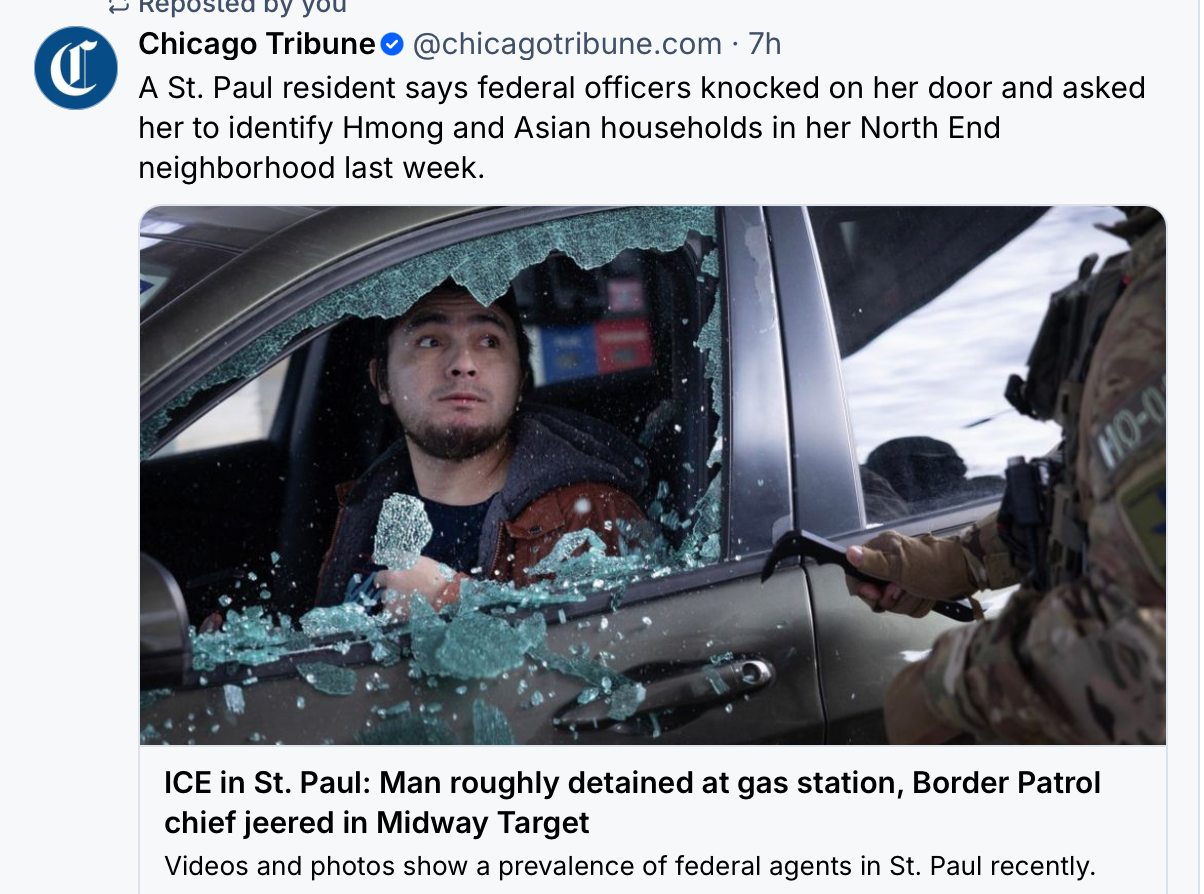
Minneapolis has been heroic. Even after the murder of Good, people continue to show up, continue to organize, continue to resist. In a Somali neighborhood, a crowd prevented one man from being abducted; a singing patrol is among the many trying to protect the neighbors; violence is being documented across the region by ordinary people with phones and by journalists; and "six federal prosecutors in Minnesota resigned on Tuesday over the Justice Department’s push to investigate the widow of a woman killed by an ICE agent and the department’s reluctance to investigate the shooter." A Minneapolis minister, writes Bill Lindeke, says “You’ve probably seen the videos of agents saying to protestors and legal observers, ‘You saw what happened. Didn’t you learn your lesson?’ The only lesson learned is the love for our neighbors is growing three sizes each and every day.”
People remote from the fray have called for more institutional or confrontational countermeasures, including for Tim Walz to call up the Minnesota National Guard to protect Minnesotans from the federal government. There's a real risk that this could play into a Trump Administration desire to become even more violent, even more in violation of our rights, even more committed to regarding the public as the enemy. On the one hand, scholar of nonviolence George Lakey has long said that polarization is not something to be avoided — it is a clarification and a crucible in which people have to choose their values, in which as the old labor song had it, they must decide "which side are you on." From it profound social change often emerges.
On the other, the Trumpists are obsessed, from Pete Hegseth to the ICE goons to the rhetoric from Trump, Miller, and Vance, with a cartoonish manosphere notion of bullying and brutality as strength and masculinity, and they appear to have no ethical limits. But they are weak, and the more horrific their actions the weaker they become, because political strength comes from broad support (or in the case of real authoritarians successful terror-backed repression of a kind I do not believe can be fully realized in this huge, diverse country full of people who are intransigent about our rights). They are weak and they are making themselves weaker.
Yale historian Joanne Freeman said in a video conversation with Heather Cox Richardson this weekend that "they realize it's their last ditch effort. They know that they're not a majority; they know that they do not have approval even if they're looking at all the polls that say people don't like what they're doing. They realize, and it's hard to believe this, but please listen: they are in a position of weakness, they are performing brutality, they are performing strength, they are performing dominance, because they don't have it. They don't have the numbers, they don't have the power. What we're seeing right now is concentrated, forceful, nasty, bloody because it's their last attempt to grab what they've been trying to get all along but they realize that fates are not with them."
Lawyer and human rights advocate Jay Kuo agrees. In his newsletter, he writes, "we could and should view these escalations for what they are: the fever pitch we have long expected. The walls are closing in on Trump, and he finds himself increasingly cornered. As I wrote recently, we should judge every new move by Trump by whether it signifies some new expansion of his power, or whether it falls within his ever-shrinking zone of actual authority. By this measure, Trump continues to signal notable weakness, not strength. That pattern is now unmistakable. The White House escalates, but the public and the opposition do not back down. That will ultimately force Trump to commit even more outrageous acts. Eventually, and across multiple gaps, these acts will prove bridges too far. Whether it’s brutal ICE crackdowns, threats against our allies, or now the baseless criminal prosecution of [head of the Federal Reserve Jerome] Powell, each will accelerate erosion of public support and compound losses at the ballot box." Of ICE, Kuo notes, "Among those who disapprove, 42 percent strongly disapprove. And some 40 percent now believe the entire agency should not just be reformed but abolished entirely. That’s up over 20 percent since the beginning of the year." The more they grab individuals and brutalize communities, the more they weaken whatever support they had from the public.
Freeman and Kuo: two informed voices agree that they are weak, they are frantic, they hear the ticking clock, they are caught in a cycle of extremism that leads to unpopularity and unpopularity that leads to extremism. They have to govern with brutality because the will of the people, the rulings of the courts, local and state governments, and more and more, the will even of Republicans in Congress, is not with them. Neither is the law. Nor will history be. I do not know what will come of this weakness, but it will not sweep them away by itself. It will create the possibility for us to do so (though Trump's apparently declining health and the administration's internal discord and lack of real loyalties may help us along).
The question of who is "us," what "we" means, is always important to ask. "We the people of the United States" begins the preamble to the Constitution. "We" are now a divided people, but the far-right side is fracturing and failing at both the highest and most grassroots levels., from MMA athletes to manosphere podcasters to some of the January 6 berserkers to ordinary Americans to members of Congress. In votes and in rhetoric – and in the resignation of Marjorie Taylor Greene – we can see that the once-reliable loyalty of Republicans to Trump is over, and that many are unwilling to follow them all the way into the brutality, the lawlessness, the recklessness, and the destruction.
North Carolina Senator Tom Tillis, a member of the Senate NATO observer group, denounced Trump's and Stephen Miller's threats to invade Greenland: “Folks, amateur hour is over. You don’t speak on behalf of this U.S. senator or the Congress. You can say, it may be the position of the president of the United States that Greenland should be a part of the United States, but it’s not the position of this government, because we are a coequal branch, and if that were to come to pass, there would be a vote on the floor to make it real. Not the surreal sort of environment that some deputy chief of staff thinks was cute to say on TV.” The Hill quoted several other Republican senators likewise disparaging the threats to Greenland that would undermine the NATO alliance and bring conflict, possibly war, with Europe. The Trump Administration has been able to do much of what it has done over the past year because Congress's Republican majorities had largely surrendered its powers. They now seem to be reclaiming them.
Still, not all the senators are standing up for principle rather than Trump. The Epstein files are being used by Republican James Comer to try to coerce the Clintons to testify to Congress or be found in contempt at the same time the Department of Justice has violated the law by refusing to release more than a tiny trickle of the massive files (and is ignoring that Bill Clinton has called for the full release of the Epstein files, and that the administration is still covering up for the men who are already known to have sexually abused minors in concert with Epstein). But the public is not fooled, and Trump still seems to have much to hide. Yesterday, a Ford worker in Dearborn yelled from the factory floor at Trump, who was visiting the Dearborn plant, "pedophile protector." Trump responded by flipping him off and apparently saying "fuck you." The worker, Thomas Sabula, has been suspended from his union job – but a GoFundMe for him has passed a quarter of a million dollars, and he says he has "no regrets whatsoever."
NPR reported yesterday, "As federal immigration enforcement actions intensify across the Twin Cities, communities of faith are at the forefront of resistance, organizing public witness, mutual aid and political action rooted in long-standing religious commitments." A striking thing all through 2025 was the presence of clergy in the demonstrations and protests to protect immigrants and refugees and their rights. This week Rob Hirschfeld, Bishop of the Episcopal Diocese of New Hampshire, announced, "I have told the clergy of the episcopal diocese of New Hampshire that we may be entering into that same witness and I've asked them to get their affairs in order, to make sure they have their wills written, because it may be that now is no longer the time for statements but for us with our bodies to stand between the powers of this world and the most vulnerable.” Priests, ministers, rabbis, imams, nuns and monks have spoken up and shown up as part of the resistance, and across the country churches have hosted meetings and trainings for resistance and solidarity. Pope Leo himself, who was raised in Chicago, has spoken out again and again for the rights of immigrants and refugees. Of course the white supremacist right has its churches and congregations too, but they appeal to a narrower swathe of the population.
And maybe winning looks like the "we" keeps growing in strength and commitment. The US Department of Labor recently posted yet another piece of administration white supremacy on the hellsite formerly known as Twitter "One Homeland. One People. One Heritage. Remember who you are, American." But this country's motto was long e pluribus unum, out of many one, a Latin phrase celebrating exactly the diversity that has been as part of DEI under attack; we are states that are at best united, but not one state. We are many peoples with many heritages; Minnesota is enriched by its Hmong and Somali refugees; it is home to Lakota, Chippewa, and Ojibwe peoples who were here long before the USA existed. We never were and never will be the wall-to-wall white nation the racists in the half-smashed White House seem to dream of. The beautiful force behind the resistance is solidarity, which is by definition not self-defense but defense of something beyond the self, a reaching across difference to find common ground (it's why Indivisible's name is a stroke of brilliance). I do not think we have seen solidarity with immigrants and refugees with this breadth and power before; I hope it leads to a lasting change in policy and posture in this country.
As I write, as you read, Buddhist monks in saffron robes are on their twelfth week of a pilgrimage for peace, walking through ten states from the Huong Dao Vipassana Bhavana Center monastery in Fort Worth, Texas, to Washington D.C. "Our walking itself cannot create peace," says their mission statement. "But when someone encounters us—whether by the roadside, online, or through a friend—when our message touches something deep within them, when it awakens the peace that has always lived quietly in their own heart—something sacred begins to unfold." They walk to encounter others and to invite others to encounter themselves, the deepest selves that in Buddhist tradition already have Buddha nature. They walk in the unprotected vulnerability of the human body without machine augmentation or protection; some walk barefoot or almost barefoot. On November 19, a truck hit their support van, knocking it into the monks; one of them, Bhante Dam Phommasan, was injured seriously enough to require the amputation of his leg. The walk continued.
The monks are overtly not Christian, not white, and not part of a Western tradition. They are in a Vietnamese Buddhist lineage; they all appear to be of Asian descent. Some appear to be walking barefoot or partially barefoot, and they've been joined by a rescue dog they adopted. What has been most striking is the generous and enthusiastic reception they've had in community after community as they traverse the south, joining church groups, receiving practical support and offerings, attracting media coverage, gathering crowds to hail them or walk a little ways with them. The welcomes they have been met with demonstrate the existence of this other America, this e pluribus unum America. It won't overthrow the regime, but it will remind those who encounter them directly or in the media of who else we are and can be.
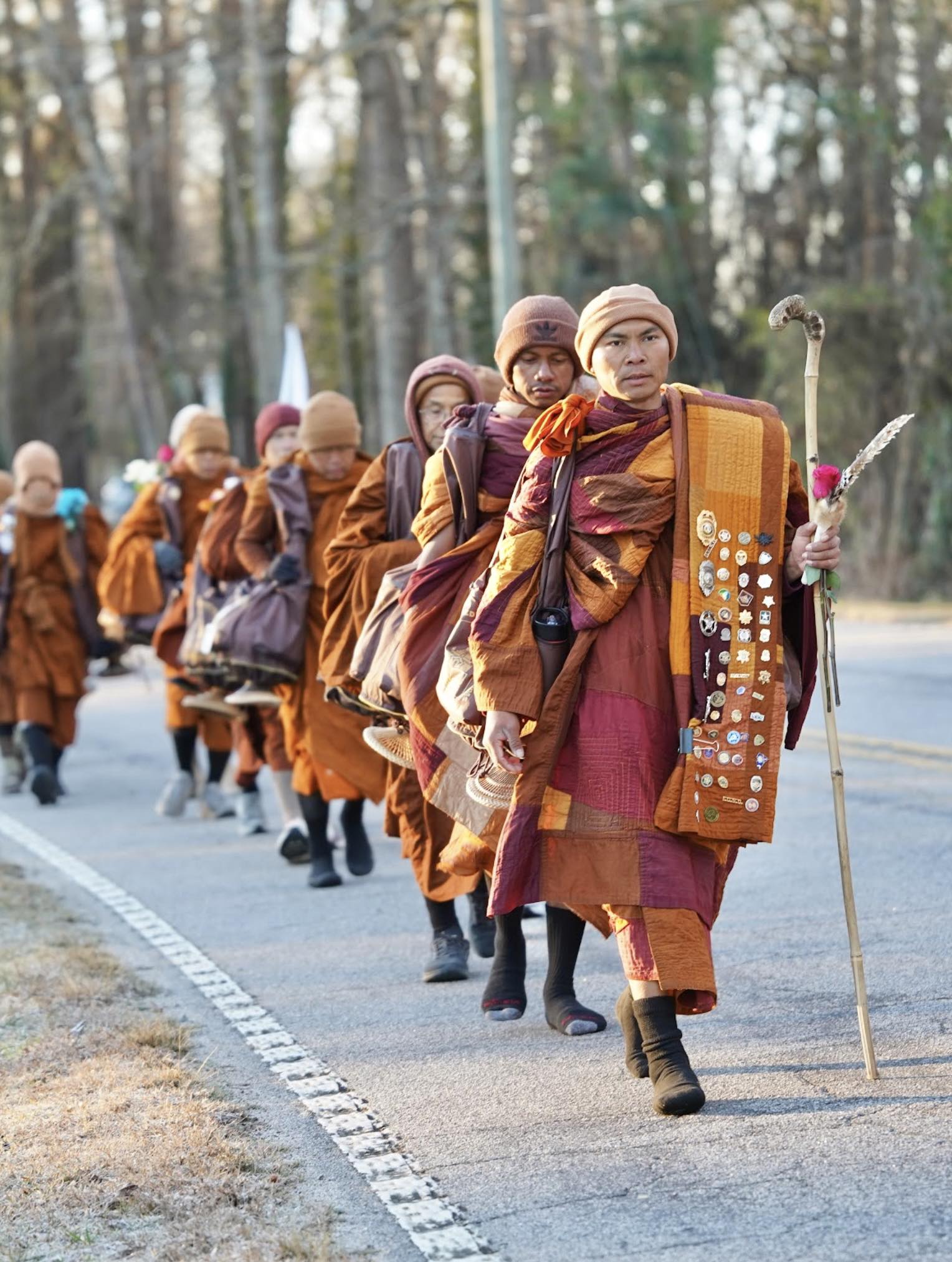
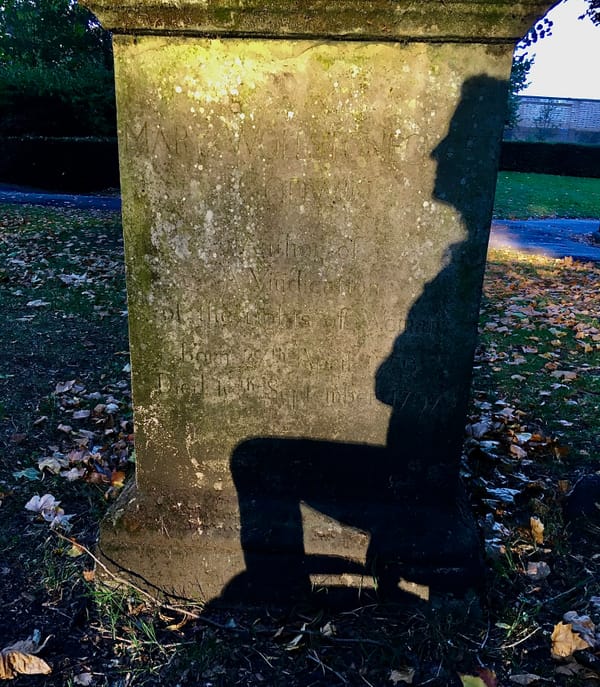
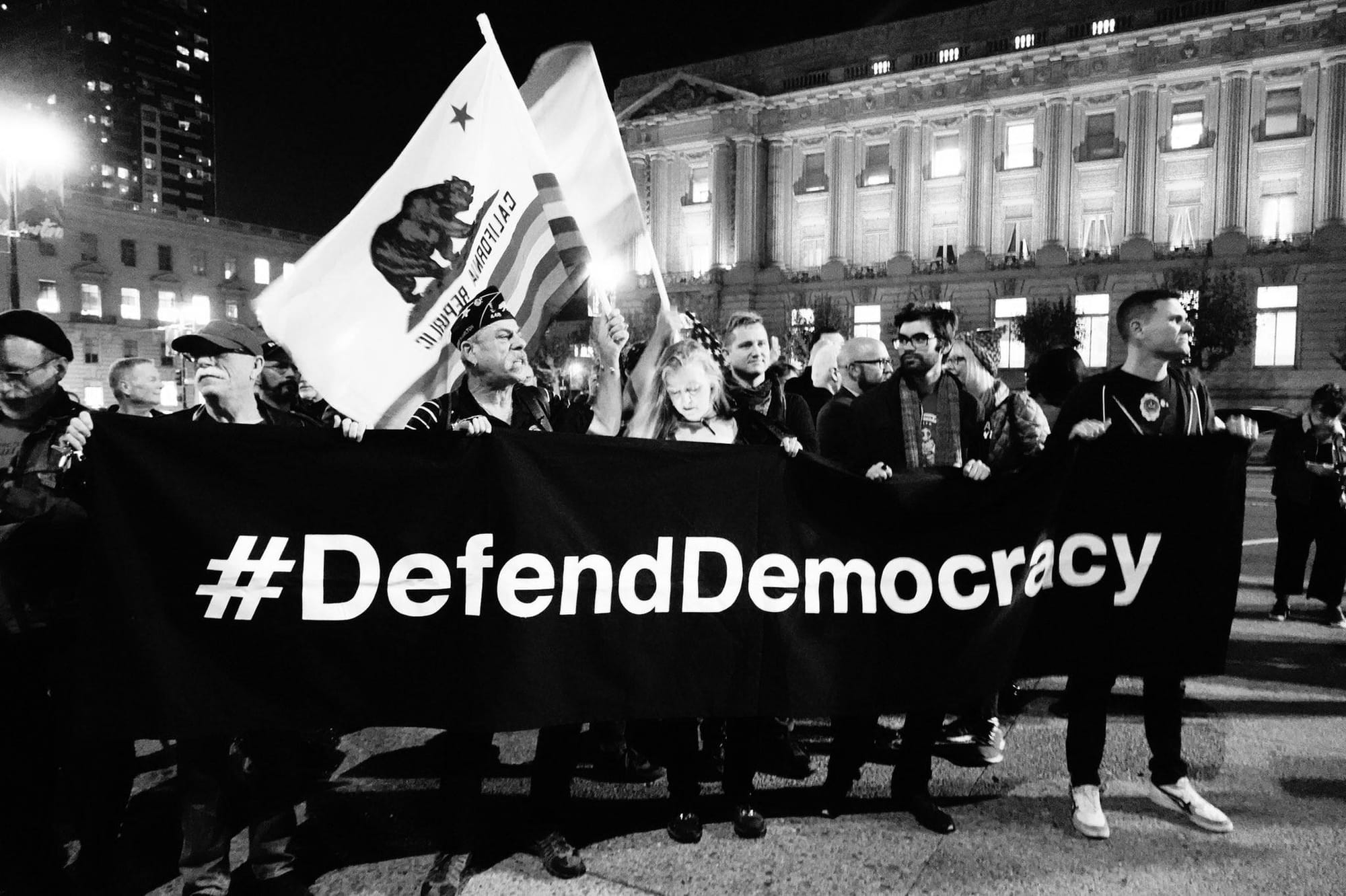
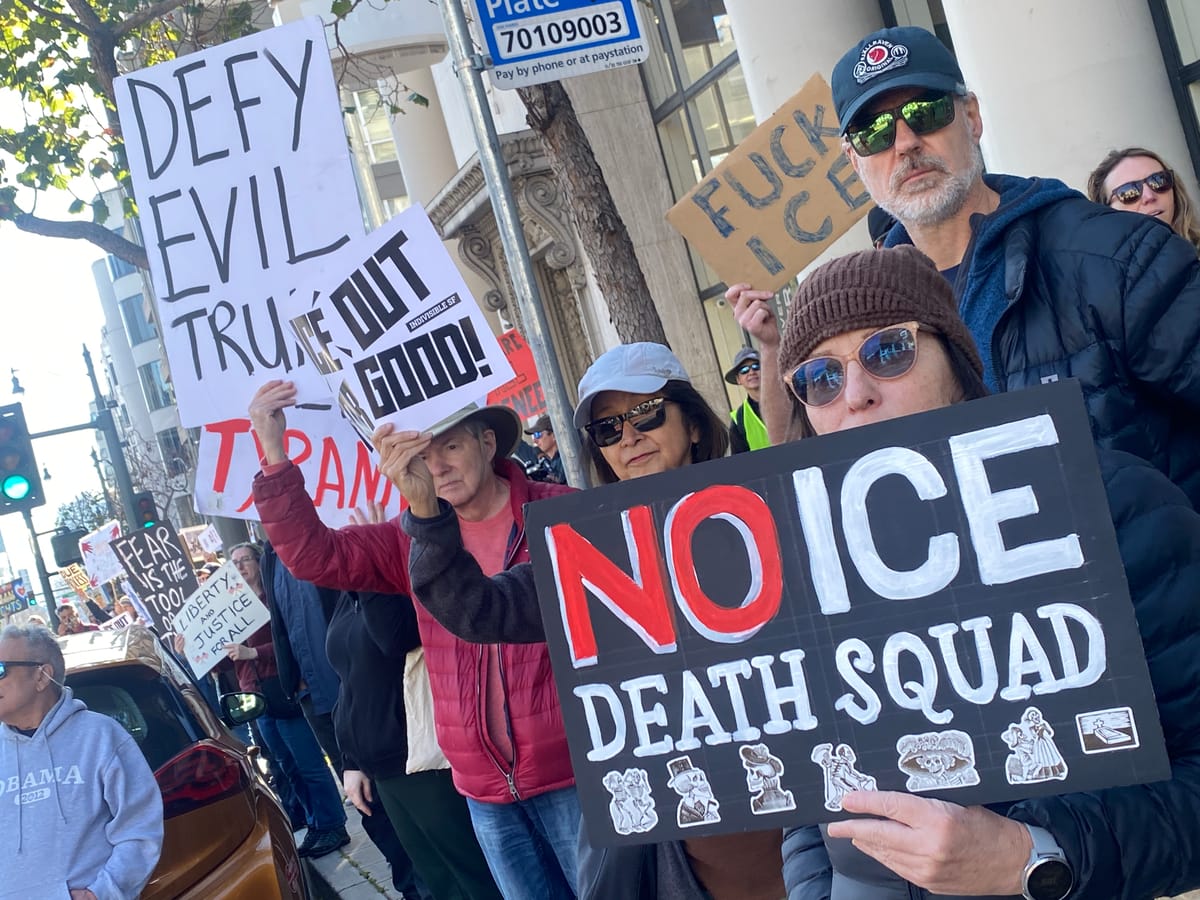
p.s. It's striking to me that I have selected two kinds of photograph to accompany this essay: photographs of people coming together in solidarity and for peaceful coexistence, photographs of people being violently ripped apart from their lives, their places, their communities by an unwelcome, heavily armed, unaccountable, masked, and lawless Trump army.
p.p.s. Today I'll be talking with Bill McKibben and Kafia Ahmed of Third Act and visionary organizer Daniel Hunter at 3pm Pacific/6pm Atlantic about resistance, possibility, and where we are in this moment. Third Act is a climate-and-democracy activist group on whose board I sit. https://thirdact.org/events/fighting-authoritarianism-in-our-third-act/?