Cynicism and Naïveté in the Summer of a Thousand Fires
To refuse to participate in the shaping of our future is to give it up. Do not be misled into passivity either by false security (“They don’t mean me”) or by despair (“There’s nothing we can do”). Each of us must find our work and do it.
--Audre Lorde
Some people like to strike worldly and cynical postures, perhaps because they don't realize that worldly and cynical are only too often in conflict with each other. Those striking the posture often assume that the more you know about something the darker and grimmer it will get, and therefore, having not really bothered to learn more, they can set themselves up as worldly by waxing cynical. Often they're wrong in assuming that any positive view is the result of – well the favorite word is naïveté – when often the opposite is true. There is naive cynicism, bitter naïveté, confident assumptions that things are worse than they actually are.
One arena in which this is startlingly true is climate. I have been around the climate movement for more than fifteen years. Everyone who's up to their neck in climate politics, economics, and science knows the situation is serious, alarming, dismaying – but not doomed, and so they keep doing what they can do. Their valor, generosity of spirit, dedication is so profoundly beautiful that being around these people one of the rewards for doing climate work (though our main purpose trying to protect the miraculous, gorgeous, astonishing planet and all its elegantly orchestrated systems of life and the support systems of that life).
But outside that world of informed people who are doing the work are people who throw up their hands and give up. I will assume some of them sincerely believe that it's too late, there's nothing we can do, we have no solutions, and nobody cares. For others it might be an excuse for doing nothing – if you can pretend the drowning people will inevitably drown, you justify remaining a bystander. But it's always puzzled me: if you think the entire realm of life on earth is threatened wouldn't you throw yourself into understanding the threat the way you do when you get an alarming medical diagnosis? But lots of people don't. They make uninformed we-are-doomed-it's-too-late pronouncements and remain bystanders. (It's been staggering to hear that people make the decision not to have kids based on vague assumptions about the state of the planet; in recent years, my younger climate friends had a little baby boom.)
In the Petri Dishes of Public Opinion
With apologies, I am going to lead you into the Great Dismal Swamp of social media with a screenshot and discussion. I was happy to see a Democrat in Congress take the climate crisis seriously, when Congressman Casten shared Zeke Hausfather's Bluesky post (and I do know Dr. Hausfather slightly, and by the way he's a parent too):
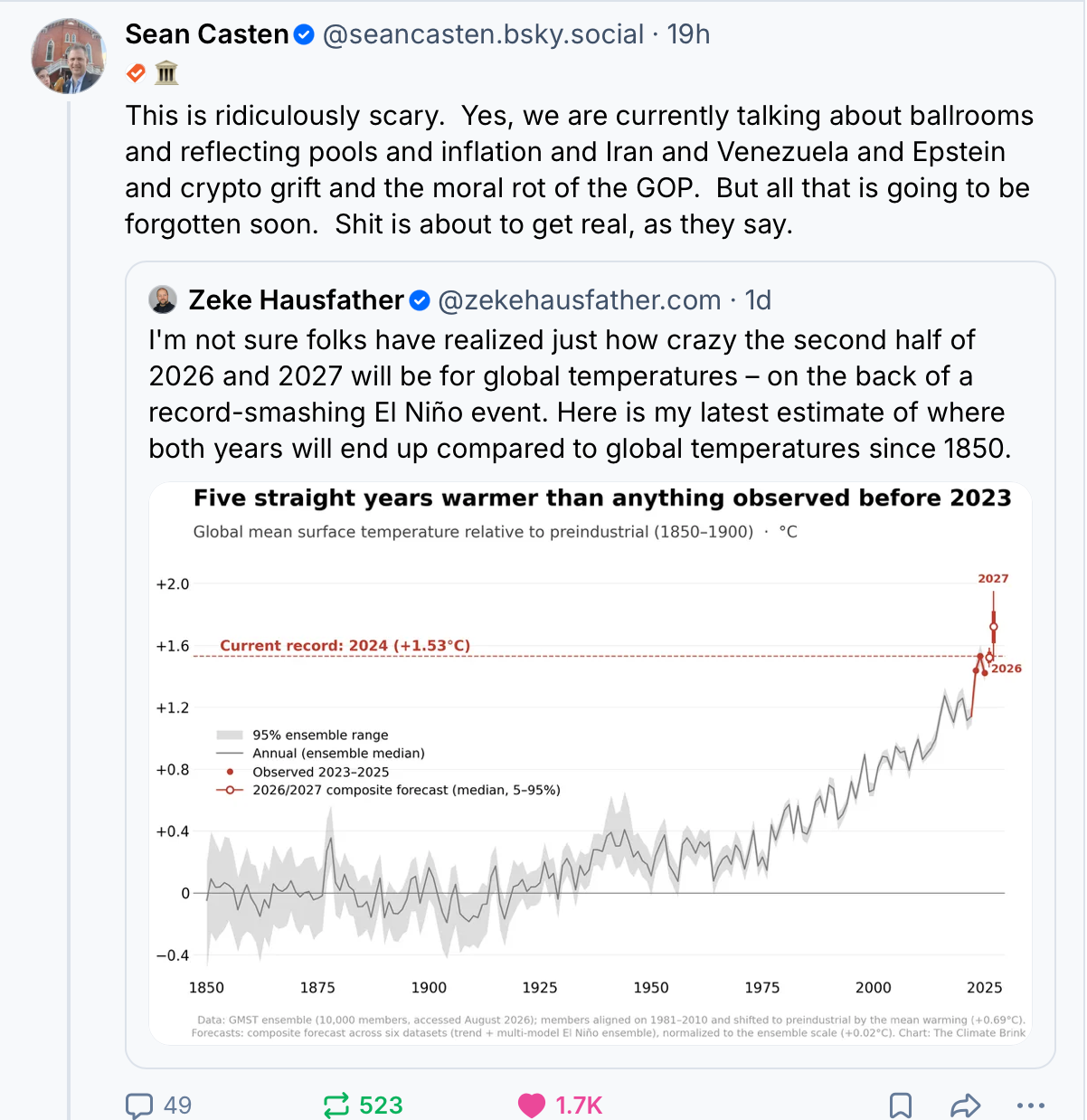
Some guy replied to the post: "Climate scientists lied to us. They downplayed how bad things are because the feared being called out by deniers. We are completely screwed and there is no stopping it at this point."
But they didn't, and that's a sloppy accusation floating around the Internet and Holy Plaid Socks of the Savior, people who were not really listening to extremely alarming statements climate scientists for the past 37 years now want to blame the scientists?
"No they didn't. And what we do now matters," I declared. I added a link to a piece from Project Drawdown, a wonderful climate organization focused on sharing solutions whose very name is about this process of drawing carbon down from the atmosphere. The piece is by Dr. Kate Marvel, a climate scientist (and parent) who recently left NASA for Project Drawdown; it's titled "Is climate change unfolding faster and fiercer than scientists expected?" The answer is no.
Doomy guy replied with some sketchy science: "There is no stopping it. CO2 stays in the atmosphere for thousands of years."
I replied, "As for the "no stopping it," it is actually possible to go carbon neutral or carbon negative (if not currently likely). Nature, in the form of trees and oceans, among other things, is drawing down carbon dioxide all the time." Were we to actually go carbon negative – i.e. emit less carbon dioxide than nature takes up – we could actually reverse some aspects of climate change. The ice would keep melting, the oceans rising, but other parts of the earth's grand operating systems would stabilize. Obviously we're very, very far from doing that right now, but we do have a wide array of choices about how good or bad the future will be in how we act or fail to act. I think one stumbling block for a lot of people is the idea that if we cannot save everything, we cannot save anything, which is profoundly untrue and seems to arise from the habit of framing everything in all-or-nothing absolutes.
The same kind of sloppy thinking made it into Le Monde, which is to France more or less what the New York Times is to the USA , the august newspaper of the nation's status quo. A sociologist published a piece there titled "Climate disasters do not automatically lead to greater care for the world." Who ever said they did? The reality of climate change is in everyone's face; lots of climate disasters have happened; so have lots of kinds of response and nonresponse. Of course it's usually the editors who write the headline, so I won't hold the author responsible for that, but I will for his own words. Sociologist Benoit Giry declared, "the venerable intellectual tradition of viewing catastrophes as positive forces for transforming the world seems to be experiencing a revival in our country. The tradition that could be found, 2,000 years apart, in Polybius (Histories, Book VI) or in Rebecca Solnit's A Paradise Built in Hell (2009), can still be seen today."
"This proposal is marked by a profound sociological naivety. As if, after going through disaster, societies inevitably became more united and more responsible." Who said that? Not me. I suspect he assumed he knew what I wrote and, well, he didn't (amusingly he uses my friend Eric Klinenberg's 2002 book Heatwave to offer what he thinks is a counterargument; it's a book cited at length in A Paradise Built in Hell). Inevitability is a sneaky word to change "yes sometimes this can happen" into "this always happens no matter what." It's a word in which naïveté and cynicism merge into an assumption that you can make an airtight category when the evidence is forever showing us that, when it comes to human beings, categories are leaky and exceptions abound.
My book drew on decades of research by and conversations with leading US disaster sociologists (and yeah, disaster sociology is a field of its own dating back to the aftermath of the Second World War in the USA; it has its own centers and annual conference). It also drew on interviews with survivors of the collapse of the World Trade Center Towers, Hurricane Katrina, the 1985 Mexico City earthquake and on oral histories and other sources for earlier disasters. A Paradise Built in Hell does document the extraordinary constructive, generous, altruistic responses to disaster from San Francisco in the 1906 earthquake to Hurricane Katrina 99 years later. It also explores the startling exhilaration in many of the accounts from people who found a sense of connection, immediacy, purpose in responding to the crisis, a kind of liberation from the alienations and anomie of everyday life.
The book also explores what disaster sociologists Caron Chess and Lee Clarke of Rutgers term "elite panic," the fear by officials and elites that unless they are in control everything will be out of control, that ordinary people will run wild, wreak mayhem, panic, and urgently need to be subdued and controlled, even as those people are often brilliantly self-organizing rescue and aid. It's the authoritarian personality panicking about human nature, with the assumption that most people are rabble who only behave thanks to the threat of police violence and other forms of domination.
In, fact ordinary people often do behave splendidly. And elites often behave barbarously, abandoning people to die, valuing property more than human life, sending in the troops to control rather than rescue the populace. That was what happened in Hurricane Katrina when the elite that is corporate media portrayed the stranded people (mostly poor and Black) in the badly flooded and battered city of New Orleans as marauding hordes needing to be subdued and contained, and the elite that is government acted accordingly. But exposure of the amoral selfishness of elites does often lead to constructive change – it did in Mexico City after the 1985 earthquake, where many died as concrete buildings collapsed. There, the government's callous response helped lead to the end of one-party rule in the country, prompted the creation of a seamstress's union, tenants' rights organizing, and more.
From 9/11 to the Covid Pandemic to Last Week's Attacks on Dr. Fauci
I posted about the annoying Le Monde piece on BlueSky, in a thread that ruminated about 9/11, a disaster in which ordinary people helped each other evacuate the collapsing towers, escape the area via the vast water evacuation from lower Manhattan, and care for the impacted through magnificent decentralized organizing. One thing that is striking about 9/11 is that the Bush Administration was in a frenzy to subdue the local and national initial generous, brave, and openminded response of the residents of the USA. They urged and bullied us to be fearful, divided, to see ourselves as dependent on men in uniform (even though most of the important work that day, including bringing down one hijacked plane, was done by ordinary citizens), to go shopping, spy on our neighbors, and to join them in demonizing Muslims in the USA and around the world. Patriotism was weaponized to punish dissent; people lost their jobs for speaking out against the wars, civil rights and liberties were rolled back in the name of safety.
The first war in response to 9/11 was not against Afghanistan. It was against us. I believe that for the Bush Administration a united public was a threat – they may not have known it consciously but they knew it at some level and worked hard to sow division. It was in watching last week's sordid inquisition of Dr. Fauci by Republicans in the senate that I realized that of course the Trump Administration's response to the pandemic was analogous. They too recognized the threat of a disaster to unite the nation and proceeded to sow doubt, division, confusion, misinformation. This is one of the ways that social media is useful to me; it's often a sketchbook for airing ideas and encountering views outside of those of my own friends. In my thread there, I said "A disaster that gave rise to great social solidarity and pro-social behavior is a threat to a regime with authoritarian aspirations."
Both vicious elite response and violent vigilante and police racism were part of the response to Hurricane Katrina in New Orleans, but so was remarkable solidarity in what one Tulane University historian told me he thought might be the single biggest volunteer effort in US history at that point. The Bush Administration's failed response broke the pall of patriotic obedience that had fallen on the country after 9/11. Bush’s own pollster, Matthew Dowd, said later, “Katrina to me was the tipping point. The president broke his bond with the public. . . . I knew when Katrina— I was like, man, you know, this is it, man. We’re done.” That is: one disaster was manipulated to strengthen a destructive regime; another weakened it. Disasters can have many kinds of impact, and what transpires is a struggle over what meaning it will have.
The Heart of the Matter Is a Debate About Human Nature
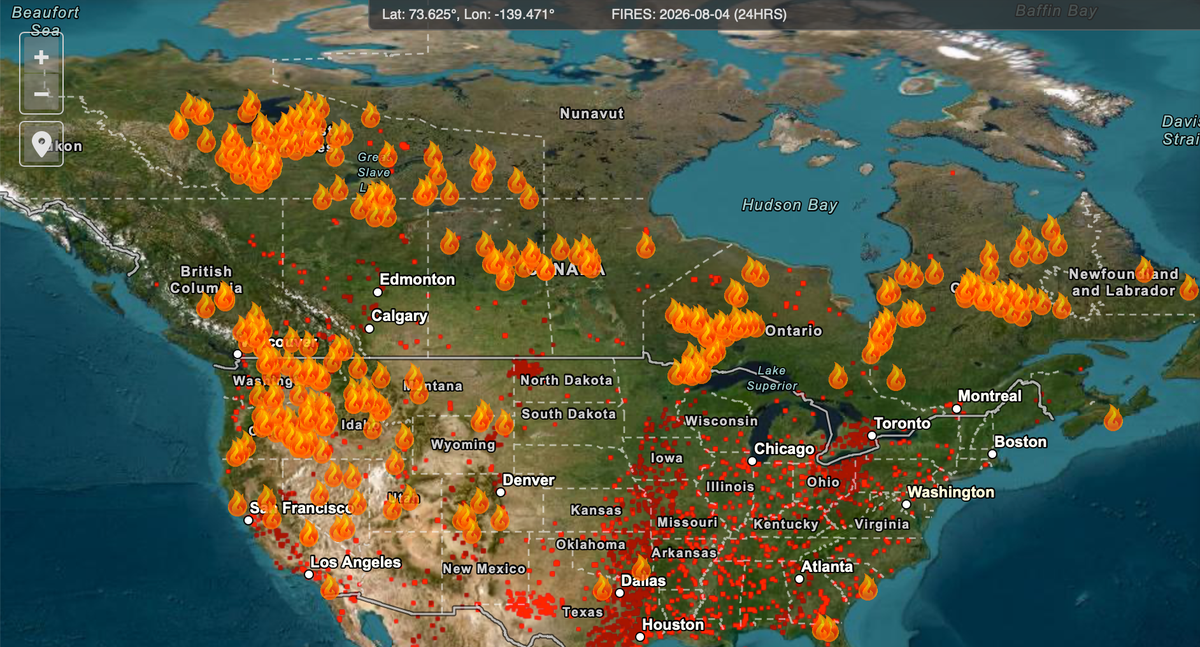
I wrote that 2009 book because I saw what climate chaos was going to bring: more and worse disasters, and I thought we needed to know how disasters unfold. And here we are in the summer of a thousand fires. Climate change is the crisis. But misinformation and cynicism, naive cynicism, discourage fighting the sources of the crisis. One source of that premature surrender is the assumption that most people don't care, won't act, won't support action. For example, when I posted that thread on Bluesky about the Le Monde piece, this happened:
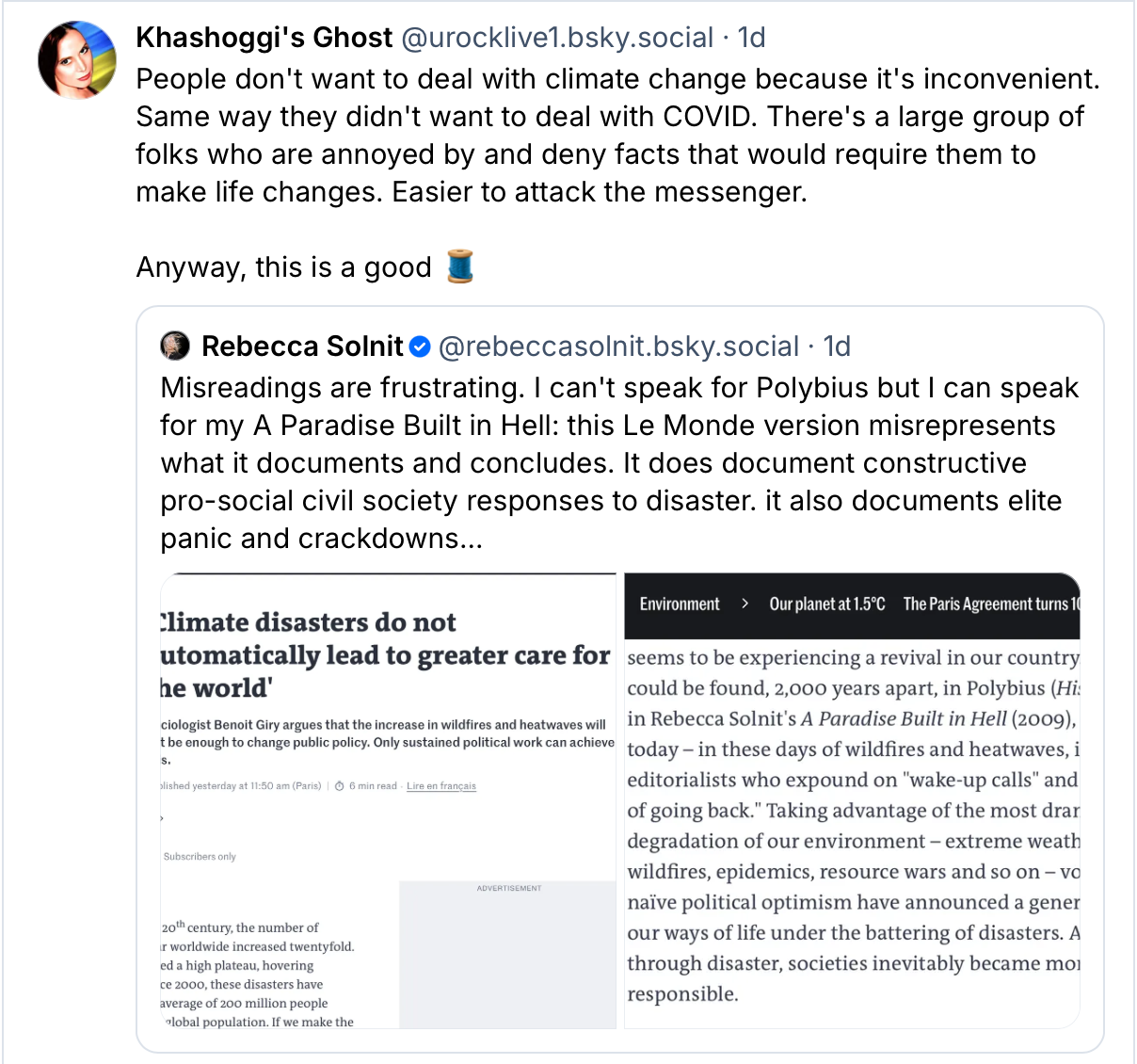
Many, many surveys, national and international, have shown that the great majority of people are concerned about climate change and support action, including government spending, to address it. The United Nations Development Program and Oxford University report that in a survey of "more than 73,000 people speaking 87 different languages across 77 countries," the result was: "80 percent of people globally want their governments to take stronger action to tackle the climate crisis. Even more - 86 percent - want to see their countries set aside geopolitical differences and work together on climate change. The scale of consensus is especially striking in the current global context of increased conflict and the rise of nationalism."
The perception that most people don't care about climate change contributes to the sense of helplessness many people feel about climate change. Even the 2021 movie Don't Look Up, which uses the awkward allegory of a meteor hurtling toward earth for the climate crisis, seemed to blame the public by portraying that public as shallow and distracted/distractable. Here's another great climate scientist and communicator, Dr. Katharine Hayhoe, noting how much such dismissiveness undermines climate action.
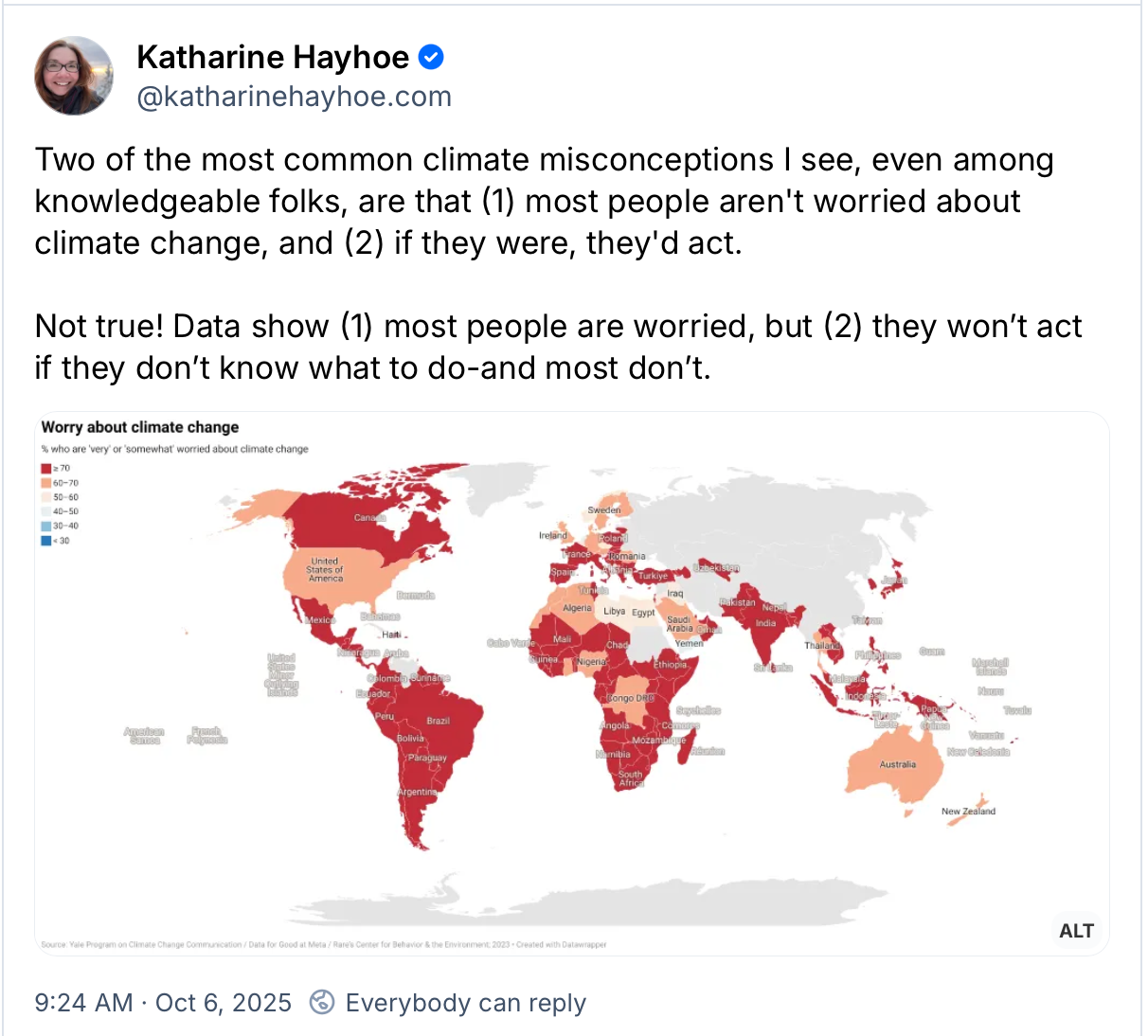
A few people hopped on board the Khashoggi's Ghost post to reiterate the cynicism. One said, "The myopic public has a sad about calamitous climate events ...but underneath it all the public's ignorant apathy is enragingly obtuse.)" A lot of the cynicism about climate is cynicism about human nature. The simplest response to that is that there is no one human nature: we are a malleable species, much shaped by the beliefs and values of the society we're from, and the same society, even the same family, can produce wildly varying specimens of humanity. Renee Good going out on a cold January morning to try to protect her immigrant neighbors represents human nature; so does the ICE agent who shot her. Recent noodling around online led me to learn that fashion designer Christian Dior's sister Catherine Dior was a hero of the French Resistance, but their niece was a neo-Nazi. Even the same family can produce wildly different versions of humanity.
We live in a society in which many powerful forces try hard to produce the worst, smallest, shallowest version of us. Much of pop culture, entertainment, advertising, and a lot of politicians constantly instructs us we are or urge us to be selfish creatures pursuing our own needs and desires without regard to the well-being of the larger community, society, earth. (It's true that these days some merchants try to cash in on our consciences with claims ranging from low-carbon to sweatshop-free, but the goal is still to get us to buy.) Even some supposed progressives argue that poor people only care about "kitchen table issues," as though idealism and empathy are luxury goods. They're not (and the poor are more generous than the rich, measured in what percentage of their income they donate).
For politicians who want to govern without being pestered by the governed and for corporations that want us to seek meaning and reward through buying their junk, the smallest, most banal version of us is most useful to them, the version that doesn't meddle in public life and seeks to stuff the emptiness in our souls with products. Given that reality, it's striking that in sudden disasters people seem to revert to a default setting of solidarity, generosity, bravery, and a glorious capacity for grassroots organizing to meet the needs of the moment. In this context, the Trump Administration is a long disaster that has produced some of the same kind of altruistic response.
I've been moved by how in this dire moment, so many people turn out to care deeply about truth, justice, equality, human rights, nature, and a lot of other things that have put them in active opposition to the deep selfishness of the Trump Administration and the far right and the oligarchy backing them. Over a much longer timespan, a minority of people have demonstrated their commitment to the well-being of the earth itself by becoming climate scientists, activists, donors, and educators. A lot of people care about the well-being of the whole. Not all of us, of course. Because there is no one human nature.
p.s. By the way, a few years ago I created a "What Can I Do?" guide as part of my Not Too Late climate project with Thelma Young Lutunatabua, outlining as many possibilities as I could for people in all kinds of situations with all kinds of resources. Because people often want to do more but don't know how.
Also there's a great Ted talk on solar energy, its astonishing growth, and role as a climate solution by Bill McKibben here.