In Praise of Dolly Parton, 1946-2026, Our Goddess of Kindness
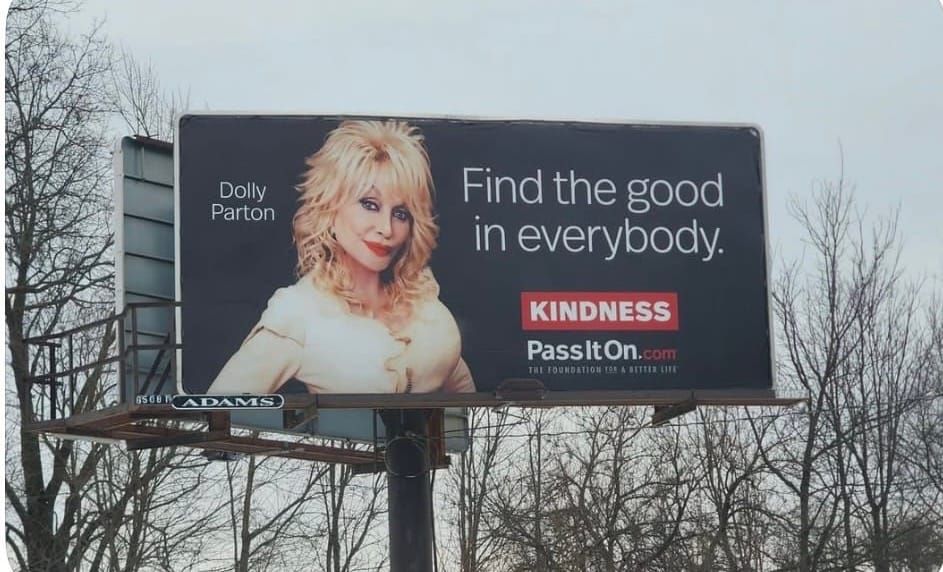
We will always love her, and there will never be another like her, this artist who came out of deep rural poverty in the 1960s to become not just a staggeringly great performer and songwriter but philanthropist, humanist, humorist, and – well there's a way she demonstrated that lots of things often thought to be opposites could be the same thing, especially if you were her. Down home and brilliant, feminist and feminine, glitter-bedecked and generous, country and cosmopolitan, funny and soulful. In her songs and interviews and in 9 to 5, the movie about workplace sexual harassment she co-starred in with Jane Fonda and Lily Tomlin, she was a hell of a feminist all the way back to songs like 1968's "Just Because I'm a Woman," with the lyrics:
My mistakes are no worse than yours
Just because I'm a woman
When I saw the first headline about her demise, it mentioned that she was eighty, and it staggered me to think that she was the same age as Donald Trump, because she was utterly profoundly magnificently opposite to him in every way. Born into extreme poverty in rural Tennessee, she made her own way with massive talent and ambition that seems never to have been decoupled from kindness and principle. Born into great wealth, he was helped along into late middle age by his father and then by his inheritance from that racist real estate tycoon father. He learned a particular kind of ruthless unscrupulousness from Fred Trump and from Joe McCarthy's righthand man, Roy Cohn, as he stumbled, failed, scammed, lied, litigated, and got picked up again and again by Fred.
No matter how rich Donald Trump is he will never have enough because the poverty isn't material, it's emotional and spiritual. In exactly the same way, Parton demonstrates that she had inexhaustible spiritual and emotional riches even as a kid growing up in a one-room shack. That's evident in her huge hit "Coat of Many Colors," about wearing, because of the family's poverty, mended, patched, patchwork clothes her mother sewed:
My coat of many colors that my mama made for me
Made only from rags but I wore it so proudly
Although we had no money I was rich as I could be
In my coat of many colors my mama made for me
She describes how other children mocked her but "And, oh, I couldn't understand it for I felt I was rich/ And I told them of the love my mama sewed in every stitch." Love might be the very essence of the difference between the two of them. The Partons were so poor that they lived in a one-room shack without running water or electricity. Her parents paid the doctor who attended her birth with a sack of cornmeal.
Albert Camus once wrote, "In the midst of winter, I found there was, within me, an invincible summer." Let winter be the inner poverty in which Donald Trump will always be stranded, that no amount of gilt tchotchkes glued to the oval office, no amount of cryptocurrency scamming will alleviate. Let summer be this immaterial wealth Parton had in who she was and how she lived and what managed to spread around in her art and her advocacy. They did indirectly interact: she twice turned down the Presidential Medal of Freedom from Trump.
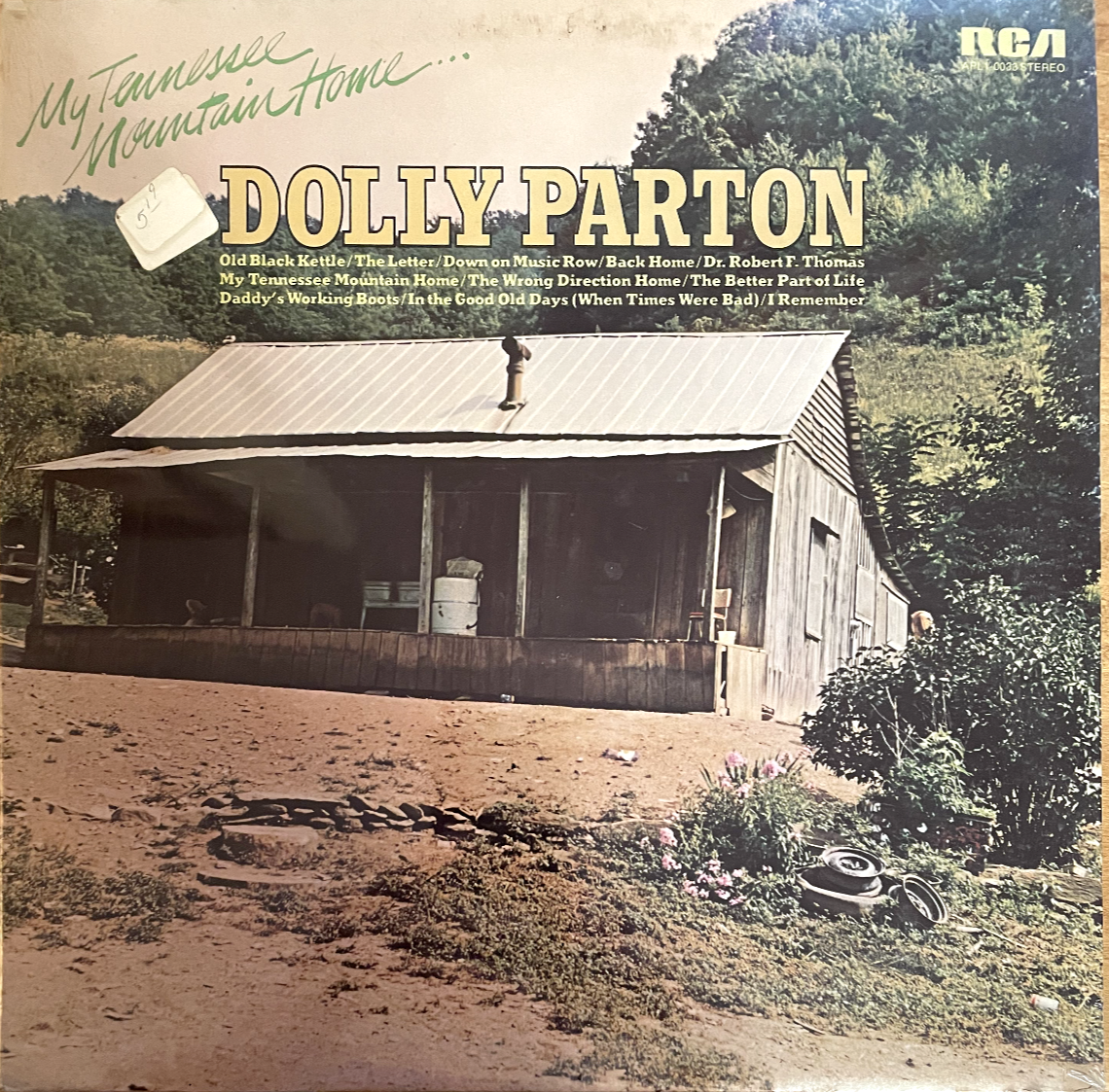
Never forget that Dolly Parton wasn't just a singer, songwriter, and philanthropist. She took stands, often in her own country way, trying to avoid what might seem like partisanship (especially since Reagan, country music has swung right and so have a lot of its audiences) and yet speaking up against racism and, in the summer of 2020, for Black Lives Matter, for queer and trans people, for women's rights. "If I hadn't been a girl, I'd have been a drag queen," she famously said and she was beloved of the LGBTQ community and made it clear she loved them back. Asked about trans women and bathrooms in 2016, she said "I think everybody should be treated with respect. I don’t judge people and I try not to get too caught up in the controversy of things. I hope that everybody gets a chance to be who and what they are. I just know if I have to pee, I’m going to pee — I don’t care where it’s going to be."
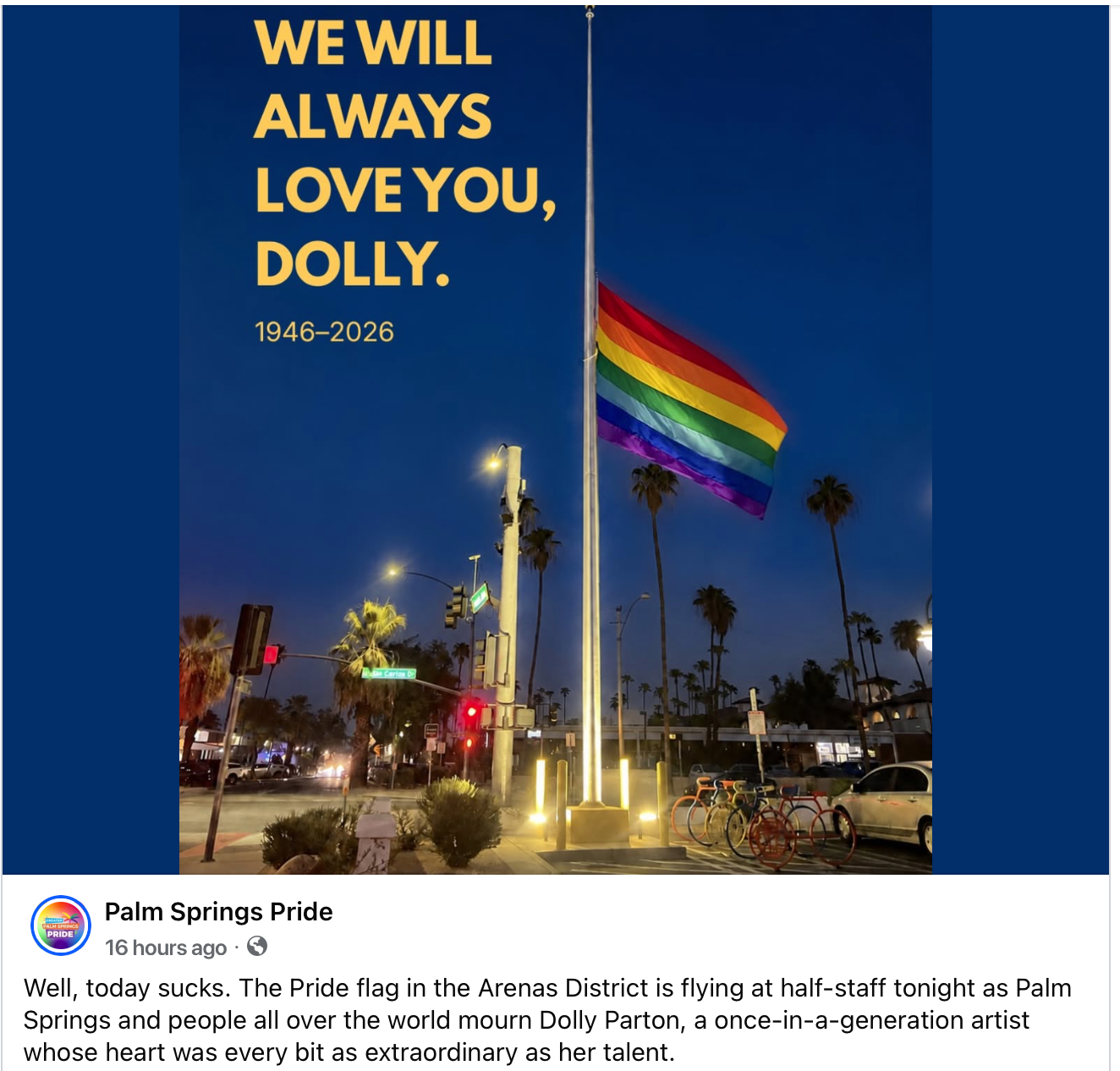
In a statement after Parton's death, singer Brandi Carlile said, "Before I met her, I loved her because she took a risk and accepted me (and all of us) for being gay in a time where she didn’t need to say anything. And she has been asked to comment and speak on MANY things over the years… choosing only to speak on that which brings love and mercy to real people, and shutting down any line of questioning that won’t. She never wavered on accepting anyone for who they were and who they were meant to be. " That love was in her interviews, her outreach, and her singing, most recently in "Traveling Through" for the trans-themed film Transamerica and the song "Rainbowland" with her goddaughter Miley Cyrus. In "Rainbowland" godmother and goddaughter sing:
Wouldn't it be nice to live in paradise?
Where we're free to be exactly who we are
Let's all dig down deep inside
Brush the judgment and fear aside
Here I want to pay homage to Miley's dad, longtime country star Billy Ray Cyrus. When the teenage Black artist known as Lil Nas X leapt from nowhere to superstardom with the extraordinary hit "Old Town Road" in late 2018, the largely white country world didn't want to recognize it as country or support it in Nashville or on the radio (it's sometimes identified as country rap). It got dropped from the top of the Billboard country charts for not being country enough, which was widely seen as meaning not being white enough. So Billy Ray Cyrus recorded a remake with the artist, in which the middle-aged white guy and the young Black guy who'd just come out as gay pair up.
Or rather in the video, Lil Nas goes solo until about halfway through. Then Cyrus pulls up in a long red convertible that sets off his fuchsia fringed cowboy outfit and takes the younger man with him while the voice on the soundtrack becomes Cyrus's for a few rounds. It's like when Marilyn Monroe got the Mocambo nightclub in Hollywood to book Ella Fitzgerald by promising she'd come sit in the front row for the shows. And then when Lil Nas X recorded one of Parton's hugest hits, "Jolene," in 2021, Dolly supported him enthusiastically: "I was so excited when someone told me that Lil Nas X had done my song #Jolene. I had to find it and listen to it immediately…and it's really good. Of course, I love him anyway. I was surprised and I'm honored and flattered." And yes, the new version didn't change genders, so it was a man pleading with Jolene not to take his man.
In 2020, she'd given Billboard her take on the Black Lives Matter protests sweeping the country: "I understand people having to make themselves known and felt and seen," she told the magazine. "And of course Black lives matter. Do we think our little white asses are the only ones that matter? No!" She added later that year, “I love everybody. And, of course, Black lives matter. We all matter. We’re all God’s children. I hope people learn to love one another a little more than they do, and if I can be any help in that respect, then I hope to be.” She joined Beyonce on the latter's countryesque Cowboy Carter album and is said to have quietly donated to support high school marching bands across the south, especially at majority Black high schools.
She had a way of treating social justice like down-home common sense. She was reluctant to seem partisan – the New York Times wrote of her a few years ago: "at the 2017 Emmys, Parton looked visibly, uncharacteristically flustered when she appeared onstage to present a best supporting actor award with her co-stars Fonda and Lily Tomlin — both of whom took a seemingly unscripted verbal swipe at President Trump. Steering the conversation back to more familiar territory, Parton did what she’s also done when some interviews have gotten too political or contentious: She pulled from her trusted arsenal of boob jokes." But overall, she managed to just be on the side of people, especially the vulnerable and the marginalized, which is to say she was on the side of kindness.
The Dalai Lama once remarked "my religion is kindness"; it was also hers (and one of the affectionately joking names for her is Dolly Lama). She once remarked, “The Holy Ghost is that part of God that lives in everybody, and the way you sin against it is by not loving everybody with all your heart, for exactly who they are.” In a lesser-known 1969 song, "Evening Shade," the kids who are being mistreated at a juvenile detention facility burn it down, and she's with them all the way:
But understanding isn't learned from punishment and anger
An iron hand has no gentle touch and love ain't learned from hate
The reason we were there is cause we had no one who cared
She was love incarnate, and though she looked like a campy love goddess a la Venus on and off the half shell, she was a goddess of the other kinds of love, of empathy, compassion, kindness, and to use a term from Thich Nhat Hanh, interbeing. "She was the voluptuous embodiment of empathy," her friend and 9 to 5 costar Jane Fonda said today upon hearing of her death, adding "To her gay and trans fans, I want you to know that she loved you." Parton was so kind she couldn't be a judge on American Idol, explaining, “If you make a mistake, it’s best that you pick it up and it turns into something positive. Sometimes the best part of my show is when I mess up and people know I’m human.”
I listed some of the paradoxes she resolved in how she lived, but one remains irresolvable: she was hugely public for sixty years while keeping her private life private, including her seldom-seen husband Carl who died last year, and never appearing without being elaborately styled in a glamorous tight outfit, full makeup, and a haystack of golden hair. "My wigs are my armor," she declared. While drag queens are most often gay men doing a glammed-up job of looking like someone else, Dolly Parton seemed like another kind of paradox, someone dressing up in drag as herself. Or a version of herself (she had to parry endless public jokes and comments from men about her breasts over the years and she did it with humor and grace).
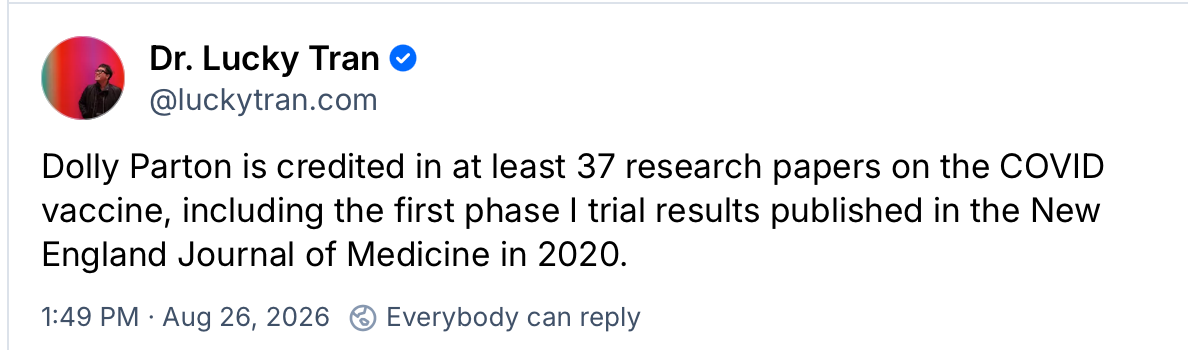
She did serious humanitarian work while cracking jokes; in 2020 she donated a million dollars for covid vaccine research and got an early dose of the resultant Moderna vaccine, which she turned into a pro-vaccine promotional event (singing, "Vaccine, vaccine, vaccine, vaccine, I’m begging of you, please don’t hesitate" to the tune of "Jolene"). She sang about poverty, heartbreak, good men and bad, about women's lives, about her religious faith, sang tragedy, sang comedy, sang manifestos, sang invitations, sang jauntily, soaringly, sweetly, unstoppably on forty-nine studio albums and nine live albums and showed up for duets with everyone from PeeWee Herman to Paul McCartney to Queen Latifah to Julio Iglesias.
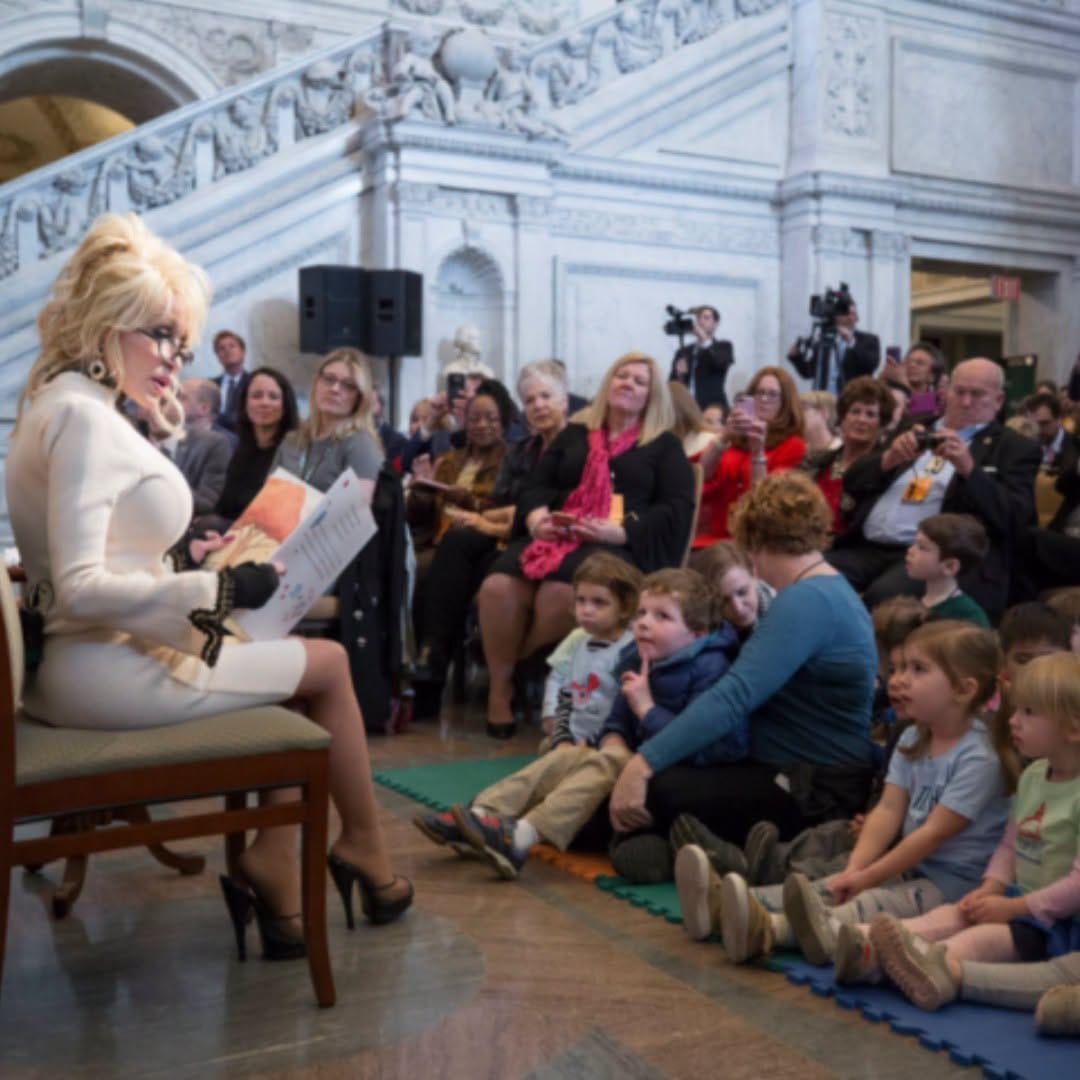
One way her impact will continue long after her is with her massive, 31-year-old Imagination Library project to bring books to small children, inspired by her father's illiteracy (and her generosity). She explained, “Before he passed away, my Daddy told me the Imagination Library was probably the most important thing I had ever done. I can’t tell you how much that meant to me because I created the Imagination Library as a tribute to my Daddy. He was the smartest man I have ever known but I know in my heart his inability to read probably kept him from fulfilling all of his dreams. Inspiring kids to love to read became my mission." It is said, to date, to have distributed 300 million books and is now in five English-speaking countries after launching in the Sevier County, Tennessee, where she was raised. Three hundred million is a lot of books and a lot of kids. The benefit of those books, even if the program stops tomorrow, will be part of the lives of its young participants for their lifetimes stretching, in some cases, into the next century. One last Dolly Parton paradox: she rests in peace; she lives on in many ways in millions of us still.
Her voice was often called angelic, and her comic timing was superb. Maybe her tragic timing was perfect. In a grim summer when the violent weather of the climate crisis and the destructiveness of the greedy, cruel, selfish Epstein class in government and tech weighed down on us all, she lifted us up as she left us by making us turn toward who and what she was. Her life was a testament to the power of love, the value of kindness, the reality of goodness among us. In the day since her death was announced, everyplace I've been was playing her songs, everyone was mourning and celebrating her and sharing stories about her countless acts of generosity. Somehow her being gone made her more present than ever in one way. In another, with her gone, it's up to us to be what she was to the best of our ability.
Thank you, Dolly Parton.