Tech Kings vs. No Kings: The Best and the Worst of Us
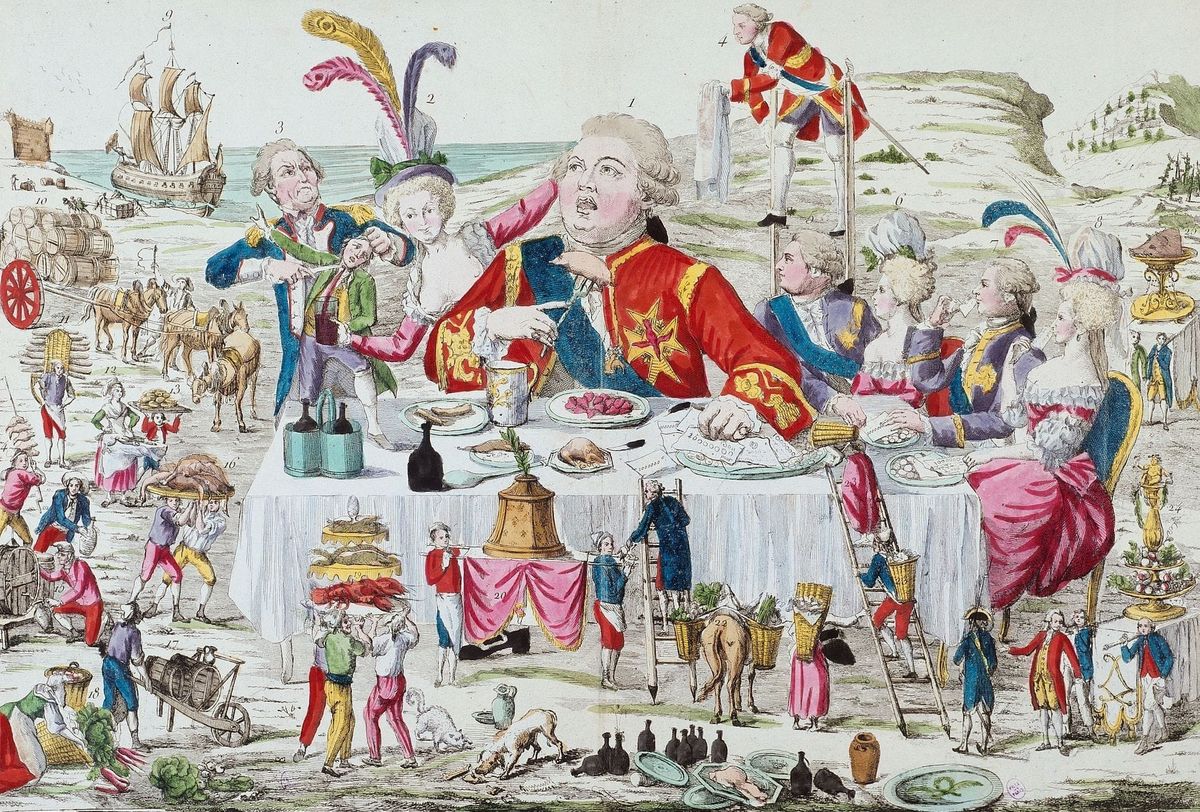
Today is Anthropic's IPO (initial public offering) in a prospectus that threatens colossal disaster while claiming they can offer us the sun, the moon, and the stars in a sort of fantasy utopia dismantled by Jill Lepore in the New Yorker. Meanwhile the Guardian reports today, "The world’s datacentres will create 70% more carbon emissions within the next four years as the US andChina turn to fossil fuels to power their AI growth agendas, according to the world’s energy watchdog. The International Energy Agency (IEA) warned that datacentres will consume twice as much electricity by 2030 compared with today, with the global expansion of artificial intelligence accounting for three-quarters of this growth." AI people seem to like the idea that their technology will be dangerous in some exciting yet-to-be-realized sci-fi movie way even while, with a massive contribution to climate chaos, they drag us all into a very familiar one.
In the wake of the election, both the best and worst of humanity is on display in the United States, and this is a bifurcated piece about both of them. First, the tech kings (but jump ahead to the #nokings if this is too dreary):
I had an online argument about the French Revolution recently, which was a waste of time like most online arguments were, but I was frustrated by people who considered it an entirely bad thing. It is true that there was a revolution in 1789 and then in 1793-4 there was the Terror, the Robespierre era when the guillotining and other bloodshed was abundant, and then came Napoleon. But it is also true that France never was an absolutist monarchy again, and that the republican spirit (in the sense of "let's be a republic and not a monarchy") remained strong in France, which had three more revolutions in the nineteenth century. The idea of the rights of man that arose from that revolution even gave rise to the rights of women, which emerged as a full-fledged movement in the USA from the women who were part of the antislavery movements of the 1830s-1850s. Those ideas of liberty, equality, and fraternity (and sorority!) spread far beyond the French borders as part of a new era in which universal human rights were seen as limiting the rights of some of us over others of us.
But in Silicon Valley's higher echelons, feudalism is popular, the idea that a small elite should govern the great masses and the great masses should shut up and be governed, or replaced, or whatever ("the network state" and other ugly fever dreams of the broligarchy emerge from that devout belief in radical inequality). And that the men at the top should be as unaccountable as any Louis XIV through, well, the Louis who turned out to be accountable thanks to the revolution that chopped off his head. Sometimes it seems like its own version of absolutist monarchy, and one example of that is the petition to reinstate Jensen Huang, who recently stepped down as CEO of Nvidia, the chip manufacturer behind the AI boom. Huang didn't just have some inappropriate sexual relationships including with a woman at tech company Megaspeed suspected of being a spy for the Chinese government. He knowingly violated a US law on selling those computer chips to the Chinese government and build up a precarious economy whose benefits go to him and his fellow oligarchs but whose collapse could hit us all.
As Heather Cox Richardson summed it up, "Huang has made it clear that he thinks Nvidia should be able to sell advanced AI chips to everyone, including China, with the argument that such sales will make the rest of the world dependent on American technology. ...such a stance is also the policy that would make the most money for Nvidia…and Huang himself. In that stance, Huang appears to have had the support of Commerce Secretary Howard Lutnick, who has refused to crack down on sales of Nvidia chips to data brokers like Megaspeed, which take advantage of a loophole in the law that prohibits sales of the chips but does not stop Chinese firms from renting the chips f rom data centers in Malaysia, Indonesia, and Thailand. The Biden administration tried to close that loophole, but Trump revoked those rules, saying they stifled innovation. Ana Swanson, Aaron Krolik, and Paul Mozur of the New York Times reported yesterday that Cantor Fitzgerald, the financial firm formerly headed by Lutnick and now run by his sons, is invested in those data centers in Southeast Asia that serve Chinese customers."
Richardson notes that "Trump has also sided with Huang," and Trump himself previously held a lot of shares in Nvidia. I am neutral about what the US relationship to China should be, but not neutral about the near-merger of Silicon Valley and the Trump Administration. The AI boom that is widely thought to be a bubble has not only propped up the US stock market during Trump's second term but siphoned off investment in other industries, and the chumminess with Trump has helped underwrite this distortion. It's a merger of corporations and government that is typical of authoritarianism, which routinely sabotages the public good for private gain.

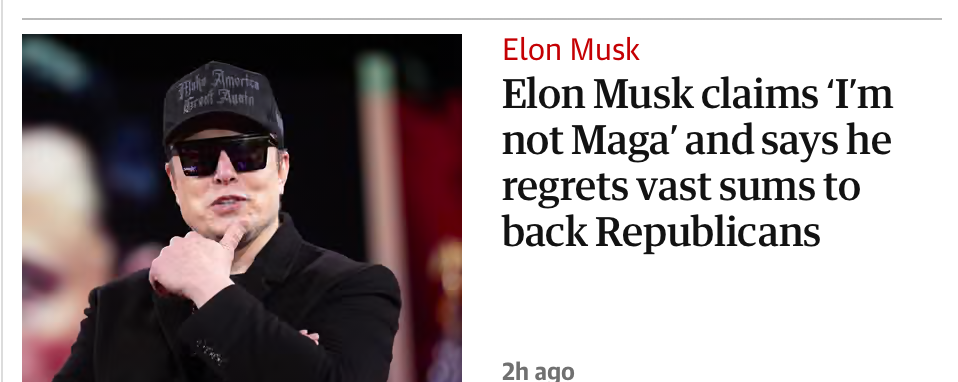
Meanwhile a petition (shown above) was launched to reinstate Huang by someone who knew where the oligarchs hang out. The first name on that petition is Elon Musk, who has made much of his obscene pile of money off the US government with SpaceX and StarLink. They have given him power that should never belong to individuals – as demonstrated by his return to manipulating StarLink in ways that impair Ukrainian efforts in the war with Russia. Musk too, after a spat last year, is in Trump's good graces. The Guardian reported, "Ukraine’s military has suddenly had its access to Starlink satellite internet terminals restricted as theTrump administration has increased pressure on Ukraine to halt long-range strikes on Russia’s oil industry immediately. The terminals, which are produced by Elon Musk’s SpaceX but managed by the US government, are a key component of Ukraine’s military operations and the sudden restrictions on the terminals travelling at high speeds on Tuesday evening led to the failure of several combat missions."
That was because Trump started an idiotic war against Iran which led to the shutdown of the Strait of Hormuz which led to a global oil crisis which led Trump to think he could make up the shortage with Russian oil, which made him yet again in his years of wavering between sides favor Russia and its authoritarian leader again. Trump's pointless, degrading summit with Putin and China's Xi Jinping seems like he's going to his authoritarian safe place after being threatened by a surge of democracy backed by a belief (see: revolutions, eighteenth-century) in certain inalienable rights. Or maybe it's not pointless since the three seem to be orchestrating an assault on the United Nations.
Just a little further down the petition to reinstate Huang is Travis Kalanick, who some years ago was himself forced to resign as Uber's first CEO after a series of scandals, including sexual harassment and abuse and inequality inside the firm, Kalanick's own sleazy sexism, and a plethora of rapes by Uber drivers, as well as scummy business tactics. Inspired by the French Revolution, which she witnessed herself, Mary Wollstonecraft (mother of the first great science fiction writer Mary Shelley) wrote A Vindication of the Rights of Woman, published in 1792, but a lot of men have not yet gotten the message that women have certain inalienable rights. Of course like so many vile high-profile men, Kalanick landed fine and is the head of some other tech enterprise.
These men seem to be gunning for a world without consequences for elites like them, which might be part of why they get along so well with the Trump Administration with its policy of zero accountability for the big boys. The Trump Administration does not believe in universal human rights, to say the least; it's an ancien-regime attempt to reinstate an era when some people had absolute impunity and some had absolute vulnerability to being gunned down on the street, sent to an overseas gulag, or dumped in a country they'd never been to before. It's Wilhoit's law taken all the way back to the era of lords and serfs. Wilhoit wrote, “Conservatism consists of exactly one proposition: There must be in‑groups whom the law protects but does not bind, alongside out‑groups whom the law binds but does not protect."
Sam Altman, head of OpenAI, said of Huang that he has "strong personal empathy for the Nvidia head and that he has “long been a hero of mine. Heroes have flaws.” Flaw is one way to describe sloppy sexual activity in the workplace while handing power to the totalitarian Chinese government while also building a house of cards that could bring down significant parts of the US and international economy. Of course Altman defends him because the bubble that is AI is also a circular Ponzi scheme. The key companies invest in each other; the circulation of each others' money make them look more viable than they really are the very short explanation. Nvidia is financing OpenAI, notably for a mega-data center in Ohio. In other words, Altman, who was fired from that company for being an untrustworthy little goblin in 2023, then reinstated in a coup against the board, is, unsurprisingly, a monarch who supports monarchy.

The Bloomberg sub-headline about "cascading losses if AI falls short of its potential" leans hard on the "if." lot of experts think it's likely in that the demand for AI has been overestimated, between the way the products are often ineffective (read: stupid, insane) in business, while much of the public has turned against the AI industry and its invasive data centers. The Guardian notes of OpenAI: "The startup is nowhere near being profitable. In fact, if things stay as they are, it will burn through half a trillion dollars by the end of the decade." Ed Zitron, an independent journalist focused on AI finance, says "'Whatever value you may or may not think AI has, it is not paying for itself. It is a continual drain on the debt markets and the venture capital industry." As the director of a recent AI documentary put it, "The entire economy of AI is being propped up by a Ponzi scheme. The hype of this technology is unlike any hype we’ve seen." And you and I and the rest will likely be left with the mess.
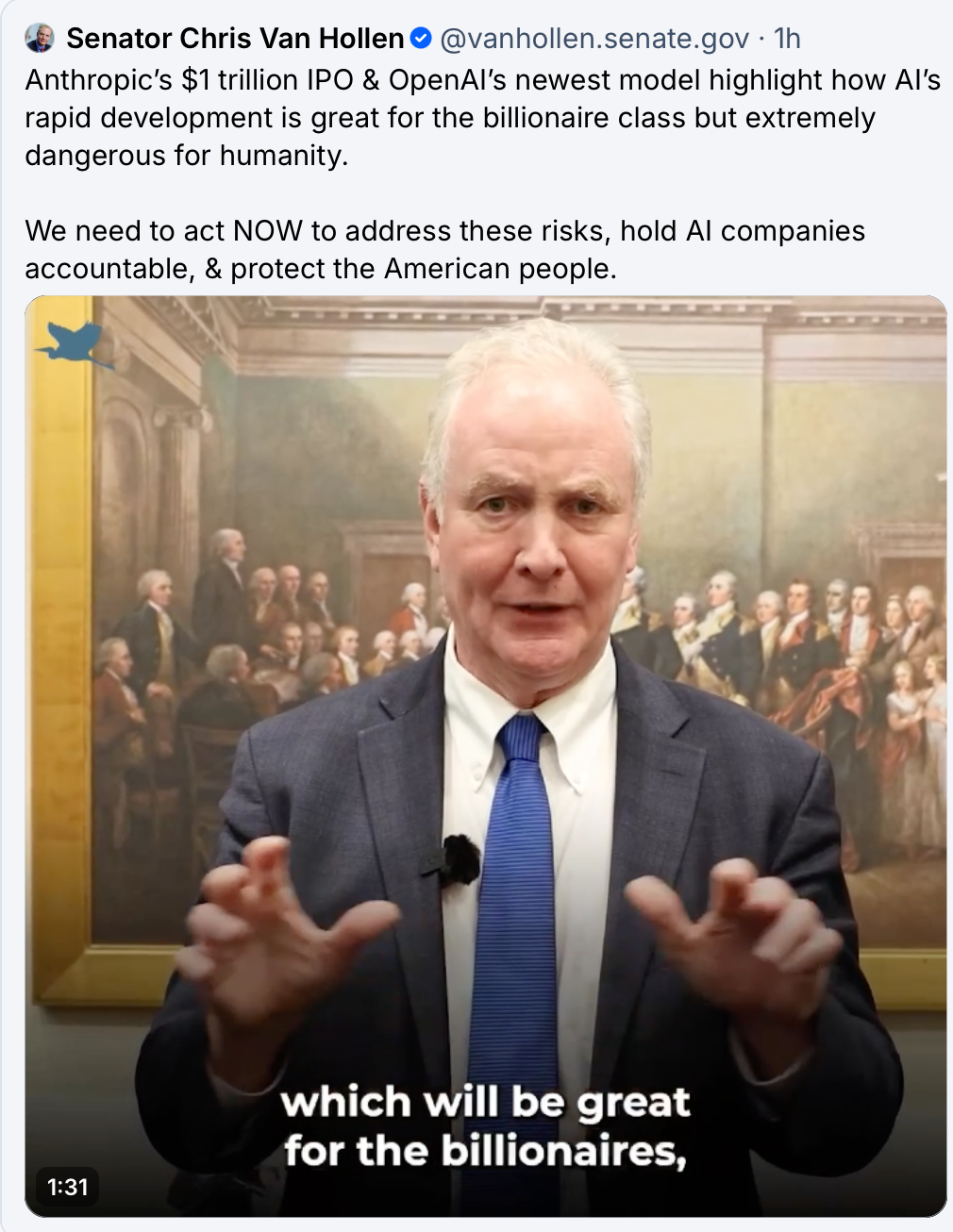
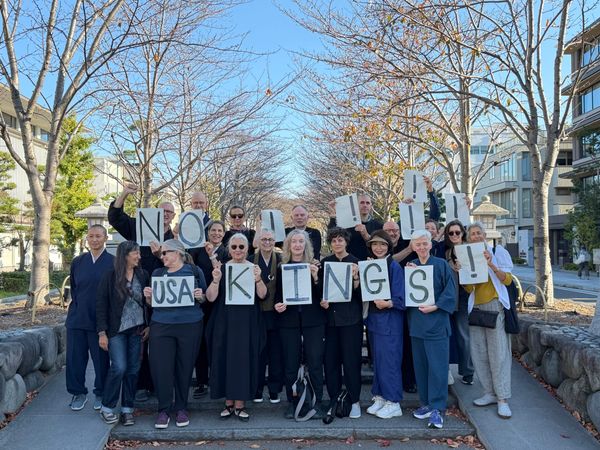
No Kings
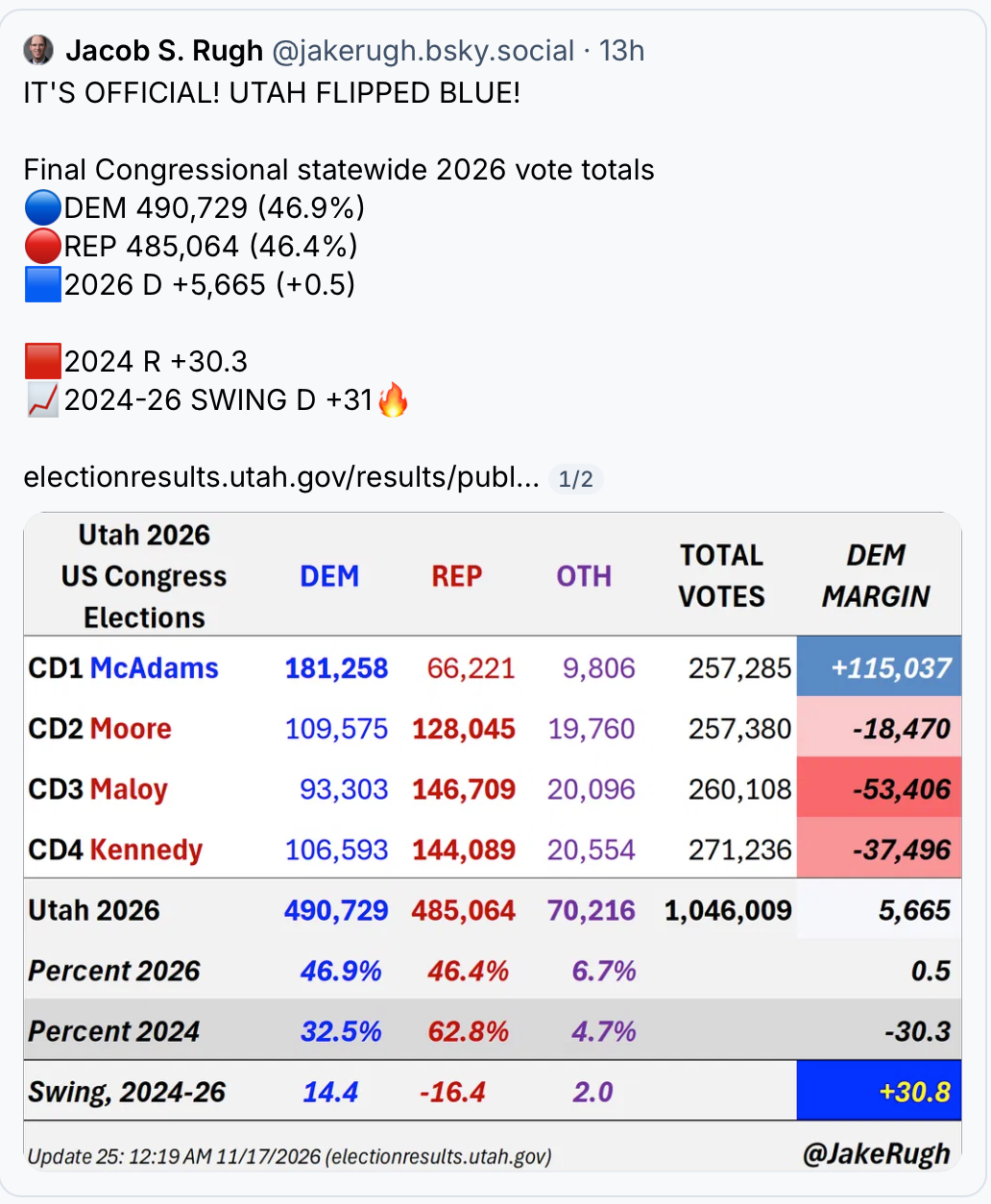
Now that I've squandered some attention on the worst people imaginable, let me say a word or two about the best. I am still overjoyed about this election whose results continue to unfold – Mary Peltola just officially won her seat in the senate thanks to Alaska's long process of counting the votes. The final tally on Utah's election shows that a majority of votes in that state, astoundingly, were Democratic, not Republican (but how they were distributed means that the state is still sending three Republicans to Congress – but it used to be four) and if this majority holds and grows Utah's future could shift from fuchsia to violet, anyway. There are so many stories like this, showing a country whose people were held back by all the forces of anti-democracy broke through to move the country forward in a seismic jolt.
This week, two stories that moved me testified to the people who kept the faith and continued to work for what they believed in when achieving it was supposed to be impossible. At the Atlantic, Ko Bragg writes of Senator-elect Scott Colom's extraordinary victory in Mississippi, declaring "this win is the product of decades of uphill, incremental, thankless, and overlooked labor powered by an ancestral charge and a conviction to reclaim Mississippi. ... The state’s “faith tradition” that Colom evoked is as much about prayer as it is about remembering generations of bloodshed in Mississippi, where Black voting rights were redeemed by those who could only dream of what Colom has now achieved: finally turning his home state blue. “There were times when I was tired, and I felt like I couldn’t keep going, but I kept the faith,” Colom said during his victory speech Wednesday night. “And that is another tradition of our state. There’s so many people that had faith in Mississippi at times where it seemed impossible.” Later, he writes that it wasn't Colom alone who achieved this victory, "Colom’s win was propelled by grassroots organizing to register voters, get them to the polls, and, in some cases, help them return to certify or cure provisional ballots. "
At Vanity Fair, Ta-Nehisi Coates interviewed Stacey Abrams, widely regarded as the strategic genius behind the huge wins in Georgia and beyond. What she said is so remarkable as a demonstration of brilliance and perseverance that I want to quote it at length. She told him:
The US census is a tool that is incredibly powerful and deeply inexact. It was the first time Republicans had power to draw the lines since Reconstruction. And I took a posture in my caucus, and it was this: “If you vote for their maps, I will come after your seats.” And I was not only unequivocal in saying it, I wrote it down because I didn’t want anyone to misquote me.
In order to take that posture, I had to read the maps myself. And what I saw was that Republicans were placing bets that, by drawing the lines a certain way, they were going to give themselves 124 of 180 seats. So 67% of the seats, even though they’d only won the election by 57%.
But I looked at those same maps and I’m like, In this place, in this part of Paulding County, there is a new subdivision that is predominantly Black. And in this part of Gwinnett County, there is a burgeoning Korean population that is now going into its second generation, which means a lot of those will be eligible voters. And down in South Georgia, you have third-generation migrant farm workers who are Latino, but who have decided to plant their roots here and raise their families here. When you looked at those numbers, the maps had a very different story to tell about Republican dominance: They could win for a decade. They could not win for a generation.
I love that some of the success she brought about came from careful reading of the maps, from going down into the details, and from seeing that, so to speak, the arc of justice is long but it bends toward more complex demographics. Later she says, "There are not enough Black people to win any single seat outright on their own in most legislative districts, and no statewide elections, especially post–Louisiana v. Callais, but there are coalitions that can be built. And what I saw from the very beginning was the possibility of coalition." This must be the future of this country, which took a great leap forward to its multiethnic, multi-faith, nonwhite majority future with this election, at least in the Democrats sent to Congress (Republicans mostly elected white guys again, as part of their commitment to be the party of the past). A great leap forward for women too (and a referendum on data centers: USA Today reports: "Exit polls from NBC News found that for 56% of voters, AI and data centers were a "crucial or major factor" in their vote for Congress. And about 76% of voters said they would oppose the construction of new data centers in their communities.")
At the heart of these portraits of Colom and Abrams is heroism, solidarity, generosity, wholeheartedness: a commitment to the well-being of others above and beyond what they themselves may live to see and benefit from. By this I don't just mean Colom and Abrams; I mean the many who came before them, the many who worked with them, those who not just for decades but centuries held onto the dream of a better, more just society where universal human rights and voting rights were a reality. Seven years ago Nikole Hannah-Jones wrote in the preface to the 1619 project, "Our democracy’s founding ideals were false when they were written. Black Americans have fought to make them true." She means that the founding fathers didn't really support universal human rights and equality in practice, but their ideas were seized by others who carried them forward. And who continue to carry them forward, because that was on the ballot. We won big in that election, in a grand repudiation of Trumpist authoritarianism and inequality. May it give us the power to manage the next threats, including the recklessness of Silicon Valley and the related catastrophe of climate change.
Anthropic's IPO claims its technology “could rapidly accelerate scientific innovation, greatly increase economic growth rates, bring cures for major diseases within reach, and solve problems that have resisted generations of human effort.” This is the kind of slopaganda Silicon Valley specializes in. The economy is liable to be trashed by corporations like Anthropic. Scientific innovation would be doing much better in the USA and beyond has its oligarchs not gotten behind Trump and his attack on science, including massive cuts to scientific research and higher education in this country as well as attacks on foreign students, research within the government, and scientific principles in everything from environmental stewardship to human health (hello return of measles, hello climate denial).
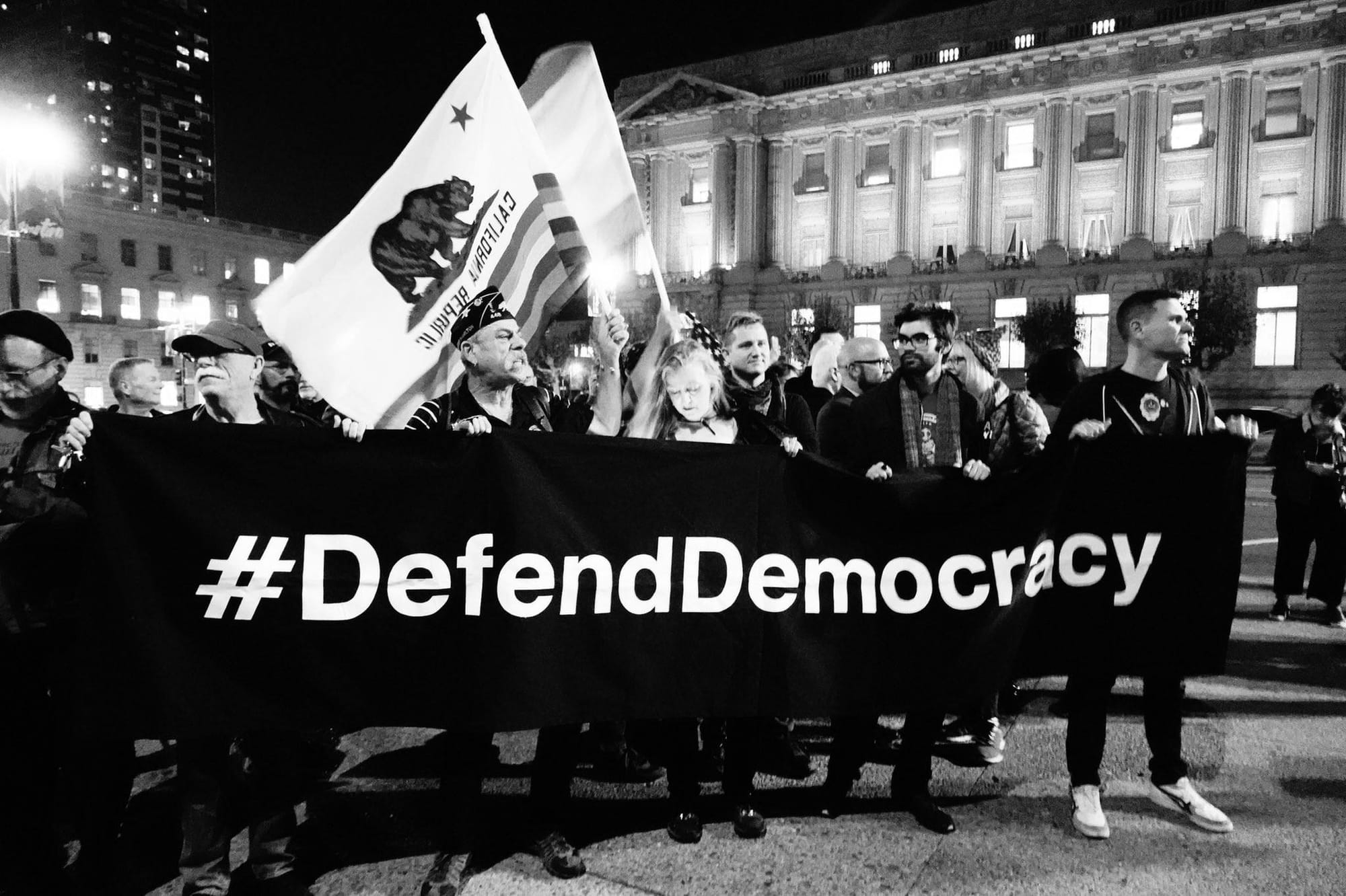
So many of our problems are solvable and so many of us want the solutions AI is not reaching for – economic equality, universal healthcare, a swift transition away from fossil fuels. But it's the oligarchical minority who obstruct it; they are as usual the problems pretending to be the solutions. The AI overlords are forever justifying their climate destruction via data centers with claims that somehow AI will then "solve" climate change, which is already solved. We have the solutions. We have had them for a long time. We just need to remove the obstacles to implementing them, and they are among those obstacles. In the fight for democracy and human rights they remain on the side of monarchy. May our successes in the recent election strengthen us to take on this other trouble, this other illegitimate power. #nokings
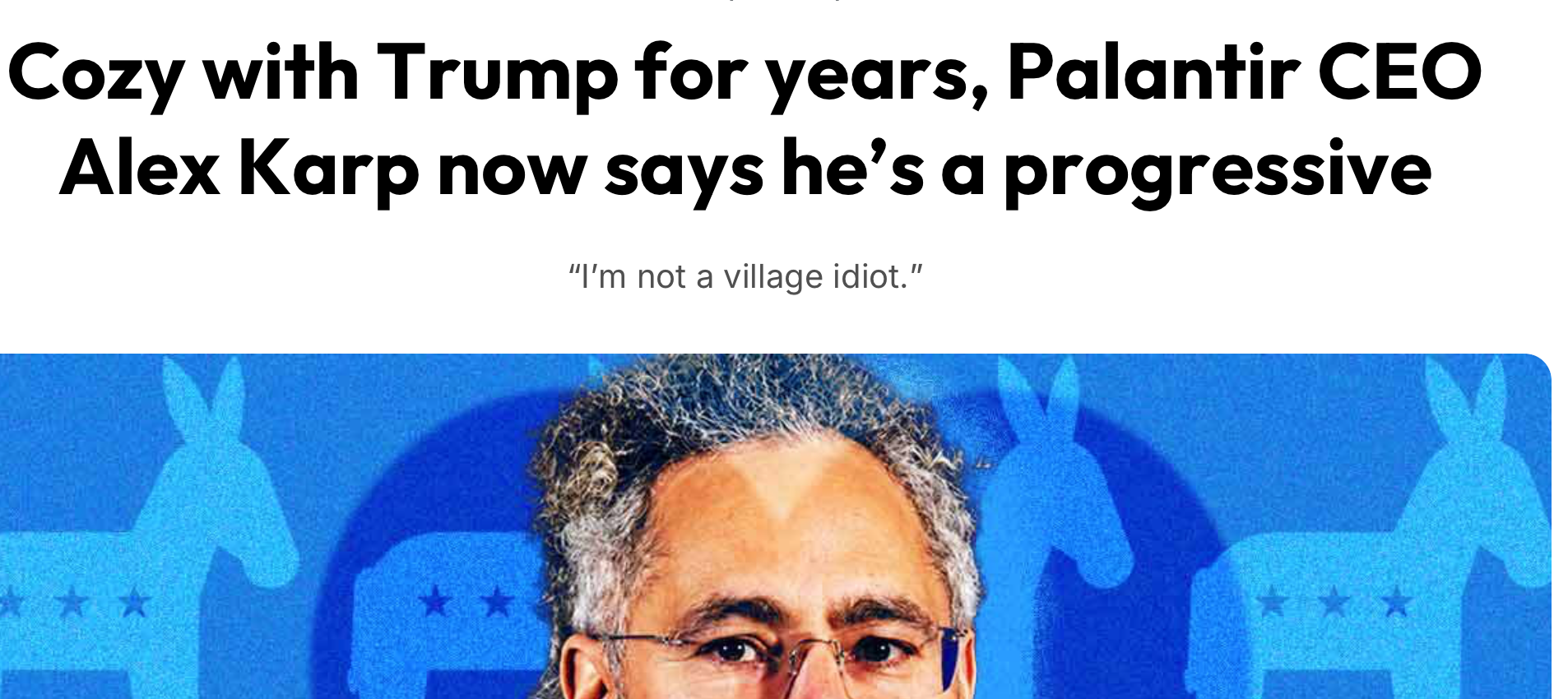
p.s. Snapshots from the rats/sinking ship department (but remember they are always remain on the same side: the side that is themselves and their profits and power).