To Starve a Whale: Letter from a Hot Planet
I've gotten tough or resilient or case-hardened to the ugly things I read up on daily as part of my writing and civic life. Some of them, the amoral destructiveness of the tech industry and the Trump Administration, often appear in impersonal terms, as statistics and economics posing a fairly abstract harm or as lies, threats, boasts, representations of an aberrant worldview. Other kinds of news, especially violence against women but also the refugee crisis, the mass murder in Gaza and the invasion of Ukraine, are visceral, personal, about what happens to bodies, could happen to any body, to my body and yours, but I'm used to living in a barrage of human-on-human brutalities. I do sometimes wonder what the steady diet of horrendous things men have done to women has done to me one the decades, but I persevere. I read a lot about environmental destruction as part of my climate work, some of that also cast as statistics and scientific facts, or as theoreticals about future losses, and I'm still fine.
But then there's the ocean.
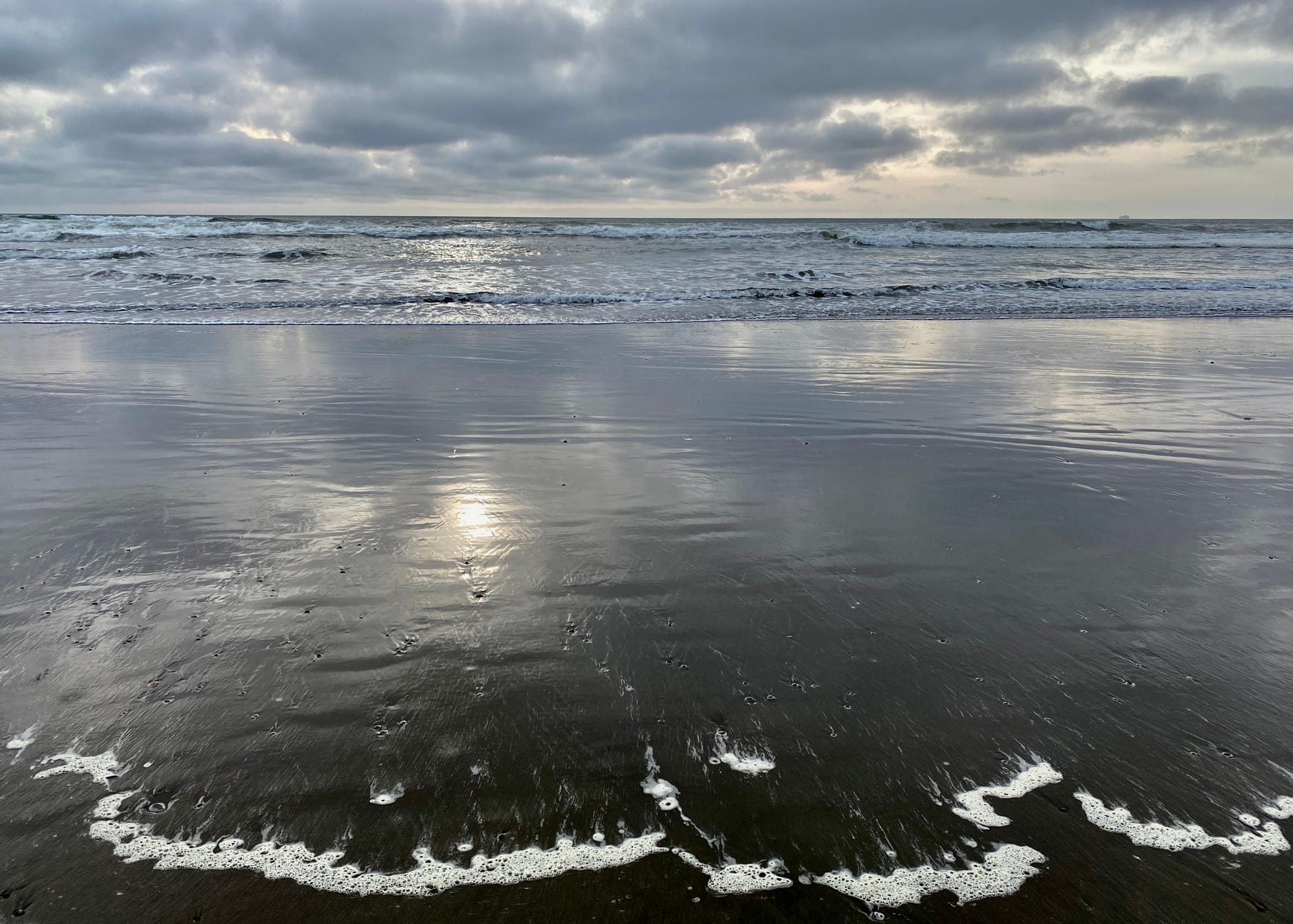
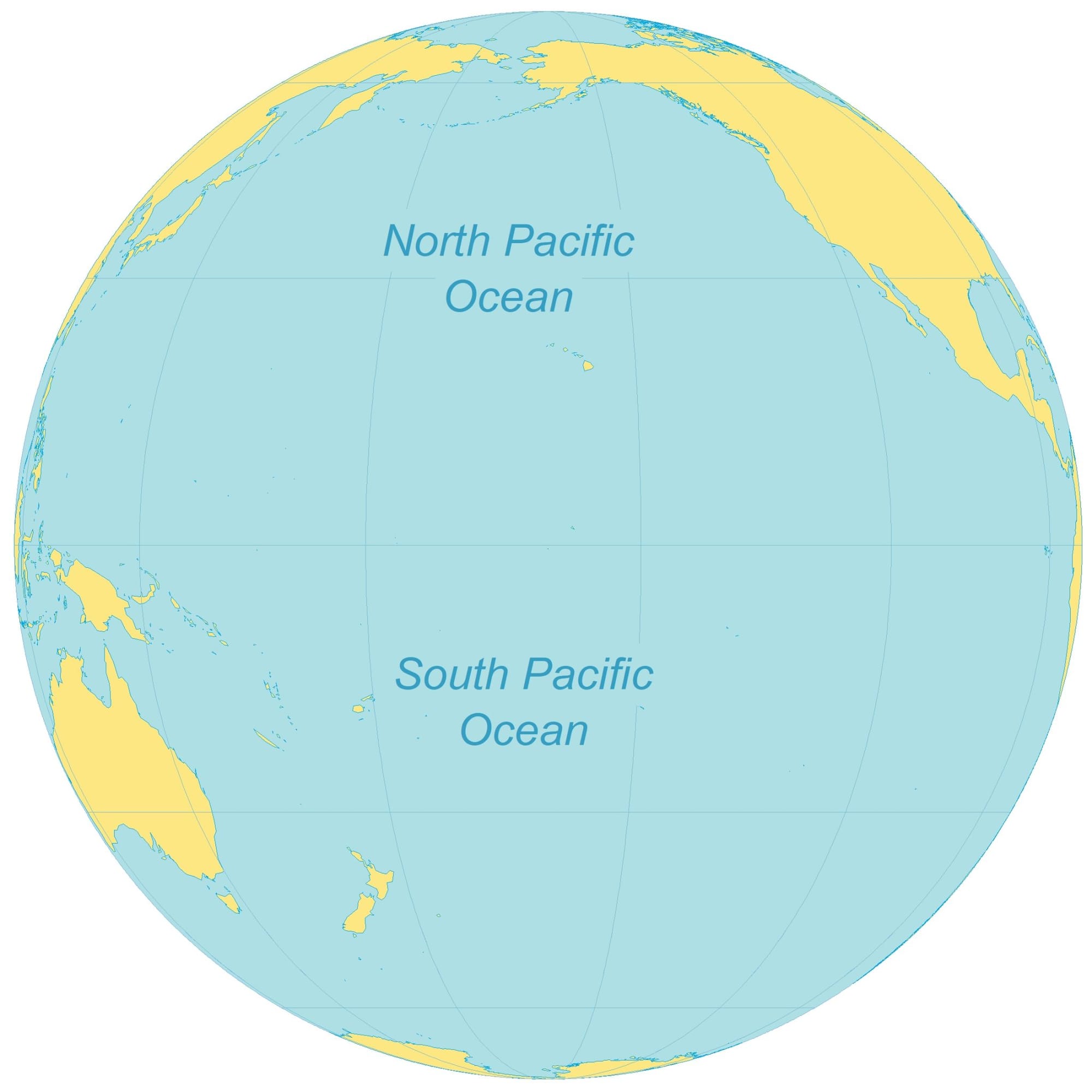
I've lived nearly all my life in coastal California – in the north bay as a kid, near the wetlands where the Petaluma River comes out into San Pablo Bay (the northern half of San Francisco Bay). I've lived in San Francisco since I was 18, and last week, when a foreign journalist asked me why I live in a city when I love and write about nature, I pointed out my city is bordered by salt water on three sides, that a mountain lion was just captured a couple of blocks away from my old home, that coyotes and hawks are regular sights. The west coast of San Francisco between the cliffs of Land's End and the city's southern border is several miles of sandy beach, where, I have told myself for decades, the entire project of western civilization comes to an end and the vast wilderness of the biggest ocean begins, a lovely reprieve I visit often. I lived in an apartment facing the ocean for part of the pandemic, and while I did, I liked to say that my front yard covered two fifths of the planet.
I've also often said that the only true borders on earth are between land and water, and those are mutable, shifting, a meeting place as much as a marker of difference. The edge of the sea has always spoken to me of eternity and infinity, of a rhythm that is ancient and unstoppable of lunar cycles, tides, waves, of a vastness like no other on this earth but the sky. I've gone there for sunrises and sunsets and comforted myself, thinking of climate, that we will still have the unstoppable beauties of the elemental world no matter what we do to the biological. I've gone to it for refuge again and again and joke that it's my real mother. We did, after all, emerge from the sea, where life began.
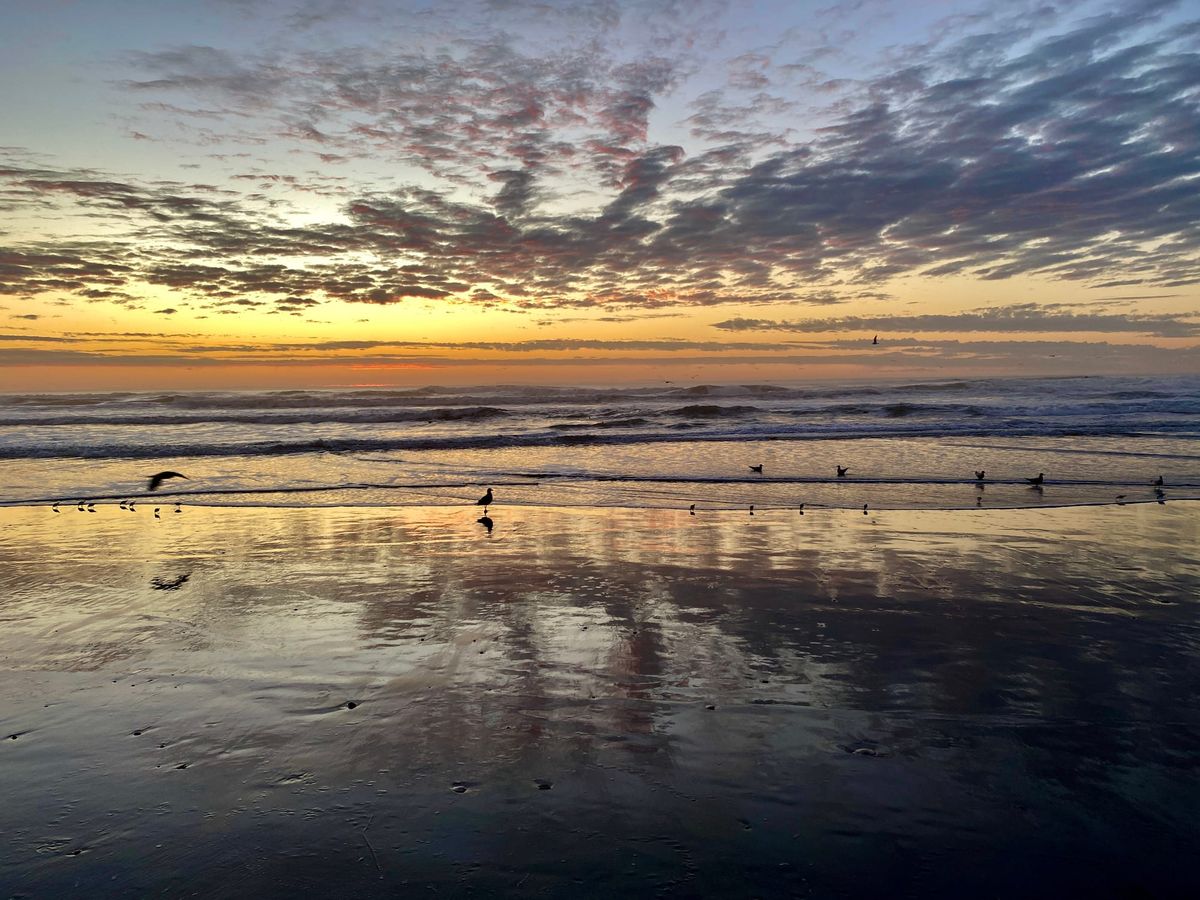
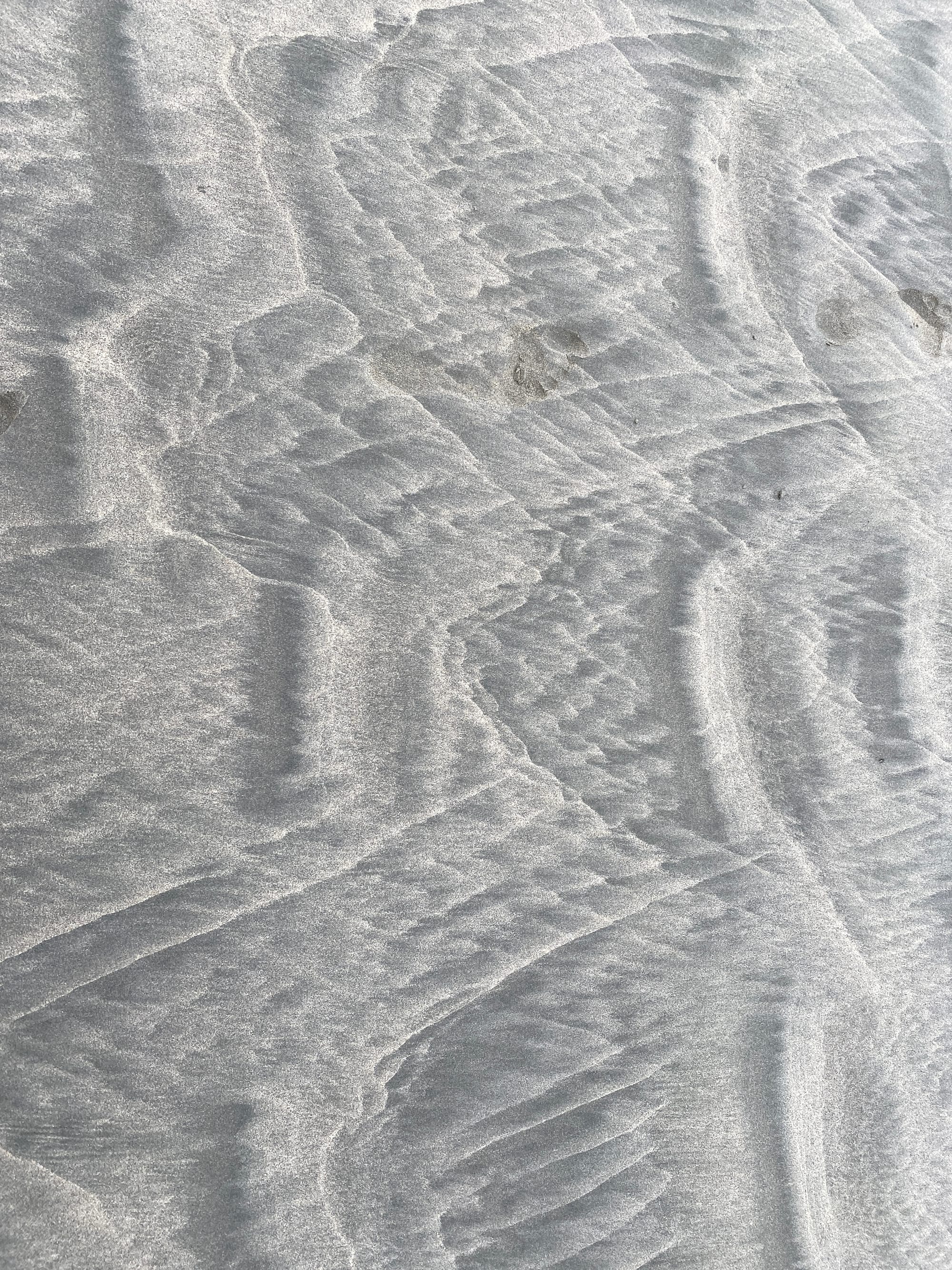
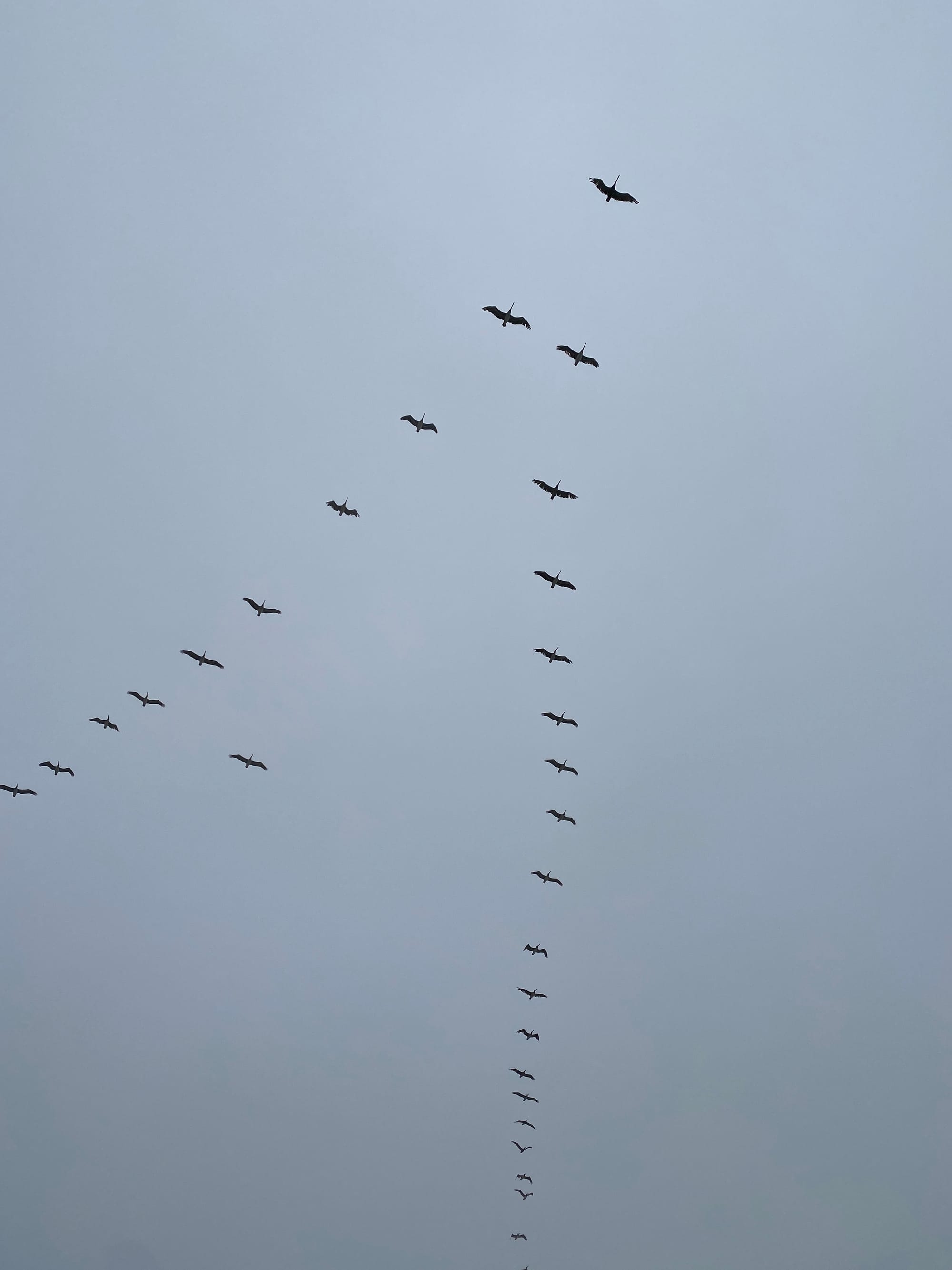
I've seen whales from land, migrating along the coastline, seen countless times the flocks of sanderlings wheel and pivot and land again and again as they feed along the shoreline, the brown pelicans flying in formation, once a great flock of terns, so many other birds, seen surfers and picnickers and sandcastle builders and fellow runners and walkers. That edge is also a sort of slate washed clean twice a day by tides on which birds and humans and the winds and tides themselves inscribe their movements. The elaborate patterns in the sand as wind and water sort the lighter and darker grains have been one of the beauties I attend to out there, along with the alluvial-fan drainage patterns that look like drawings of trees in the sand.
To go back to the sea again and again and find that whatever else is going on on earth, the moon still governs the tides, the waves still run on their own schedule, that there is a liquid realm that even when we wade into it or swim or surf or set out to sea remains somehow beyond all our human mess and muddle in some ways is a reassurance, a promise that something will always be beyond.
While I read constantly about climate, including climate disasters of heat, flood, drought, fire, of destroyed places and human deaths, somehow the stories about what we're doing to the sea disturb me most of all. Perhaps because it feels as though this should be beyond our reach more than the land, for we are land animals. Perhaps land-based climate disasters seem more local. Even the biggest wildfire is measured in acres or square miles, while ocean acidification is about much of the surface of this watery planet. What goes wrong in the ocean goes vastly wrong; it shows how far our mistakes reach.
Much of the excess heat we've produced by burning fossil fuels has been taken up by the oceans, as if shouldering the burden for us, but it has made them too acidic and then too hot. Part of why we don't realize the full impact of what we've done is that much of it is hidden as that heat in the waters (and by the plant kingdom sequestering a significant percentage of the carbon dioxide we produce, likewise cleaning up after us). The menacing super-El Nino weather coming this winter is because of this heat. In a sense heat itself is a kind of garbage we're dumping offshore while we dump the carbon dioxide in the upper atmosphere. Hurricanes, cyclones, and typhoons also arise from heated ocean waters, and climate change makes them stronger. It's seen as a major factor in the unprecedented impact of Hurricane Helene two years ago this week, which reached all the way into western North Carolina where it dumped 30 inches of rain in some places and trashed tens of thousands of homes, some of them permanently abandoned or still being rebuilt. All this violence killed more than 250 people.
For a couple of decades, Ocean Beach has also been the place I go with one of my closest friends when he returns to this city he used to live in. We've run, walked, strolled, talked for miles and miles in all seasons, through all sorts of life events and creative projects to be talked over. Last week we went there again. The shore is always a death zone of sorts, where sea creatures wash up out of their habitat already dead or die stranded on the sand, and land creatures drown, and a feeding zone so important that there's a whole group of birds known not as seabirds but shorebirds, including stilts, avocets, so many kinds of gull, sanderlings, and snowy plovers (which are severely endangered but nest in the dunes above Ocean Beach).
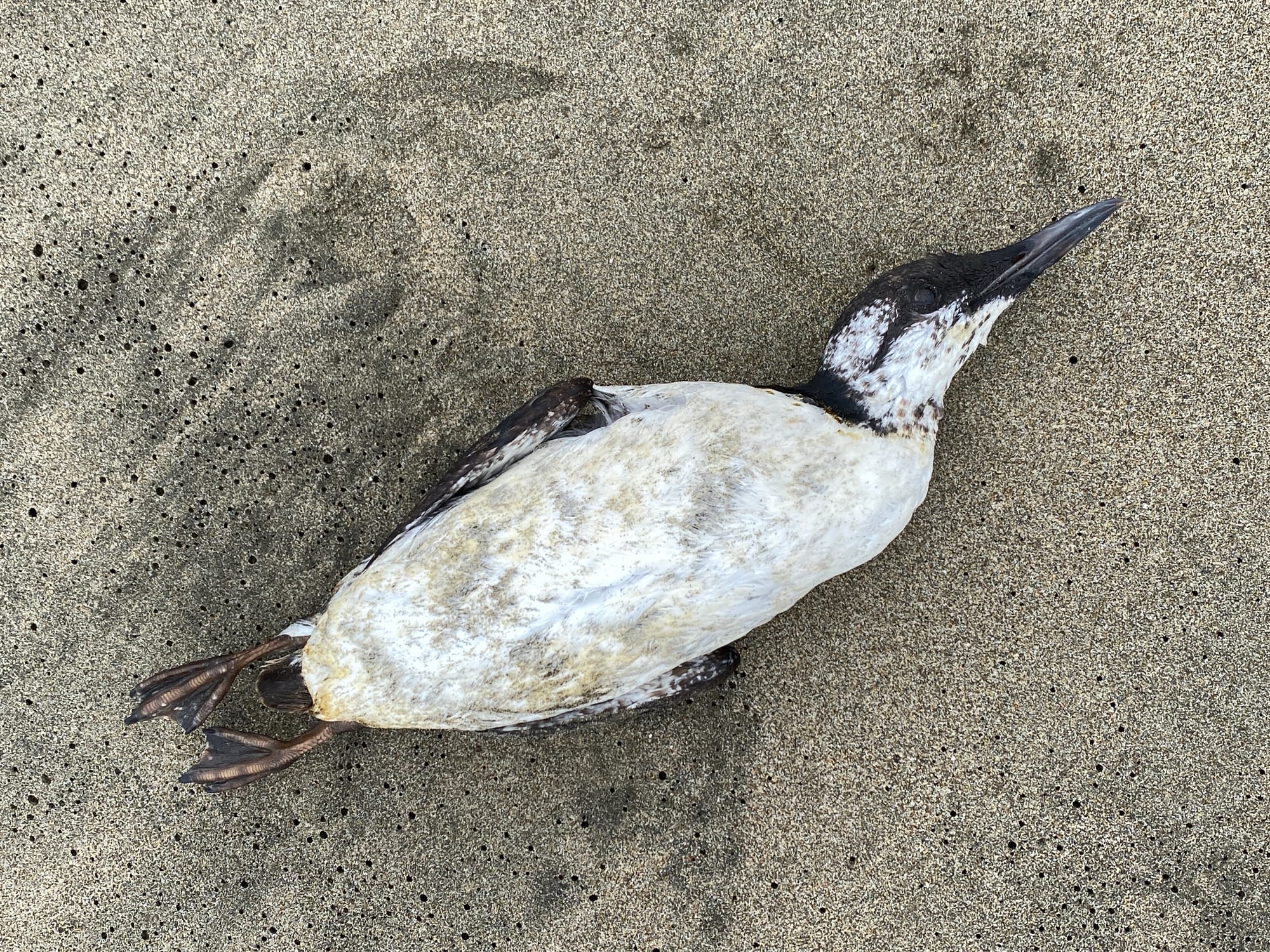
It's a liminal space where worlds literally collide, a space of abundance for both life and death; I've seen dead sturgeons, sea lions, bits of a 19th century shipwreck, dead birds, so many sand dollars, countless scuttling and deceased sand crabs, Dungeness crabs in every stage, including being released by crab fishermen, pecked at by gulls, and dismantled into stray claws and shells, miles of tidelines cluttered with those little translucent-and-blue jellyfish-like by-the-wind sailors. But on the walk with Sam we saw a dead bird and then another and then another and another and then a tiny dead dolphin with its eyes pecked out, a dead sea lion, and another bird corpse and another. There must've been a dozen on our long walk along with the dolphin. That was not normal.
They were murres. The local CBS affiliate put it this way: "Visitors to Bay Area beaches are starting to see a disturbing sight: dead and dying seabirds. They're called murres, and wildlife rescuers are scrambling to try to save them as they fall victim to a rapidly warming ocean. The birds, which resemble tiny penguins, are starving because the water has warmed, increasing the metabolism of predator fish, making them hungrier. That puts them in competition with the murres who can dive to depths of 300 feet to hunt." The ocean is a fine-tuned orchestra of processes organic and inorganic, and the temperature changes are devastating, turning its symphonies into discord and destruction. I go to the coast, in a sense, to go for peace; to find the casualties of a war there was distressing.
It gets worse: the Guardian reports, "Climate change is driving a gray whale “catastrophic mortality event” in the Pacific Ocean as melting sea ice depletes food sources and the animals starve, environmental groups warn. Meanwhile, a range of other issues, like ship strikes, oil spills, microplastic pollution, algal blooms and Russian harvesting are also probably contributing to the die-off that has nearly halved the whales’ estimated population. It fell from 20,000 in 2019 to fewer than 13,000 this year, and the deaths appear to be accelerating. The gray whales, which travel from Baja California to Alaska to feed each year, came close to extinction in the 1970s, but rebounded following robust conservation efforts.... The average annual number of gray whale strandings from 2006 to 2023 was 43, but rose to 179 in 2025. Through the first half of this year, 146 whale carcasses have been directly counted. The whales that wash up are emaciated, Steiner said, and the scientific consensus is that they are starving due to a loss of access to food sources that is driven by the dramatic reduction in sea ice around Alaska due to climate change." The verb strand comes from the noun strand, a synonym for the shoreline.
To starve a whale is a crime against nature that staggers the imagination. Whales seem akin to gods to me in their vastness, their mysteriousness, their still unfathomed intelligence, their use of language, these hugest of mammals who evolved with us on land until they turned around and walked back into to the waters that let them become massive beyond any other animal ever on this planet. Gray whales, like humpback and blue whales, are baleen-equipped feeders, aka the ocean itself is a soup they sip from, their baleen a filtration system that lets them keep the tiny solids they strain out. For them to starve speaks to the disruption and impoverishment of the formerly superabundant microscopic life in the Arctic and elsewhere. It speaks of human beings doing things we have no right to do (though here it's always worth noting a lot of human beings in the global south have very modest impacts and the majority of people on earth want to see climate action; most of the blame belongs to the powerful minority who are obstructing the energy transition and other appropriate reactions to the crisis).
The destruction of the White House east wing disturbed me even though it didn't involve the suffering or have the impact of, say, ICE kidnappings or wildfires. We have a kind of map of the world in the background of our minds, a map with fixed points we orient ourselves around, things that seem permanent or stable, and that includes laws, institutions, and norms, as well as places (some norms should be messed with but that's the subject of another essay). And then there's nature which until we became capable of breaking it, seemed like the whole stable background against which our merely human dramas unfolded. It's 64 years and two days since Rachel Carson published Silent Spring, most Americans' first wakeup call that nature was not a stable background but a destabilized and threatened system, one that could get better or worse. Carson's book had positive consequences, and those lines of brown pelicans that fly above the waves at Ocean Beach are among of them, because they were one of the species devastated by DDT. There have been campaigns for whales so epic that "save the whales" is tattooed on many of our memories of the 1970s and 1980s.
I have come to understand relatively late in all this climate work of mine that one of the major ways climate chaos manifests is as water: too much, not enough, in the wrong place, at the right time, or missing from the right places. Suddenly appearing with brutal violence, as with the glacier collapse in Nepal a few weeks ago, out of season as with New Mexico's monsoon rains that hardly came at all when they should in July and August and have been coming with a vengeance in September. I will say that sometimes I see stories about what's going wrong in the ocean and say to myself, I don't need to read that because I'm already a climate activist/ donor/ journalist/ board member, already doing what I can to forestall it.
But sometimes I'm not reading about it; I'm finding it in the place I have sought refuge all these decades. When bad climate news comes up in conversation, I joke to my colleagues, "Maybe we should be climate activists?" We should. For the whales. The birds. The people of Nepal, Bangladesh, Bolivia, of North Carolina, Alaska, everywhere. The great grand symphony of life. But this wasn't the news. It was my refuge, full of corpses, murdered by climate change and its perpetrators. I usually write essays here and elsewhere that wrap up with solutions and possibilities, and this is not one of them today. It's just an account of where trouble found me or I found trouble a week ago. You don't need to feel good to do the work, just that it's worth doing, and the tragedies, the destruction, makes it only the more so. I will never quit, but some days, Ocean Beach has taught me, are painted in somber shades of silver and gray, sometimes the light comes filtered through clouds.