A is for Airtight Categories, B for Blanket Statements, C for Cherrypicking....

I spend a lot of time thinking about our habits of mind, overarching stories, and unexamined assumptions that shape thought. Because behind the events that shape our world are communications and representations and behind them are thoughts and ideas and frameworks and so the equipment of our minds shapes the world as definitively as bulldozers and budgets. Ideas and frameworks matter, and alas, the bad ones matter as much as the good ones. This is an essay mostly about the bad ones.
One of the major stumbling blocks to clarity and accuracy I run into a lot is the habit of framing people, events, organizations as all or nothing, good or evil, total victory or total failure. For example, people have been saying over and over that the Inflation Reduction Act, the Biden Administration's huge, ambitious climate bill is dead. But my friend and climate hero, Dr. Leah Stokes, a political scientist focused on climate and renewable energy at UC Santa Barbara, just wrote "Rumors of the Inflation Reduction Act’s death have been greatly exaggerated. Headlines declared the Democrats’ big climate law dead soon after Republicans passed their One Big Beautiful Bill Act last summer. But the truth is, much of the law is still alive."
Stokes writes that she led "an econometric study that looks at the manufacturing renaissance the Inflation Reduction Act kicked off. We found that the law helped drive $185 billion in private investment into building factories that make solar panels, batteries, and electric vehicles.And here’s the amazing thing most people don’t know: nine in ten of those facilities are still getting built, under a president who promised to kill them." Parts of it in other words are dead; parts of it are just fine; and talking about it in all or nothing terms ill-equips people to understand or engage with the reality of the situation. I'm not sure why people declared it dead, except as part of this habit of making everything into an absolute, when the reality is so often so much more complicated, interesting, and full of possibilities.
I declared in the introduction to my 2026 essay anthology No Straight Road Takes You There that "the discomfort with temporal uncertainty that manifests as false certainty about the future has, I’ve come to realize, an equivalent in the unease about ambiguity, complexity, contradiction, and opacity that manifests as the urge to stuff reality into airtight categories. Categories are inevitable—language itself is a collection of categories—but their leakiness and limits should be recognized.... Categories too often become where thought goes to die. That is, there’s a widespread tendency to act as if once something has been categorized, no further consideration is required." If the Inflation Reduction Act is dead, we just mumble a little eulogy or doomy dirge, rather than stay with the unfinished possibilities.
I guess people like rules. Maybe that's why we get those everything/nothing statements, and boy do we get them. Last weekend on BlueSky I wrote a thread about the power of nonviolence, in response to someone saying "holding up signs & peacefulness didn't get rid of bad people throughout history." Sometimes it didn't; sometimes it did as recently as Bangladesh's July Uprising that toppled an authoritarian regime in 2024. (As nonviolence scholar Stephen Zunes comments, "he seems to think holding up signs & peacefulness' is what nonviolent action consists of, and not also occupations, general strikes, blockades, alternative institutions, and countless other confrontational but nonviolent tactics which really did get rid of bad people throughout history.")
When I piped up, I noticed some people were eager to make my advocacy for the effectiveness of nonviolence into an absolutist position denying that violence is ever effective, justified, etc., or claiming nonviolence always works, neither of which is something I said or would say. That is, they wanted to turn my "nonviolence is often effective" into "it always works and the other thing never works and I'm against it," which is to turn a strategy ("nonviolence can work") into a rigid rule ("it always works") and an ideology ("and violence is always wrong"). That way lies demagoguery and also detachment from reality and the all-too-common phenomenon of ferocious opposition to what someone didn't really say.
Perhaps it's a defensive measure. We live in a time where people are more isolated then ever from the kind of private, personal engagement where you can wonder, doubt, improvise, or just admit you don't know, and where many of us are instead more than ever in the para-public sphere of social media where you perform for an audience of casual acquaintances and strangers who may savage you if you get anything wrong or even seem weak or uncertain or uncommitted. This requires a performance of confidence and certainty that is seen as powerful even when it's also uninformed or oversimplified. I think of it as "you're naked without an opinion," in that lots of people there seem to think they need to have an opinion on everything and the old assumption that you have to have the facts first has faded.
Categories are leaky is one of my go-to aphorisms, as in part of the Inflation Reduction Act was murdered and part of it is thriving, as in sometimes nonviolent resistance works and sometimes it doesn't. And if they're leaky, then we have to keep paying attention rather than sweep it all up with a sweeping generalization and dump it in an airtight category. Likewise, a whole lot of climate doomerism consists of overgeneralization to the point of untruth: no one cares, no one has done anything, it's too late, we don't have the solutions, the obstacles are insurmountable, a jeremiad in justification of inaction, including the inaction of continuing to pay attention. Among the complexities of the situation: we cannot save everything but that does not mean we cannot save anything; we have solutions that though spectacular are not perfect; no one solution can do it all so while there is no solution there are many solutions that must be pursued together; there are heroes and villains and some governments are both at once; while we can make the state of the earth and life on it better if we act, we can't save or win in the sense of making all the damage and disruption go away, so we have to embrace better not perfect.
When it comes to racial, religious, and other groups, overgeneralization paves the way for discrimination – with stuffing a diverse group into a tidy category to declare and believe that all members of a group do or are or believe this thing. It's easy to go from there, and many do, to to collective punishment as in, "since I have rendered this group homogenous all members are guilty of this thing and any member can be punished for it." (Every marginalized group, from trans kids to Black men to immigrants gets treated this way while, for example, a crime by one white Christian man is not treated as implicating all white Christian men.)
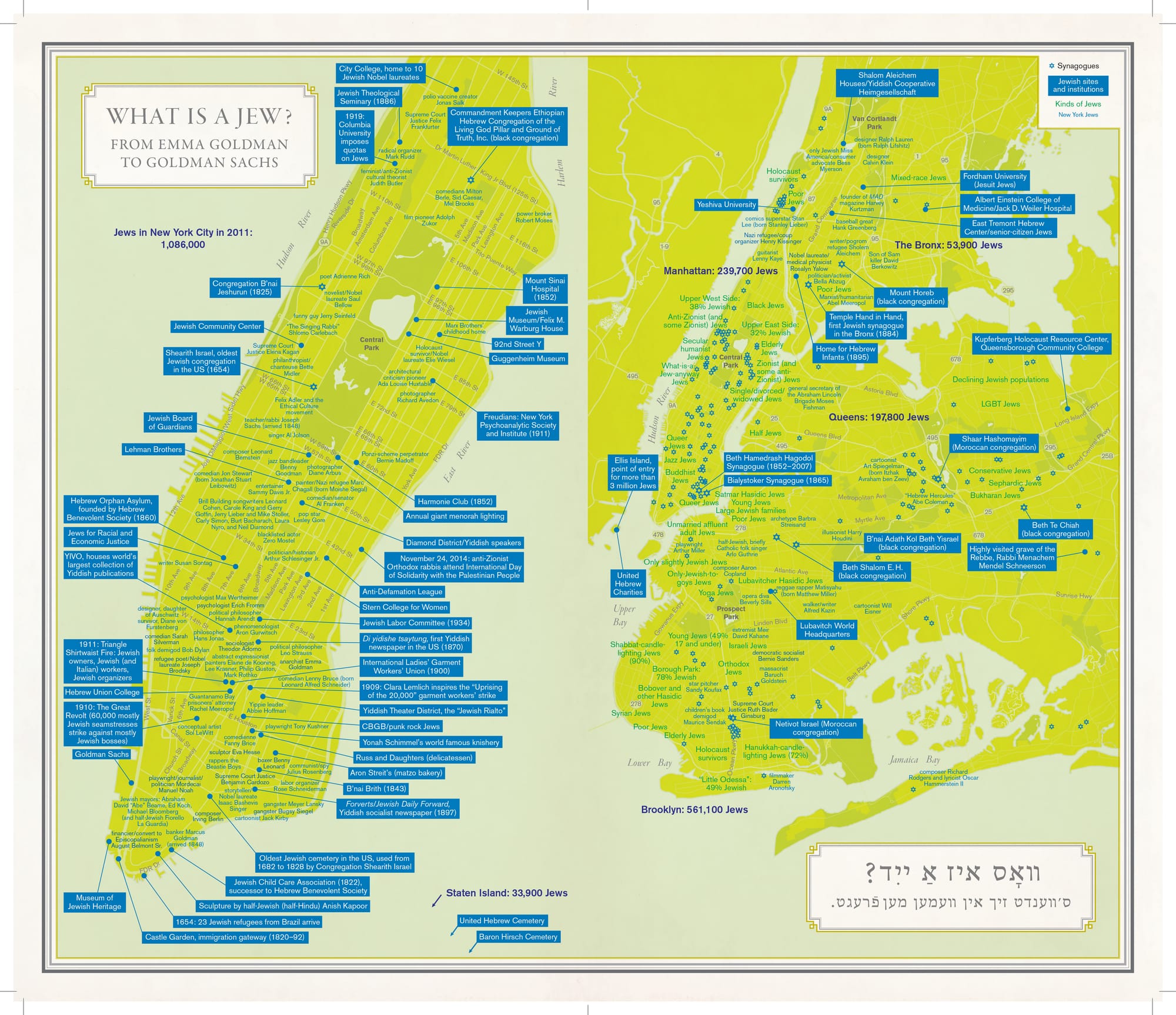
I greatly enjoyed making the map reproduced below, of the leaky category that is Jews for our 2016 New York City atlas Nonstop Metropolis: here are right-wing and leftwing, rich and poor, gangster and scholar, sports and superstar Jews.... I mean what do you say of a group that includes Bugsy Siegel, Henry Kissinger, Harry Houdini, Hannah Arendt, Ralph Lauren, Ruth Bader Ginsberg, and Emma Goldman? A group that is not exactly an ethnicity (it's several, including middle-eastern Mizrahi and Ethiopian Jews, plus converts), a religion (there are lots of versions of Judaism, and lots of secular Jews), or a culture, but a kaleidoscopic Venn diagram of these things?
What We Homogenize, What We Leave Out
One way to tidy up reality is by cherrypicking, as in selecting only the evidence that supports the statement you want to make. "Moderate Democrats Prepare for ‘War’ Against an Ascendant Left" screamed a New York Times headline after Abdul El-Sayed won the Michigan primary and became the Democrats' candidate for the senate there. War! That sounds angry and violent. But the article by Shane Goldmacher built up its case out of one guy at one centrist organization who doesn't like democratic socialism. His organization's $15 million budget for opposing it is not much money in the context of national electoral politics. Clearly the New York Times wants a story about, as another recent headline of theirs said "Democrats in Disarray," but Haley Stevens, the pro-Israel moderate El-Sayed actually defeated, generously congratulated him and pledged her support when the results came in Tuesday night and even hugged him onstage, which is not what war tends to look like.

Goldmacher does admit, midway through the piece, "Most party leaders — from Gov. Gretchen Whitmer of Michigan to Senator Chuck Schumer of New York to former Vice President Kamala Harris — quickly embraced Dr. El-Sayed’s Senate candidacy, given the stakes of the Michigan seat at the play. But some moderates see the emerging left as a danger." Some do and "some think/some say/some see" is one of the New York Times's favorite tools for claiming some kind of important mass of public opinion. Of course, through cherrypicking you can pretty much find someone to say anything from Stalin was lovely to the moon launch was fake, but they may not represent a significant population.
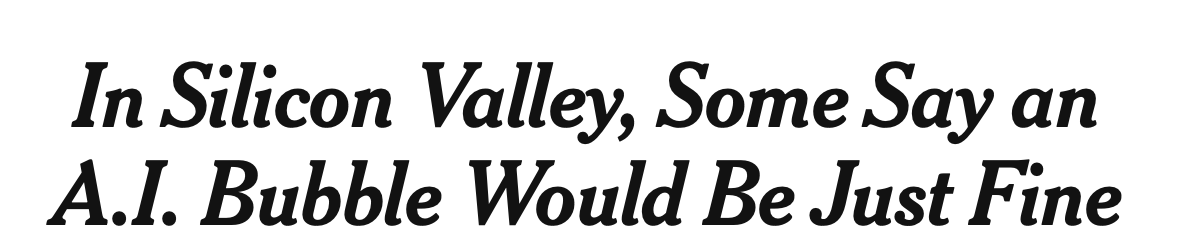
Like so much New York Times journalism, it's opinion in drag as reporting. Behind all the "Democrats in Disarray" pieces over the last several years is the implication that a party with rigid adherence to a single ideology ("party discipline") would be better. We have it in the Republican Party, where Trump punishes any Republican in Congress who votes against his agenda, while MAGA minions will often make more direct threats against any dissenter. What I'm seeing a lot of from progressive newsletters and magazines and not seeing much of in the mainstream is another interpretation of "Dems in Disarray": younger voters are taking stronger positions on economic justice, among other issues, and the party as a whole is slowly becoming more progressive, but remains diverse.
Robert Hubbell writes, "Are the contests between 'progressives' (sometimes Democratic Socialists of America) and 'moderates' important and instructive? Yes! But they are a sign of a healthy party trying to figure out what voters want. Rather than saying that the 'progressive' or 'centrist' candidate won, the correct framing is that voters chose a candidate who promoted policies relevant to voters in that district. When voters speak, their parties and political commentators should listen. If voters in different parts of the country choose candidates who promote different policies, that is a natural state of affairs for a nation as vast and diverse as the United States. Those differences are not a sign of disunity but instead demonstrate that the Democratic Party is a broad, tolerant, and inclusive coalition."
"Some Animals Are More Equal Than Others"
Behind a lot of the cherrypicking are unspoken verdicts on who matters. When almost anything happens in this country, there's a rush of news outlets such as the Times to see how Trump supporters, especially white Christian suburban and rural ones, feel about it, with the implication that they are the real Americans whose feelings matter most. (There's a leftwing equivalent among those who – see my July Meditation in an Emergency essay on Graham Platner – think the holy grail is a working class vote that too often turns out to be a white working class vote and then a white male working class vote and then just turns out to be white males prioritizing themselves while claiming to be radical while elbowing aside the needs and voices of BIPOC and women who are the working class majority and the majority generally. But the mainstream focus on right-wingers has more impact.)
A particularly grotesque example of "who matters" came with a recent CNN piece and related coverage pumping up a petition insisting that New York City's current mayor should not come to the commemoration of the anniversary of New York City's attack by terrorists on 9/11, as every NYC mayor has since 2002. "New pain for some 9/11 families as New York’s mayor finds himself in commemoration controversy" says the CNN headline, while the Rupert-Murdoch-owned Post declares “Thousands of 9/11 families demand Mamdani be banned from 25th-Anniversary.” Muslims died in the Twin Towers on 9/11, but CNN did not track down their families to ask them about their feelings. The stories centers the "pain" of his haters and ignores the pain this hate and ostracization might cause Mamdani and other Muslims.
They legitimize the apparent assumption that because he's Muslim he's somehow implicated (guilt by association) or sympathetic (homogenization) to the 9/11 terorrists, and it bunches that attack with unrelated political actions by other Muslims he has not condemned to their satisfaction (as if, in the eyes of someone homogenizing all Christians, you had to condemn Protestant Sweden to prove you don't support Catholic Italy). Incidentally, Mamdani was nine and a Manhattan resident when the 9/11 attacks took place in 2001.
Meanwhile the petition the news stories were based on turns out to be not quite what the hateful stories claim. At his Popular Information newsletter, Judd Legum reports on the New York Post piece: "While the cover says that 'thousands of 9/11 families demand Mamdani be banned,; the article itself says the petition ;has collected over 1,100 signatures in a little over a week, including from at least 300 victims’ families.'” But the 300 families claim, according to Legum, is an estimate without a real basis, a non-fact unworthy of amplification.
Pattern Recognition
Cherrypicking can mean whose voice, politics, and feelings you choose to amplify, and, as with the Muslim families impacted by 9/11, who you leave out. There is a dishonest and distorted pattern-seeking in treating a group as homogenous in beliefs or culpability; there is another in avoiding pattern recognition in the events around us. The right, by decades of effective bullying and demonization of the news industry and journalism, have succeeded in normalizing positions that should be controversial – anti-Muslim sentiment, for example – and making others that should be settled fact – the reality of climate change – too often treated as partisan controversy.
One of the impediments to climate action back in the early days was mainstream media insistence on treating a tiny population of climate deniers, who were often kooks, idiots, or paid by the fossil fuel industry, as equal to the consensus of nearly all qualified scientists on earth. It's probably a good idea to include both sides of some stories (but do it honestly: "these people are okay with women bleeding out from miscarriages"). Other times there aren't or shouldn't be two sides – somehow I remember a left-wing journalist in the 1980s mocking the McNeil/Lehrer PBS news hour approach as "now over to you, Mr. Pol Pot, for a positive view of genocide."
The two issues I'm most involved in – womens' rights and climate action – are both impacted negatively by decontextualization, by the way each individual climate disaster or act of violence or abuse against a woman or girl is treated in isolation. In journalism, there's an assumption that decontextualization is objective and supplying context is bias or manipulation or some other bad thing. But that leaves a lot of readers and listeners bombarded with facts in which it is hard to find meaning, when meaning consists of fitting this incident into the larger picture. Some of us newshounds and historians independently build and retain this context and some don't. That is, for example, why something that is unprecedented or illegal or transgressive can be normalized or just rendered meaningless by decontextualization.
And it happens all the time, whether it's repeating a Trump lie without the context to show it's a lie, a Trump threat without noting he doesn't have the power he threatens to use, or it's a violation of the Constitution. I sometimes think that this might be why we've seen the rise of information sources such as Heather Cox Richardson who, rather than pretending to be objective as in having no position about anything, are open about their stances and meticulously fit new events into the larger context, thereby giving us facts and meanings.
We are so much better off with honesty about agendas than the manipulative dissembling I've outlined above in pieces by mainstream news media outlets that deny their agenda. One piece of that is the idea that centrism and the status quo are neutral ground when they're often either the acceptance of whatever inequality and oppression has long existed, which results in treating the pursuit of equality and rights as acts of aggressions. Or it's the idea that truth is somewhere in the middle as if there's some halfway measure between truth and lies, human rights and human rights abuses. It's very often paired with the idea that both sides of the US spectrum are equally radical, though it's the right that's gone rogue, and with the pandering to — see that 9/11 story above – conservative viewpoints and the normalization of inequality.
I have since I was a very young woman reading print newspapers noticed that on any given day there may be several stories about violence against women, including sexual assault, homicide, domestic violence, stalking, trafficking and exploitation, and misogyny-motivated mass shootings. Each of these events is usually treated as isolated incident to be explained by the individual psychology of the perpetrator or even with sympathy for his unmet needs (and almost never by addressing the broader impact on the psyches or unmet needs of women). If these stories were more often connected with statistics about the prevalence and impact of violence against women, then we might have public recognition that it is a pandemic that profoundly warps global society, and that the violence arises from the collective norms we call societal values as from individual psyches. Or we might more loudly name the misogyny and entitlement that lies behind these abuses. That, in turn, might lead to broader action and change.
Likewise, a lot of the reporting on the extreme heat, flood, and fires of this catastrophic summer and the climate disasters over the past several years treats the individual instances as essentially acts of god or just stuff that happens. But often they are very clearly acts of man, in that they were caused or made worse by what we have done to the climate. Whether we take strong climate action in the near future decides how bad things get, and that action depends on broad public engagement. And that engagement is based on recognizing the problem, on connecting the dots, on throughly understanding cause and effect and that while we live in a more chaotic climate than we grew up in, it can get far worse.
Ideas matter. How we tell the story matters. How good we are at recognizing our own habits of mind, frameworks, assumptions, biases and those of the most powerful storytellers in our society is how good we are at navigating our personal and collective path toward the truth and our aspirations. This is cultural work, the cultural work that shapes our world, because culture underlies politics the way topsoil underlies crops. Understanding the culture, the frameworks, the stories is essential to all the political work we do.
p.s. Those gorgeous Navajo blankets that head this essay: I love how they themselves model a kind of complexity and creativity of thought; with one color plus black, white, and gray, and the givens of weaving on a loom, they find immense creative expression of pattern.