Pod Save Patriarchy (or Whatever That Sorry Platner Spectacle Was)

For at least a decade we have been told that this and that and the other thing must be tolerated in pursuit of the elusive vote of the working class or the white working class which often means the white male working class which becomes in turn a way that "working class" is too often used by middle-class pundits and politicians to justify centering the needs, desires, and prejudices of white men while insisting that this is a very progressive position to take. In other words, "working class" becomes a Trojan horse for white men.
On the one hand most of those in the USA who could be described as working class are neither white nor male, and on the other those who are telling us that the Hunt for the Working Class must take priority over all else tend to be middle-class white men when they're telling us we must give up our commitment to other issues – women's rights, racial justice, immigrant rights, climate action. There is immense condescension in their imagined Working Class White Man whose prejudices must be pandered to, and of course those prejudices are their own or at least something they're willing to accept. (There's also a lot of nostalgia in this version of the working class, an image of that class as masculine manual laborers of the industrial variety when a lot of the working class in our fairly post-industrial nation is disproportionately people of color doing pink-collar women's work, casual and gig-economy labor, urban workers, janitors, and farmworkers.)
As sociologist and New York Times columnist Tressie McMillan Cottom put it last October, "Their rhetoric — and the conventional wisdom that flows from it — suggests that we cannot talk about economic solutions without abandoning our commitment to the Black, Latino, gay, transgender and female poor that are the lifeblood of the Democratic Party’s base. The conceit at the heart of that belief is that poor white people are too racist, and too uniquely ignorant of their racism, to vote in their best interests. Therefore, Democrats have to accept a little racism to win the working class." Cottom is a Black woman; Black women are the single most loyal constituency of the party, the ones who vote for it in the highest numbers, but I have never heard similar arguments about how we must bend to their needs no matter what. She continues, "Our culture is built to eternally forgive men, generally, and white men of means, especially, for their mistakes. Every single time, they were young and immature and it would be a shame to hold them accountable for anything they did wrong."
And that is the rocky road to . . . Graham Platner, Maine's Democratic candidate for senate, now being urged to drop the hell out already, because a very credible rape allegation surfaced yesterday in Politico and then on CNN. God knows there was troubling information enough about this guy who was made up entirely of red flags and white male fantasy, but before this story dropped yesterday there was a juggernaut of white men insisting he was amazing and irresistible (to them) and bullying dissenters. There's still a bunch of people on social media and in comments sections attacking the motives and credibility of the woman who reported the rape in ways that demonstrate why rape victims are reluctant to come forward and otherwise trying to make this inconvenience go away. When it seemed that Platner was the Democratic candidate, I was willing to accept him over Republican incumbent Susan Collins, but I wasn't happy about it. Now it seems that he must go and will go soon (even though he's insisting he will only go if he approves of his replacement, as if he's entitled to that).
[update: this essay was first posted on July 7th; on the evening of July 8th, Platner stepped down from his campaign in a speech blaming the “corporate media system” and “political establishment" rather than himself for the scandal/crisis.]
Earlier in Platner's brief trajectory, the writer Sebastian Junger said on his Substack, "For what it's worth, Platner might be the only Democratic candidate or congressman I wouldn't want to mess with, whereas the Republicans have at least half a dozen guys who could put me in a headlock." Who the hell cares about that? I sure don't and it's utterly irrelevant to what makes a good senator. A guy on BlueSky who goes by John Brown Stan declared, "I'm just wary from a political perspective of adopting a maximalist view of how unacceptable toxic masculinity is when that maximalist view could maybe garner 35% support in an election." Pundit Matt Stoller wrote on X, "Graham Platner represents a rejection of Dem HR lady politics," which was a pretty explicitly misogynist framework. The Pod Save America guys seemed equally infatuated with the candidate and dismissive of the red flags.
Essentially the message was "pander to toxic masculinity, machismo, to a white male fantasy of manhood." Why? This seemed to be an illogic in which somehow the white male vote counted for more than other votes. It was really about white men mattering more than others. In a way they do – they hold disproportionate power in this country, in terms of money and position, from Wall Street to Silicon Valley to electoral politics. But if the Democratic Party is committed to democracy, it has to be committed to equality regardless of race, class, gender, sexual orientation, and committed to universal human rights. Also white men already have a party devoted exclusively to their needs and fantasies.
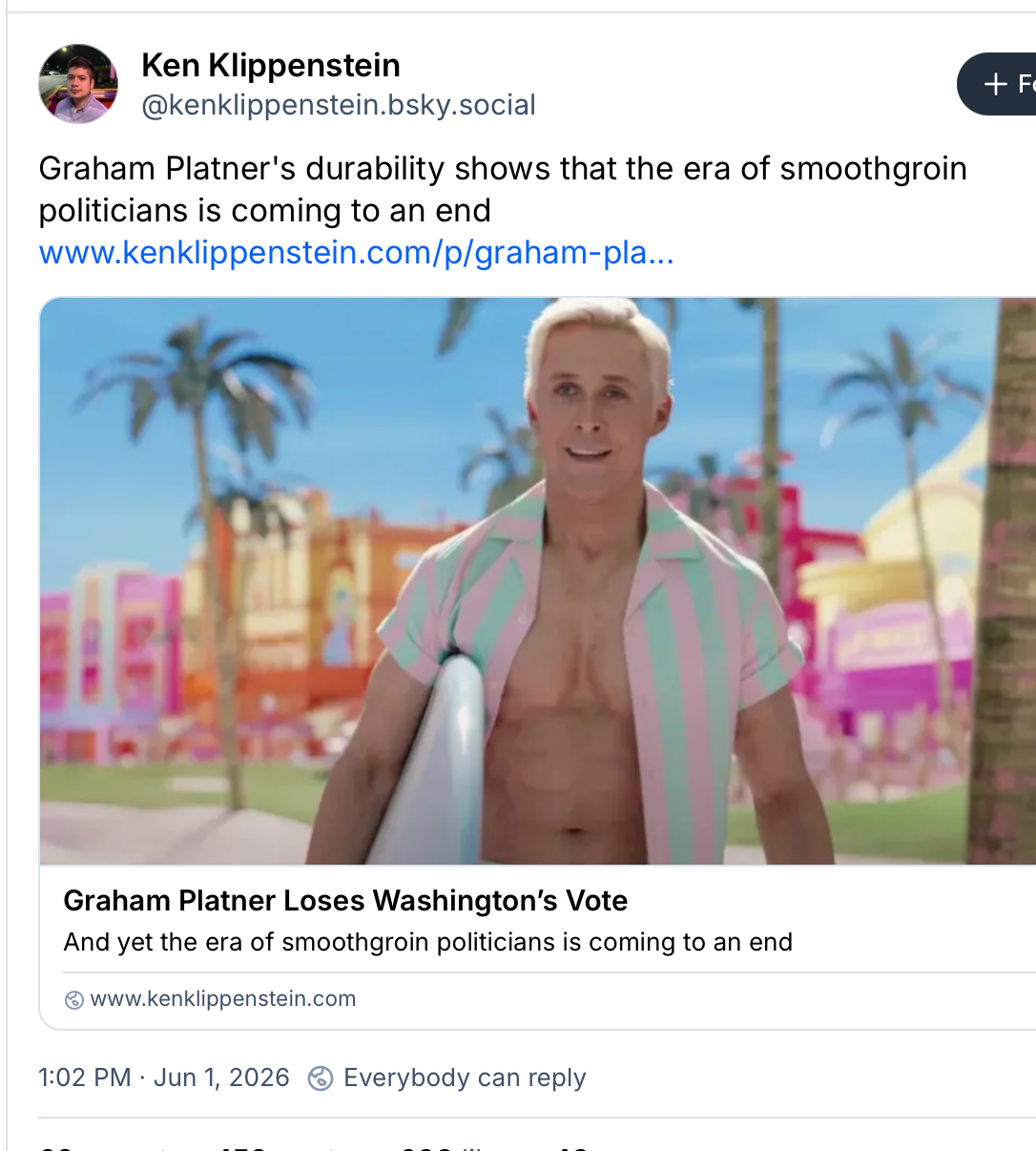
Platner was scouted and promoted by the Ivy League's Daniel Moraff, who according to the Wall Street Journal sped past a proper background check. After the New York Times published a piece quoting two women with disturbing allegations about Platner in early June, yet another white guy, Matthew Yglesias, wrote that Moraff is "emerging as a new force in politics specializing in populist outsiders. He discovered Dan Osborn and Graham Platner, and he has shown a knack for finding unlikely politicians with real charisma and skills. As we now know, Mr. Platner also comes with a somewhat checkered past and real, potentially costly flaws."
We were told the charisma mattered a lot and that the dank behavior in the past was justified by PTSD and alcoholism and has been redeemed, by some means that did not seem to involve much of anything except the declarations of the candidate and his supporters. Even Platner's working class status seemed dependent on his own rhetoric, wardrobe, and the manual labor he performs as an oyster farmer (whose main buyer is his mother's restaurant, while he lives in a house his lawyer father financed; his background is a fairly posh version of middle-class and he seems, in his forties, to be still propped up by his parents).
The alleged rape happened in 2021: the story told by Jenny Racicot, who had dated Platner, is that after she texted him not to come over, he burst into her unlocked home when he was extremely intoxicated, physically overpowered and raped her despite her protests and "no's," passed out or fell asleep. She reports that she then cut off all contact with him (and her account is corroborated by written material and people she told about the attack long before 2026). “One of the reasons I didn’t come forward sooner was, the huge moral conflict that I had between supporting his politics, but not supporting him as a person,” she said. “I just want the truth out there. I just want people to have a whole scope of who he is as a person.” She was also motivated, she says, by how the Republican woman who spoke up about abusive behavior and ugly speech from Platner was dismissed because of her political alignment; in these circumstances, victims often speak up out of solidarity, to protect others from the abuser or to support another victim.
Until her revelations, nothing seemed to matter to his champions – not the tattoo one of the women who spoke to the New York Times said Platner knew was a totenkopf, a Nazi emblem, not his racist, misogynist comments online – and much more than that, at least by my lights, Platner's decision to join Blackwater, the notorious mercenary army founded by far-right billionaire Eric Prince (and I'm not too enthused about his decision to join the Marines in 2004 when that meant fighting George W. Bush's utterly illegitimate war in Iraq that caused hundreds of thousands of civilian deaths). “My journey is one of transformation," Platner insisted, which seemed to mean everything in his past wasn't an issue because we were all supposed to believe he was transformed, though exactly how and by what means was never clear. Platner categorically denies the rape; Racicot says he seemed not to remember it when he woke up in her home after the assault. Platner also denied at various stages of his now-dead campaign that there were more skeletons in his closet, which means either that he was lying or was willing to gamble with the fate of the election, the party, and the country, or did not see those skeletons as problems. They were problems. Are problems.

To repeat, if the Democratic Party is committed to democracy, it has to be committed to equality regardless of race, class, gender, sexual orientation, and immigration status, and to universal human rights. Rape is a profound human rights violation, an act of dehumanization, and an act that says the rapist's rights and desires are boundless and the victim's rights and desires are nothing. It is incompatible with democracy. As Steve Philips declared in the Nation yesterday, " if we are willing to look away from credible allegations of sexual violence whenever the political stakes are high enough, then we are not, in fact, the movement we claim to be."
I wrote about that in the context of the Epstein case last year: "Rape is a crime against democracy in the most immediate sense of equality between individuals and the premise that we’re all endowed with certain inalienable rights. Most rapists operate on the premise that they can not only overpower the victim physically, but can do so socially and legally. They count on a system that discounts the voices of victims and only too often cooperates in silencing them, through shame, intimidation, threats, discrediting, the obscene legal instrument known as a nondisclosure agreement and a system too often run by men for men at the expense of women and children. That is to say, rapists count on getting away with it because of a system that hands them power and steals it from their victims. They count on a silencing system. On profound inequality. Democracy, in this context, means a society and system in which everyone’s rights matter, everyone’s voice is heard and everyone is equal under the law. Rapists count on this not being true, but has become more true over the past half century, thanks to feminism, and changed a lot more over the past dozen years, thanks to more feminism."
PTSD – post-traumatic stress disorder – has been cited, including by Platner, as a justification for his post-military conduct. On the one hand, while it may explain it, it doesn't justify that behavior in a candidate for senate. On the other, another Marine who served in Iraq, David J. Morris, who wrote a powerful book, The Evil Hours, about PTSD, wrote me some years ago, “The science on the subject is prettyclear: according to the New England Journal of Medicine, rape is about four times more likely to result in diagnosable PTSD than combat. Think about that for a moment— being raped is four times more psychologically disturbing than going off to a war and being shot at and blown up. And because there are currently no enduring cultural narratives that allow women to look upon their survival as somehow heroic or honorable, the potential for enduring damage is even greater.” A significant percentage of American women are survivors of male violence, including intimate partner violence and rape, yet I rarely hear PTSD invoked to justify or excuse their – our – behavior, and I've never heard it invoked to justify violence by women.
Feminism is a subcategory of human rights concerned with the rights and equality of women. But it is often treated as a non-issue, either because of the pretense that feminism won and misogyny is over (when violence against women is still the most pervasive violence on earth and discrimination on the basis of gender has not faded away – just imagine a woman candidate [or a Black one] with Platner's baggage and inexperience). During the last round of ruckus over Platner's mistreatment of women in early June, I saw Atlantic writer Adam Serwer post a New York Times report whose headline and subhead read: "Hegseth Strikes Female and Black Navy Officers From Promotion List. The defense secretary’s decision to block the officers’ promotions appears driven by his anti-diversity stance rather than based on merit." Serwer commented, "Anti-diversity stance: there's a shorter way to say that." I'm not sure what he meant, but most of the commenters decided he meant racism, when Hegseth is clearly discriminating on the basis of both gender and race. It was startling to see that unselfconscious erasure.
I've often joked, bitterly, that women's rights are very important to progressive men, just not as important as anything else. Because whether it comes to excusing a misogynist or even a rapist or dismissing the importance of reproductive rights and or being willing to trade them away for some electoral advantage, or joining campaigns of online abuse against women, or just attacking women in ways they would not attack men, I have seen progressive men do these things and other progressive men stand by. Not all of them – I know men in my own life and see men in public life and read men in print who are great feminists, both ardent and informed, but they're a minority. We need more men to articulate how they benefit from feminism, aka from living in a world of equality rather than inequality, and to move the conversation forward into how men are oppressed and distorted by patriarchy – granted unequal power, but at what cost to their psyches?
The Epstein case seems to have been a wakeup call to some men that this stuff happens and matters and is the result of profound inequality, including inequality of voice (though it's still alarming to me how men continue to be shocked when they stumble across the foundational realities of women's and girls' lives). We still have a long way to go. Whether we as a society are going to continue that progress, or regress, or deny the problem, my commitment to universal human rights and absolute equality for all is unshakeable. I hope yours is too.