Winners and Losers: A Hell of a Week in the US of A
There is no more one-sentence-fits-all opening in literature than Dickens's "it was the best of times, it was the worst of times," and this is a review of a lot of the winning and losing over the past week or so, some of it symbolic, some of it serious, some of it joyful, some of it shameful.
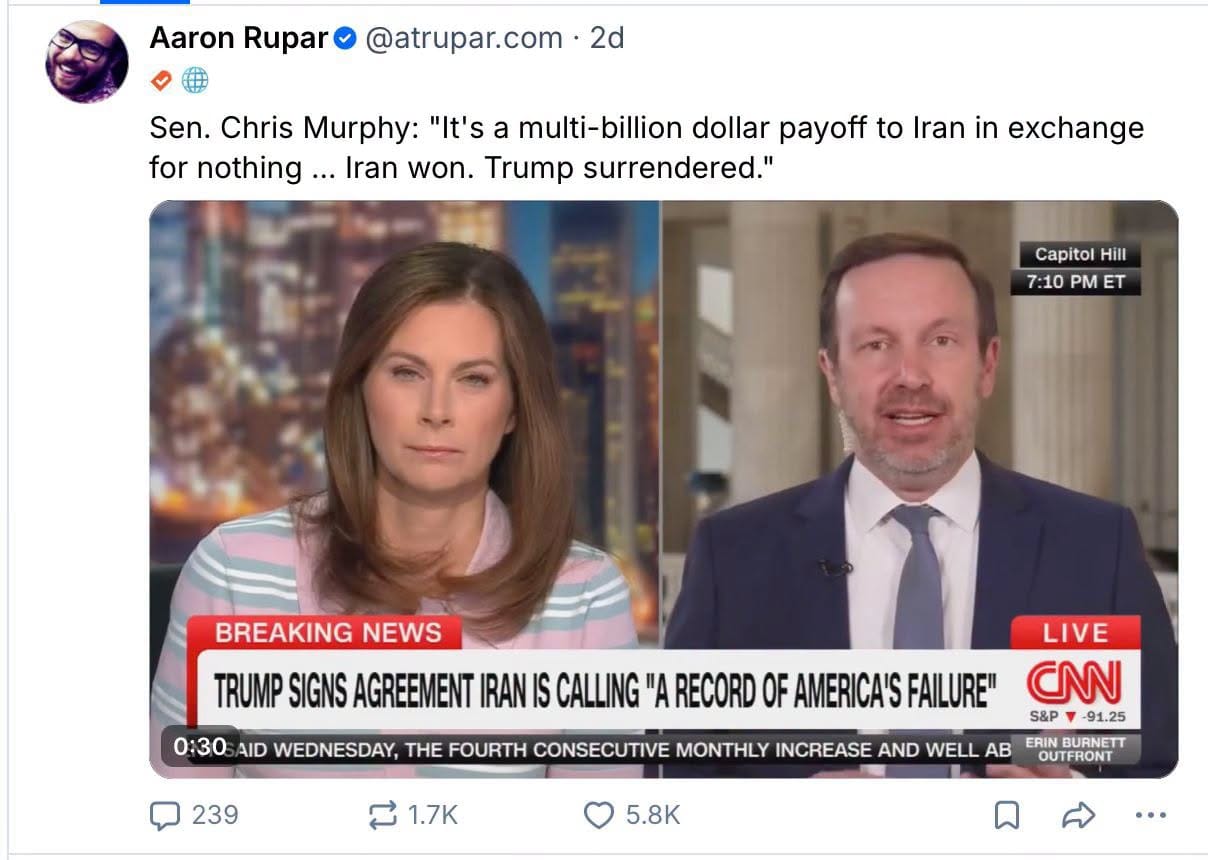
News outlets are dancing gingerly around the fact that the United States lost the war with Iran. It should be said outright. It only takes two words. We lost. Or three: the USA lost. Four? Donald Trump wrecks again. It's an odd we in that the war was not just unpopular, it was unsought and unanticipated by most of us, even sprung on us, in contrast to the usual careful buildup by presidents to get the public onboard. I'm m not sure why at this juncture the news media are afraid of offending the person who really wanted the war or at least who got talked into the war by his then-good-friend Bibi Netanyahu, but the war is also a loss for that relationship, which no one should mourn and transactional relationship gone sour number ten million for Donald J. Trump (see: Musk, Elon; Tillerman, Rex; Bondi, Pam; Epstein, Jeffrey etc.). But mostly: Trump got the US into a stupid war no one wanted, and he lost it, and so did the Iranian people, who were having an uprising a little while ago, and whose government Trump thought he would destroy seems almost certainly strengthened by this episode, and definitely enriched. His attempt to end the conflict by essentially surrendering seems, additionally, to have failed to end it.
Donald Trump is on a big losing streak. Some of it is just symbolic, but what symbols! His takeover of the Kennedy Center had already failed in practical terms: he found out you can seize a building but not an audience, staff, and array of artists and the status or stature that came with those things. But the court order that resulted in his name being taken off the building before a cheering crowd while being live-streamed to a gloating national audience just before his grotesque birthday celebration was extraordinary: a weird moment of pushback at a shameful act of egomania. People had assumed the removal would have to wait until the end of his term or his life, but it turned out that was not necessary.
Another defeat was his attempt to remake the reflecting pool and to remake it into something more vulgar by painting it blue while not understanding the aesthetics at work, and to do it in a corrupt way because it seems that the company contracted had something to do with a donor and didn't necessarily know what it was doing either. The pool turned green with algae and then the blue began flaking off in huge sheets, perhaps because of the hydrogen peroxide poured in to try to kill off the algae. It is now a ridiculous and utterly gratuitous mess that has prompted a thousand memes drawn from everything from The Creature of the Black Lagoon to Lord of the Rings, and more schadenfreude. The drama of the reflecting pool seems like a miniature of the attack on Iran: utterly unnecessary, imagined by a Trump who did not understand the situation as leading to triumph and domination, resulting in chaos and failure.
On the other hand, media coverage of Trump's vulgarity at and after the G7 meeting in Europe was more blunt than that of the war. As the Associated Press put it, " The Italian government closed ranks on Friday to slam U.S. President Donald Trump over his claim that Premier Giorgia Meloni had “begged” for a photo with him during the recent G7 summit, a pushback that suggested America’s longtime European ally had had enough of Trump’s boasting and criticism." Trump was obviously lost, confused, out of his depth, isolated, laughed at by other world leaders at the summit. This is where his losses become our losses, in that the US has been disgraced, lacks competent leadership, is being dragged around like a pull-toy by a deteriorating windbag too incompetent to achieve the tyranny he aspires to, but still powerful enough to damage and corrupt everything around him. "Everything Trump touches dies" is relevant here, but a lot of what he's killing off is not his but ours. It's a grim warm-up for the country's 250th anniversary.
Trump's grotesque gladiatorial spectacle on the White House Lawn last Sunday was his bid at celebrating the nation's 250th or rather merging that with his own birthday that day. Barack Obama's launch of his presidential library in Chicago this week was not very subtly a counter to Trump's policies and politics and a fierce critique of him. Critiquing him is not very hard: upholding any values of equality and human rights puts you at odds with the administration. Obama spoke of "an America where everyone counts and everyone belongs," which would be anodyne if we weren't in a USA whose federal government is furiously trying to create the opposite.
The New Republic's Greg Sargent writes, "The forty-fourth president delivered an emotional speech at the Obama Presidential Center’s opening ceremony on Thursday. It offered a blistering indictment of the forty-fifth and forty-seventh president, all without mentioning the words “Donald Trump,” while offering his own ambitious rendering of the American story.... Yet in so doing, the speech also sent an implicit message to Democrats: Defeating Trumpism, MAGA, and the right-wing nationalist vision of America that animates them requires something more than small-bore politics and slogans about 'affordability.' It requires a bigger and better story, a positive and aspirational vision, a full-throated declaration of what we liberals think the United States is—and should be—instead."
Sargent describes Obama's "creedal nationalism, which holds that American identity is defined by our founding ideals, versus a nationalism rooted in heritage or ethnicity or race." That's a direct counter to both Trump and Vance's insistence that in a country founded on the sentence "'all men are created equal," some of us are more equal than others, thanks to being white, Christian, and particularly in Vance's case invested in the idea that the longer you're here the more American you are (a bit hard for Trump to air, since he had an immigrant mother and paternal grandparents). Sargent again: "Vance’s big claim, by contrast, is that fealty to our founding ideals cannot be the basis for American national identity. Blood and hereditary attachment to the soil are, to him, essential ingredients."
I am not sure why JD Vance is regularly described as smart, since he goes around making himself spectacularly unlikeable while telling lies clearly recognizable as lies while backing cruel policies obviously at odds with the faith he professes. He's currently trying to promote his new memoir about his conversion to Catholicism. Published reviews of it are scathing; Amazon restricts readers' reviews of it on its site to verified purchasers, while Amazon subsidiary Goodreads is reportedly not allowing reviews at all. Vance went on the TV show The View to promote the book, and the hosts went straight to asking him about things he'd rather not talk about, including the war on Iran and Trump's ties to Epstein, then confronted him when he lied about the latter. Trump has made Vance the face of the negotiations with Iran, not the first time he's set him up as a fall guy.
Speaking of Amazon, the mega-corporation is not only protecting JD Vance. It's protecting Sam Altman, OpenAI's head, or maybe protecting its new investment in the company. The Guardian reports, "Artificial, Luca Guadagnino’s controversial Sam Altman biopic, which is poised for an awards run next year, has been dropped by its distributor, Amazon.... Amazon’s decision to leave the project comes in the wake of a significant partnership struck between Amazon and OpenAI, of which Altman is CEO. The deal will see Amazon – whose owner, Jeff Bezos, is friends with Altman – immediately invest $15bn in the company, 'followed by another $35bn in the coming months when certain conditions are met,' according to the artificial intelligence company’s website. This follows a $38bn cloud computing deal signed by the two companies last year."
Although a lot of people think winning has to look and feel like winning, the losing side can keep inflicting damage; the winning side sustaining damage, before the conflict is over. It seems as if there's no place for Trump to go but down, but the damage continues. Nevertheless, there are victories. Here's a big one for the climate, as reported by Inside Climate News: "The Trump administration has abandoned its effort to halt wind energy projects across the United States and dropped its challenge to the court ruling that tossed President Donald Trump’s order freezing federal permitting and leasing for wind projects. States that challenged the order hailed the development as one of the most significant legal victories against the Trump White House’s campaign against the energy transition. On Monday, the U.S. Court of Appeals for the First Circuit dismissed the appeal after the Justice Department filed a motion for its voluntary dismissal on June 10. Monday’s decision affirms the Dec. 8 ruling by U.S. District Court Judge Patti Saris, which concluded that Trump’s January 2025 executive order was unlawful, finding the sweeping ban on wind projects was “arbitrary and capricious” and exceeded the president’s authority." Another win for climate came when public outcry, including that from many scientists, prompted a reversal of the Trump Administration's decision to rip up the ocean monitoring system that provides crucial information about shifting conditions due to climate impacts.
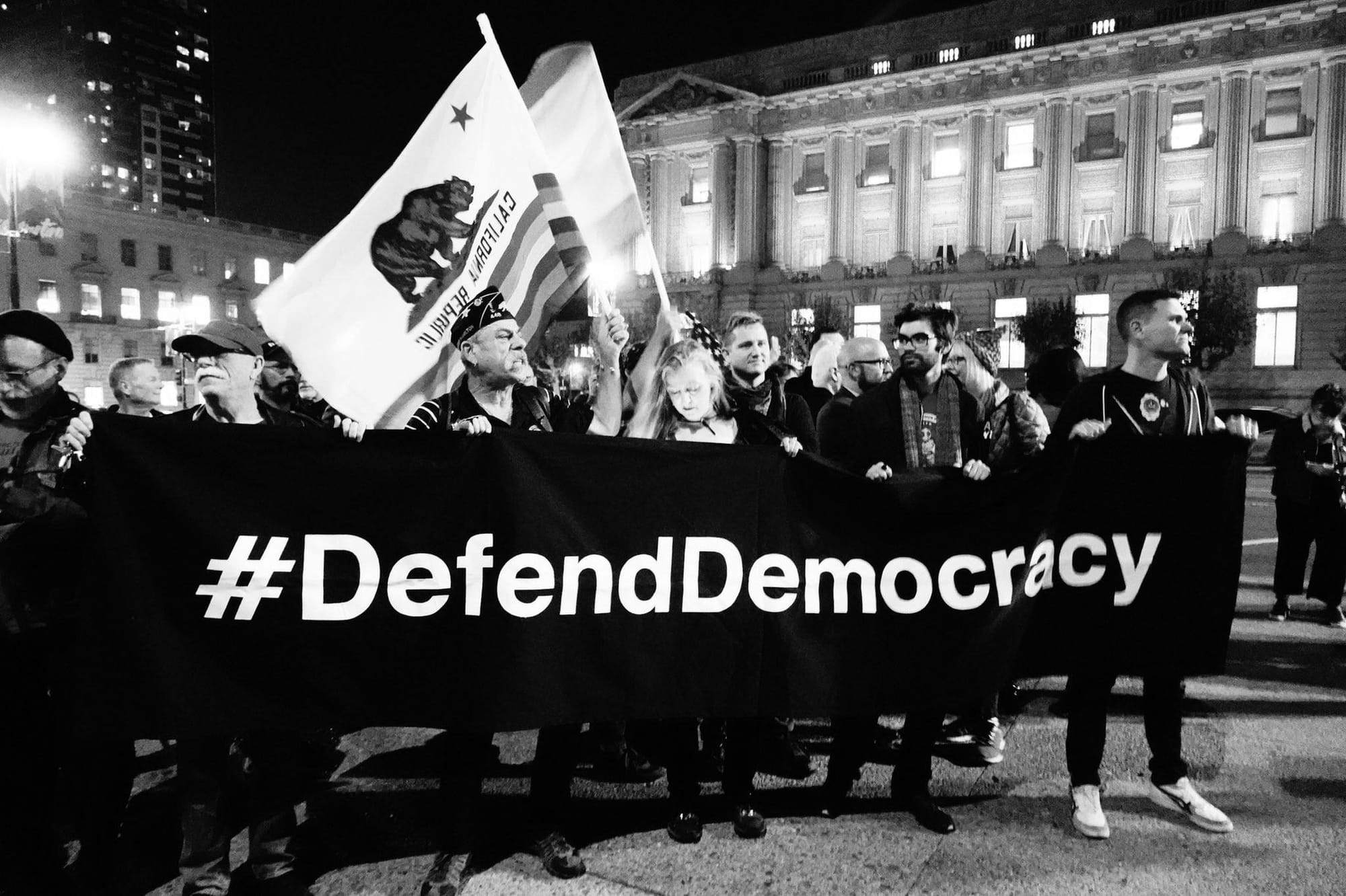
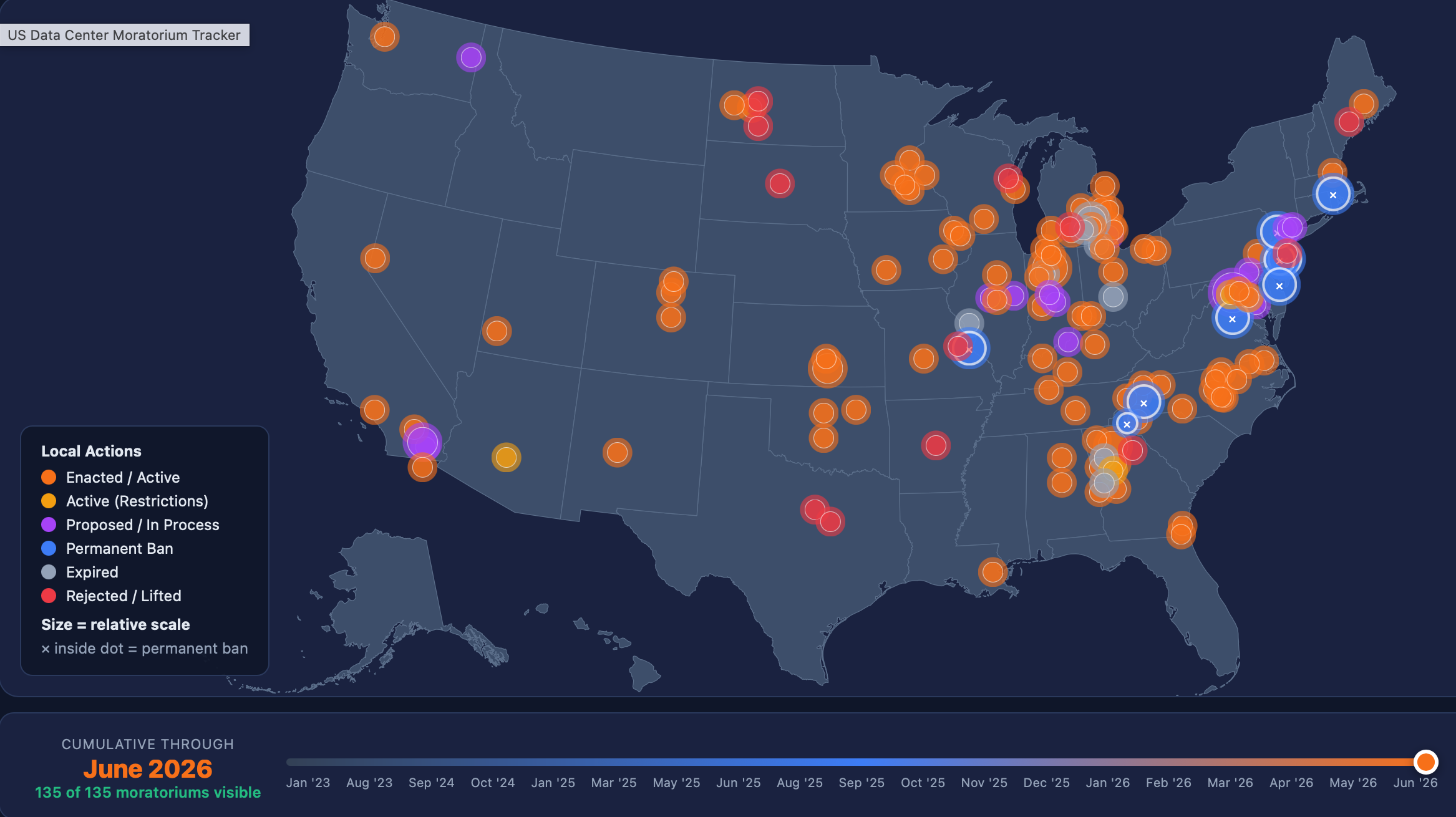
One of the encouraging things in this moment is the rise of local campaigns against both ICE detention centers and data centers. ICE is selling off or giving away, at a loss, some of the warehouses it acquired under Kristi Noem. And data center moratoriums are springing up right and left, for many reasons, but some of them are the energy and water use of these ravenous behemoths. From Imperial County in southernmost California to Reno, Nevada, to Socorro, New Mexico, to Leeds, Alabama to Durham, North Carolina– well, to too many to list across the nation – citizen campaigns are shutting down or at least delaying efforts to build them. These actions are everywhere, as this excellent map below shows. AI is widely seen as something thrust upon us, as a threat and a degradation of truth, meaning, facts on many levels, and a technology whose beneficiaries are elites, and this pushback is heartening. We're in a moment when elites think that what we want and care about doesn't matter; making it matter is all the more important.
Robert Hubbell describes another example of successful grassroots activism in his newsletter, "In a sudden reversal, Georgia legislators abandoned plans at the last minute to eliminate Black-majority congressional districts, as demanded by Trump. Republican lawmakers witnessed the widespread public protests, especially by the Black community in Georgia, and concluded that the political cost of proceeding with the redistricting would outweigh the likely Democratic wins in the existing Black-majority districts." More broadly, Hubbell notes, "Trump is humiliated, isolated, and lashing out against allies and enemies alike. While we can’t count on Trump to single-handedly defeat the entire Republican Party in the midterms, he is doing his best to make that dream come true for Democrats."
Sometimes winning and losing are terms too simple to describe the results, but then there's sports. While Trump's gladiatorial spectacle got low viewership and widespread public disapproval, soccer's World Cup got underway with teams, including the USA's, that contain exactly the diversity of race and immigration status that the Trump Administration abhors. Towns like Lawrence, Kansas, welcomed their visiting teams – in that town's case, the Algerian national team – with exactly the kind of cross-cultural positivity such events are supposed to spur. and in New York City's Knicks won basketball's championship, which allowed one of the greatest orators in contemporary American politics to say a few things.
Knicks top fan Zohran Mamdani, who himself won his race for mayor against what at least in the beginning were overwhelming odds, celebrated his city's team's victory with a joyful and passionate speech. Among the memorable lines: “The analytics guys, the sports betting companies, the pundits who watch from far away, they do what they do. They run the numbers. They calculate the odds. They write the Knicks off. They give the Spurs a 99.6 percent chance of tying up the series 2-2. A 99.6 percent chance of silencing the Garden. But there is one thing that the pundits just don’t get about this team, that they just don’t get about this city. It is in that 0.4 per cent that we go to work.... You are allowed to think about the worst possible scenario, but then you've got to go out and do something about it."

Dickens's sentence in full reads, "It was the best of times, it was the worst of times, it was the age of wisdom, it was the age of foolishness, it was the epoch of belief, it was the epoch of incredulity, it was the season of Light, it was the season of Darkness, it was the spring of hope, it was the winter of despair, we had everything before us, we had nothing before us, we were all going direct to Heaven, we were all going direct the other way – in short, the period was so far like the present period, that some of its noisiest authorities insisted on its being received, for good or for evil, in the superlative degree of comparison only."
p.s. How did I miss this? Florida's Alligator Alcatraz has been shut down and all the prisoners transferred.