Lifeguards and Angels
I have lived a long time but I have never lived through such a time of destruction, of nature, of human lives, of truth, fact, science, journalism, the rule of law. I write during a summer of colossal wildfires, of extreme heat, of human rights abuses, of attacks on history itself and the rule of law in the USA, of a pointless, gratuitous war dragging on because Donald Trump can't admit he lost it, of leaders in the UK and Canada as well as in the USA abandoning the climate struggle even as Canada burns and Europe broils and burns. It is often overwhelming, and it feels like more than any one of us can respond to.
But we can. We might need to take breaks or pace ourselves or find our niche and our people to do it. People are doing the work, often in undramatic ways — meetings, court filings, fundraisings, investigations, forms of support and solidarity that are not high-profile. But let me talk for a moment about a high-profile incident that riveted people across the country and the world. A few days ago, I watched a novice lifeguard, age sixteen, pull a younger boy out of the surf that threatened to sweep him away, on a Santa Cruz beach where the waves had suddenly become far larger and more dangerous. They swept over the lifeguard and the boy again and again and somehow each time they reemerged, the young man had not let go. There was a simplicity to his task, a clarity, that we do not get when we try to figure out how pull democracy or justice or human rights out of the storms of destruction; these are not things that one person on one occasion can resolve.
Even so, there are parallels. Many are caught up in the violence of Trump's unregulated militias, the ICE stormtroopers, and many are trying to pull them back out to safety, to the solid ground of the lives they were leading in the places they lived. I was horrified to see (in videos), a few days ago, a Ukrainian refugee grabbed in San Francisco's airport; her screams, the bystanders, the fact that it was all taking place in locations I know well and live near made it particularly vivid for me. The lifeguards are her friends raising money on GoFundMe and organizing what aid they can for her. Such lifeguards exist everywhere, as community members, as organizations dedicated to human rights, and sometimes as opposition politicians attempting to stop the administration or change the rules. They do not always succeed but they go into the surf to try. Perhaps another lesson from that riveting video of rescue is that the waves may crash over you repeatedly before you get to safety. The process may not be simple and the outcome may not be certain while things unfold, which I say because I too often hear the lack of immediate victory interpreted as defeat.
In a way this is a terrible metaphor. The harm is not being done by a vast and ancient natural force or even by a majority; it's being done by an unpopular regime that is plummeting in the polls and seems almost frantic to do as much as it can while it can (because they seem likely to lose the midterms, because they are losing popularity fast, because Trump seems to be in a phase of rapid decay, and because the courts– thanks to the lifeguards of the law--keep overturning their overreach and other transgressions). A touchstone essay for me is Michelle Alexander's 2018 proposition that we are not the dam trying to stop the river; we are the river that they are trying to dam, and whatever they build we will overtop it and flow in in the end. I agree with that profoundly; at the heart of my new book, The Beginning Comes After the End, is the argument that the right is engaged in backlash against all that we have changed over the past three quarters of a century to make a more just and equal world (and that that should be a reminder that we did change the world, we do have power, we have a history of victories that are even more often and more significantly incremental cultural shift as landmark legal successes, and they are furious about all of it).
Another way to rework the lifeguard metaphor is to note that the main effort is to keep people from being swept away in the first place, and to dismantle the forces that try to drown people in cruel displacement and deprivation. But so many are being swept away. This harrowing story was just published: "An Overland [St. Louis, Missouri, area] couple who had recently returned to Guatemala was found bound and shot to death in a sugarcane field. Nixon Giovanni Pérez Paz and Glendy Marisol González de la Cruz were killed weeks after González de la Cruz self-deported to be with her husband, who was deported by U.S. Immigration and Customs Enforcement last year. Their 14-month-old daughter, Giovanni, was found crying beside her mother’s body in southern Guatemala." González de la Cruz, who was only 25, had followed her deported husband because she had no good choices, and so she tried to navigate the bad ones.
Refugees are being sent back to the countries that they fled because those countries were dangerous or being sent to countries they have never been to before in a kind of human dumping; in the latter case, they may not even speak the language or have any resources to survive whatsoever, and the Trump Administration seems to be picking violent places on purpose. As Adam Serwer wrote abut the first Trump Administration, "the cruelty is the point." JD Vance and Donald Trump, along with fellow travelers like Elon Musk, are endeavoring to create a world in which some people don't matter, have no rights, and in which their kind of people doesn't have to care about "those kinds of people." Musk's claim that the destruction of USAID by DOGE didn't kill anyone is really an argument that nobody who mattered died because only certain kinds of people matter. They have their following, but I believe it is a minority, and how could it not be when it claims that most of us don't matter?
One thing I think about often is that we tell stories as if the only impacted people are those who are impacted directly. But an act of violence or destruction is a stone thrown into a lake; the ripples spread outward, witnesses, bystanders, family members, those facing the same threats, and really anyone with a heart is impacted. Large numbers of people now live in fear of ICE, have altered how they live, have withdrawn from public space or even school or work. Those of us who because of our whiteness and birth here in the USA are relatively fearless still suffer moral injury, moral anguish, and empathic distress.
Behind that, it's important to remember, is care, care about principles, justice, human rights, about other people than ourselves, even in a society where we have for many decades been told in countless ways that all we care about is ourselves and our material well-being. We are encouraged to do so by advertisements, influencers, and other forms of marketing as well as a lot of entertainment in which our species is stripped of its idealism and concerns about things beyond the personal. I often hear people reference Minneapolis for how many residents of that city stood up, in the face of ICE's paramilitary onslaught last winter, for the most vulnerable, but similar defenses have happened from Los Angeles to New Orleans to New York and many smaller places in between (I've heard remarkable stories of what happened when ICE went to North Carolina, in small cities like Greensboro and Charlotte and the armed countryside around them).
I had a conversation with another middle-aged white woman the other day, an acquaintance I ended up chatting with for a while. She was concerned about her children – about them being attacked by ICE, about them having few good economic prospects, about the threats of AI. But she was not giving up: she felt that we had reached the end of something, that we were in collapse or would be, that an elite had made things so bad for so many people that resistance and revolt must follow. I agree. This cannot last, this situation that has made life hard to miserable to impossible for so many people.
The waves kept crashing over the lifeguard. I've learned not assume that we see all that is happening or believe that history is linear and change does will increase in some predictable algorithmic way. Often a long quiet phase is succeeded by an eruption; volcanos and earthquakes are good metaphors here; often tension is building up or plans and new ideas are being developed in some quiet unseen corner. Other things change incrementally and almost unnoticed (one example that has been incremental but fairly swift is the change in US public opinion about the Israeli government, and for a lot of Democrats it is no longer perilous to oppose the regime – witness Brad Lander's success in his New York City congressional primary).
What I know from history is that – well, no one on July 13, 1789, foresaw a local scuffle over Paris's Bastille prison would be the opening of a revolution that would topple the monarchy while proclaiming the rights of man. No one really foresaw a lot of other eruptions from the 1989 fall of the Berlin Wall and the 2011 rise of the Arab Spring and Occupy and the ousting of Viktor Orban earlier this year and Bashar al Assad late in 2024 or the July Uprising in Bangladesh in July 2024 that drove out an autocrat.
One striking thing in this moment is that the local fights against ICE facilities and data centers are so similar, so aligned, local communities rising up against two forms of a bleak future that rewards the few and punishes the many. Elites at this moment seem to be operating on the assumption that we don't matter and our fear and fury are not their problem. They're wrong. The New York Times, which never met an elite it didn't like, published a sloppily disingenuous opinion piece this weekend titled "The Environmental Case Against Data Centers Is Misguided." It was just what the industry would've ordered. At his newsletter Dave Karp replied, "They need us to believe not just that AI is useful, but that it is inevitable, arriving fast, and bringing about a radically different world. That’s the only way to keep the cash-furnace stoked. The steady flow of investor cash only keeps going so long as they maintain a steady cadence of product demos, benchmark successes, and confident futurism. Slow the pace down, and you lose the aura of futurity. And then the whole house of cards collapses. Local opposition to data centers creates a ton of friction for the AI industry. They were not expecting this, and they don’t seem to know how to handle it. It’s a good leverage point for fighting the broader AI industry."
And the public is fighting it and often winning, as Brian Merchant observes in this conversation with Kelly Hayes: "It is a remarkable rate of victory. I think at one point it was 30 percent of data centers that were opposed, that saw sustained opposition, wound up getting canceled or shut down." AI's invasion of every corner of our lives is not inevitable and it is arguably a bubble that is going to pop – Karp worries that it will be seen, as with the banks in 2008, as "too big to fail" and get bailed out. Public fury and what we learned from the 2008 bailouts may help avertption.
Let me move from an image of a valiant young man in crashing surf to a patient craftsperson at a table. My friend Roshi Joan Halifax writes about kintsugi or kintsukuroi, the Japanese art of reassembling treasured ceramic pieces, when they break, with golden glue, so that the breaks are not hidden but rendered beautiful; the piece does not return to what it once was but becomes a new and different object bearing in these golden veins the marks of its damage and its repair. She says, "I am not suggesting that we should seek brokenness as a way of strengthening integrity, although some cultures do pursue crisis in their rites of passage as a way to develop character and open the heart. Rather, I am proposing that the wounds and harms that arise from falling over the edge into moral suffering can have positive value under the right circumstances. Moral distress, the pain of moral injury and outrage, and even the numbness of moral apathy can be the means for the “golden repair,” for developing a greater capacity to stand firm in our integrity without being swayed by the wind."
This society, this nation, is being broken, fragmented, sabotaged, corrupted. It can be repaired but it cannot be reassembled into what it once was. The world of January 19, 2025, is not coming back as though it did not get dragged through hell and shattered; reinvention as well as repair are called for. Trump seems to be in a state of rapid decay, which is a helpful reminder that something comes after him, and disaffection with his agendas and follies is increasing rapidly, which is equipment for voting in and legislating and building that something else. Roshi continues, "This, I believe, is how moral transformation happens and integrity opens—not by rejecting suffering but by incorporating the suffering into a stronger material, the material of goodness, so that the broken parts of our nature, our society, and our world can meet in the gold of wholeness."
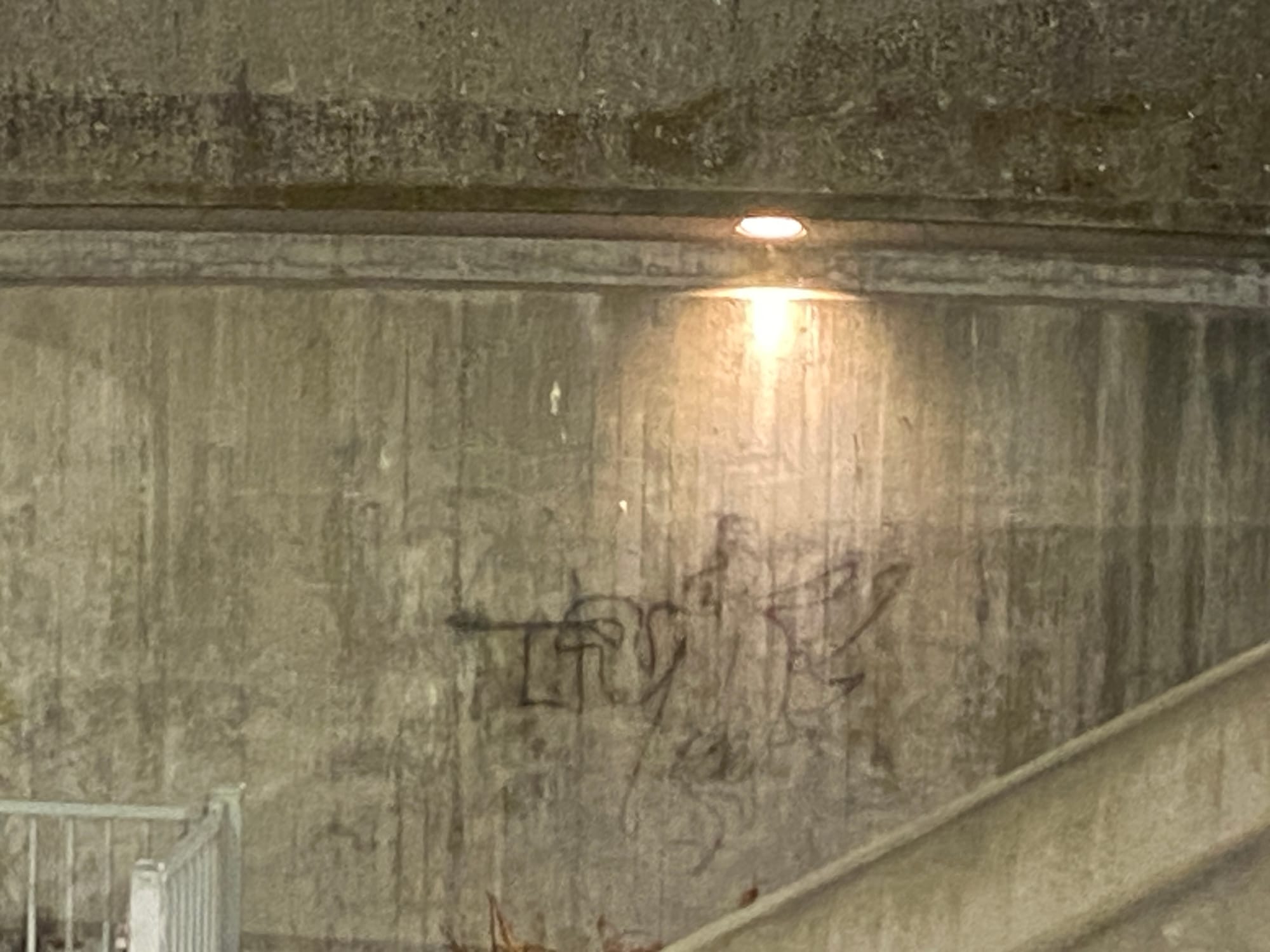
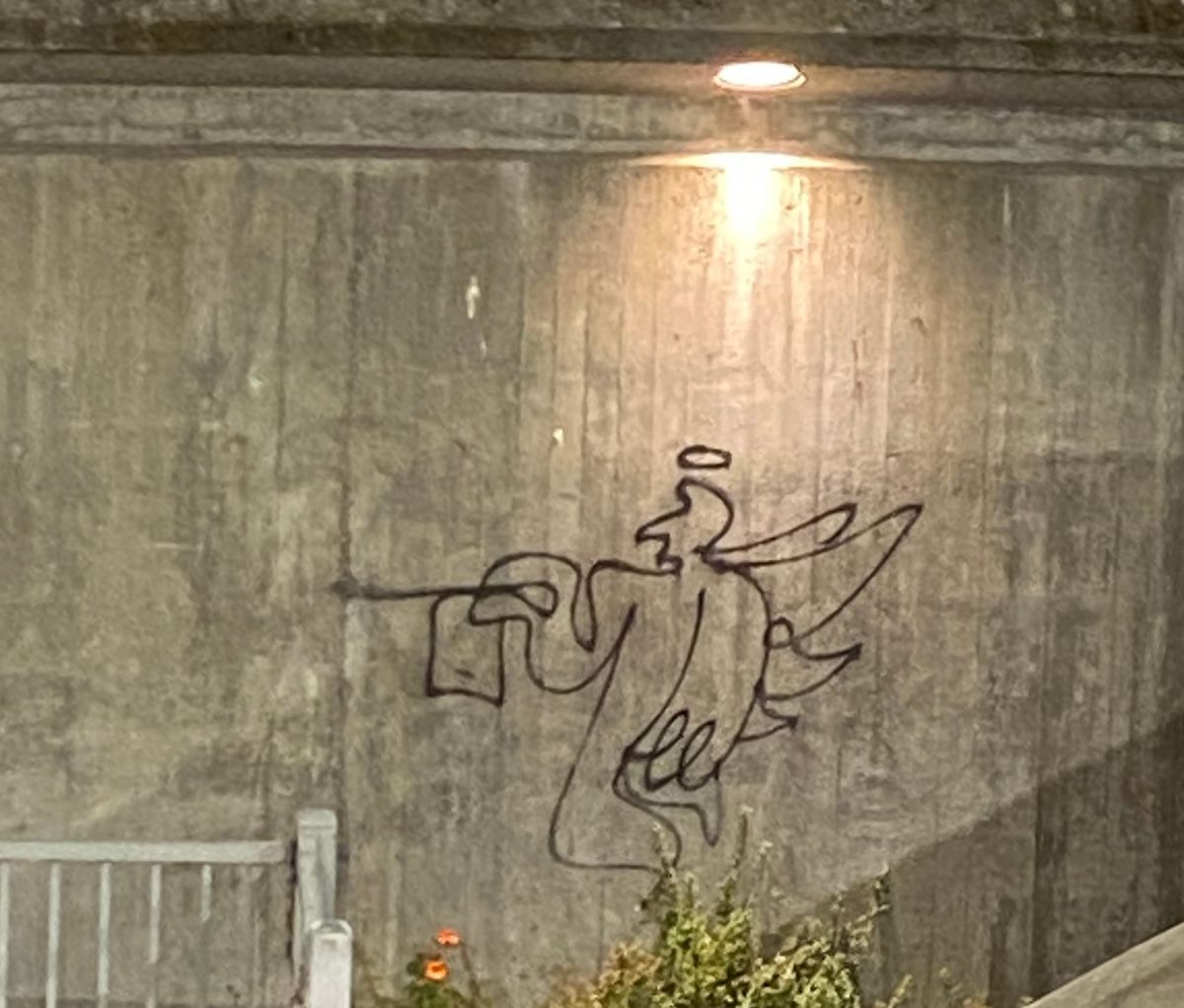
I began with a lifeguard; I end with an angel. The image at the top of this post is of a graffiti angel on the ledge alongside the staircase at the 24th Street BART (intercity train system) station in San Francisco. I saw it when I was coming up the stairs one evening and was moved that someone who had the nimbleness to get into that awkward ledge, the daring to commit this victimless crime, and the motivation and talent to draw chose to give us an angel sketched (mostly) in a single line. Like the sixteen-year-old lifeguard plunging into the powerful waves, the artist made a decision about who to be in the moment, a choice we all have. We may not know the outcome – both lifeguard and the boy he was trying to rescue could've drowned; the artist could have been arrested before drawing the angel. But we can show up.
p.s. More about that young lifeguard, Ryder Williams.
And Gil Duran on the fascists of Silicon Valley.
Bill McKibben on Trump's catastrophic energy policy which, I'm proud to say, is based on a report by Oil Change International, the great climate group on whose board I've served since 2017.
Wonderful Nation magazine story on "Inspired by Covering Climate Now’s “89% Project,” every television network and station in Japan this spring began a two-year program of airing public service commercials pointing out that 89 percent of people in Japan support climate action, 'so people shouldn’t be afraid to talk about it. And talking about climate change, the noted climate science communicator Katharine Hayhoe often says, is an essential first step towards doing something about it."
Also in the Nation, an essay about Mayor Zohran Mamdani's "politics of joy."
One more thing: they're trying to erase the angel already. But he'll live on here.