In the Dark Times Will There Also Be Singing?
This is the one-hundredth essay at Meditations in an Emergency. Thank you everyone who has joined me here.
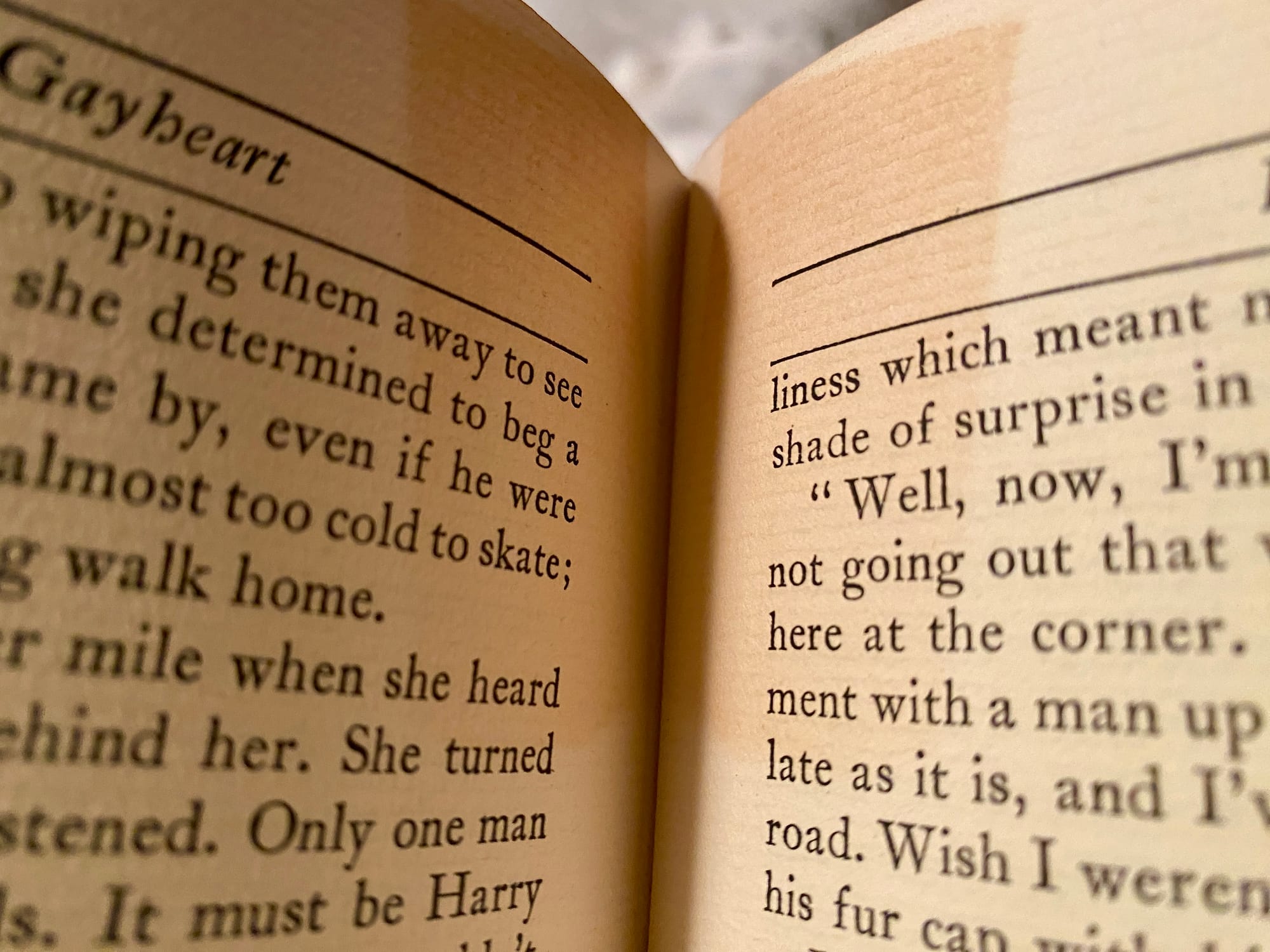
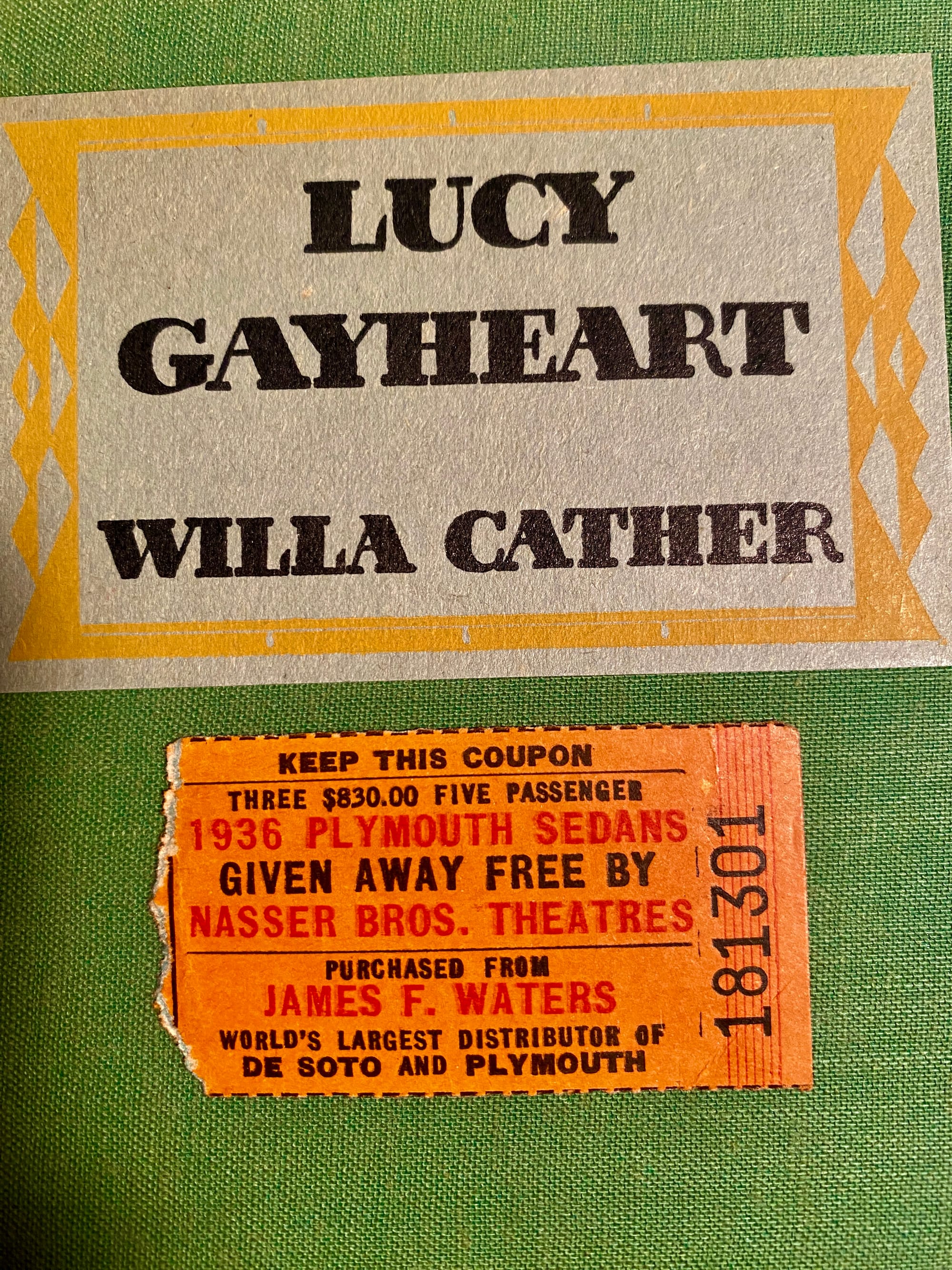
A while back I bought a first edition of a Willa Cather novel for nothing much at a library book sale. It was Lucy Gayheart (1935), one of her less celebrated books, a pretty edition, with no dust jacket, but an apple-green cloth cover with the title and author's name in fine art-deco letters printed on a rectangle of paper adhered to the cloth. Last summer, I picked it up and read it through. It felt like a companion to Song of the Lark (1915), Cather's novel of a young woman's realization of her power, her gift, and her freedom.
The latter book stands out to me because so many novels, fables, songs, films require women to be punished for their ambition, their sexuality, their talent, which amount to their apparent threat to patriarchy. Song of the Lark is the kind of novel usually written about young men, but Cather was a lesbian born in 1873 who nevertheless lived a good life in her masculine clothes with her beloved Edith and a lot of literary success that included a Pulitzer prize in 1923 and a broad readership. Somehow she did not get punished for who she was, and she in turn did not punish her heroine.
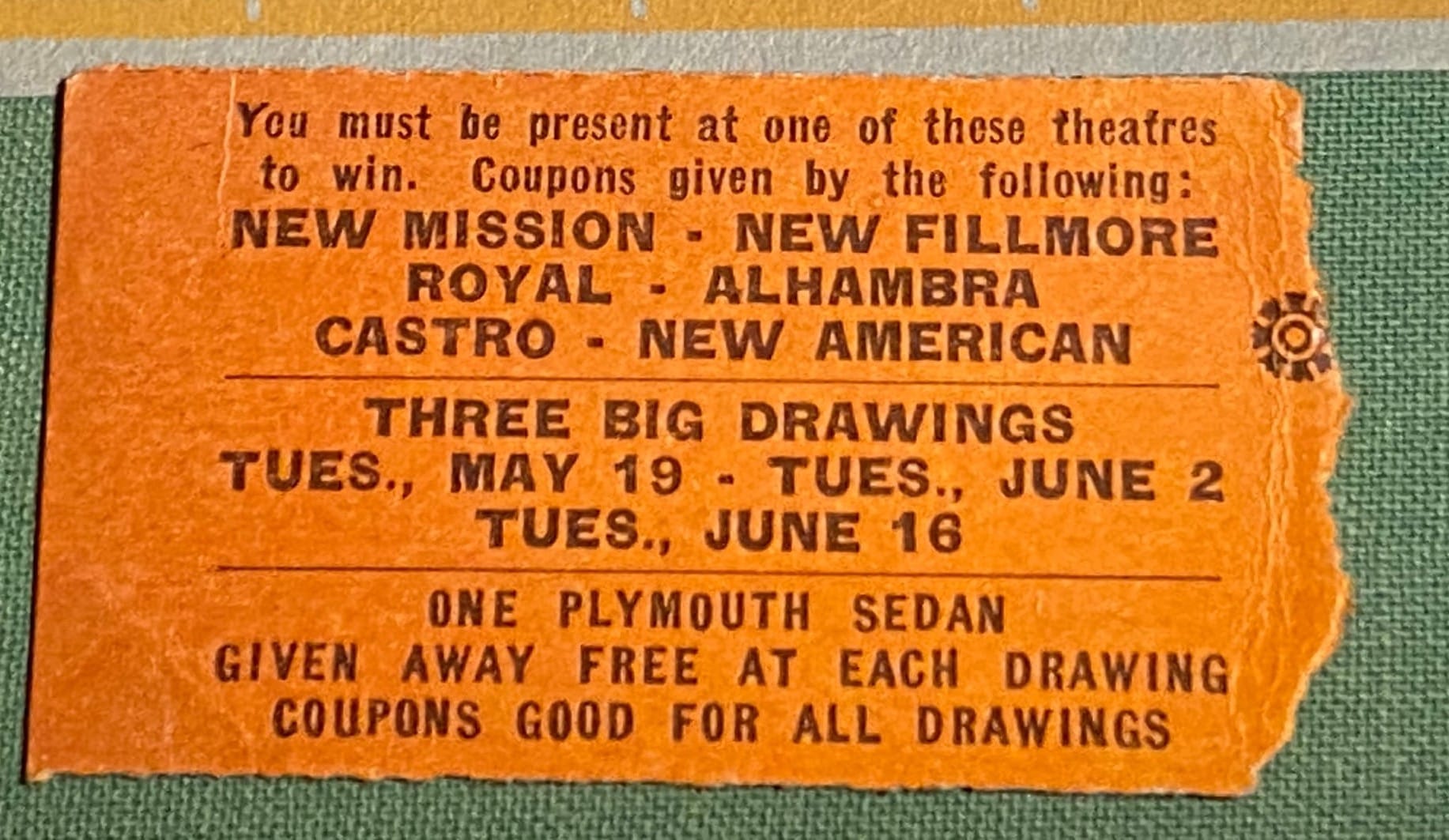
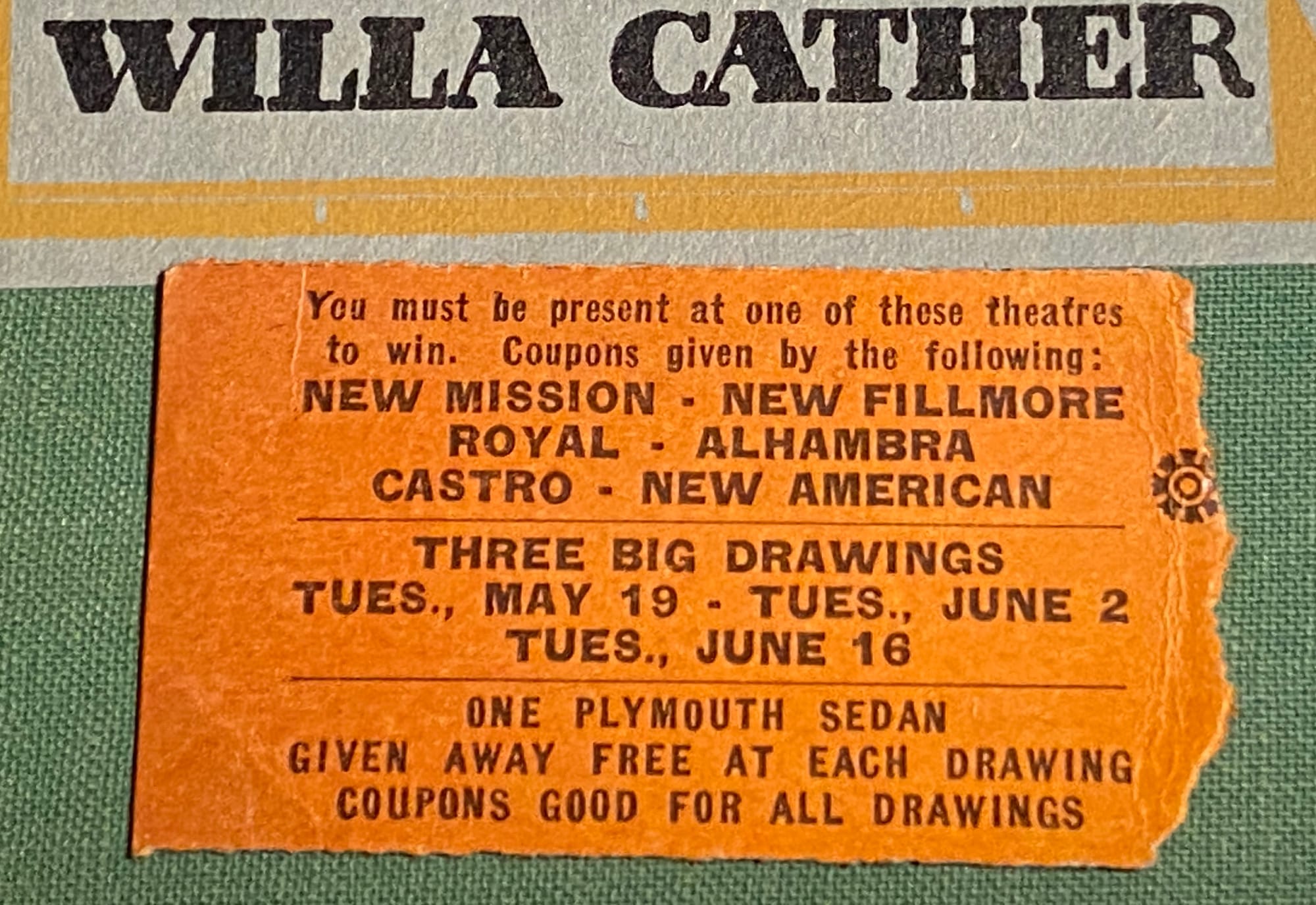
Lucy Gayheart resembles Song of the Lark in that it is a novel of a young woman from a small western town whose musical talent likewise takes her to Chicago; there the resemblance ends, because Lucy Gayheart's life is not triumph but tragedy. But this is not an essay about the novel but about the physical book and what I found in it, and yet it's not quite about that either, but bear with me. Between a couple of pages about two thirds of the way through, I found a ticket for a raffle on Tuesday, May 19, 1936, at the chain of San Francisco movie theaters owned by the Nasser Brothers, three immigrants from Lebanon who expanded from a candy factory and general store to a nickelodeon to a chain of movie theaters, one of which still exists, the Castro Theater.
The ticket was still bright orange, with red and black print announcing that three 1936 Plymouth sedans would be given away. The acid in the paperboard of the ticket had left a ghostly shadow on the pages between which it had most likely sat undisturbed from 1936 to June 29, 2025, when I found it. I suspect this means the original purchaser or recipient of the book was the only person who read it and that perhaps that marked page was as far as she got, and the ticket sat there for the almost ninety years between that reader and my reading. The ticket also told me that reader was very likely a San Franciscan, a neighbor separated from me only by time.
I've found receipts, business cards, even a pocket military manual in books, along with bookmarks from defunct bookshops, lists, letters, postcards, and the occasional squashed insect. This lottery ticket was one of the richer finds, at least to me, because one of the five theaters the Nasser Brothers owned was an important and beloved part of my life until the pandemic. In the golden age of cinema, movie houses were sometimes called dream palaces, and the Castro has been my dream palace much of my adult life.
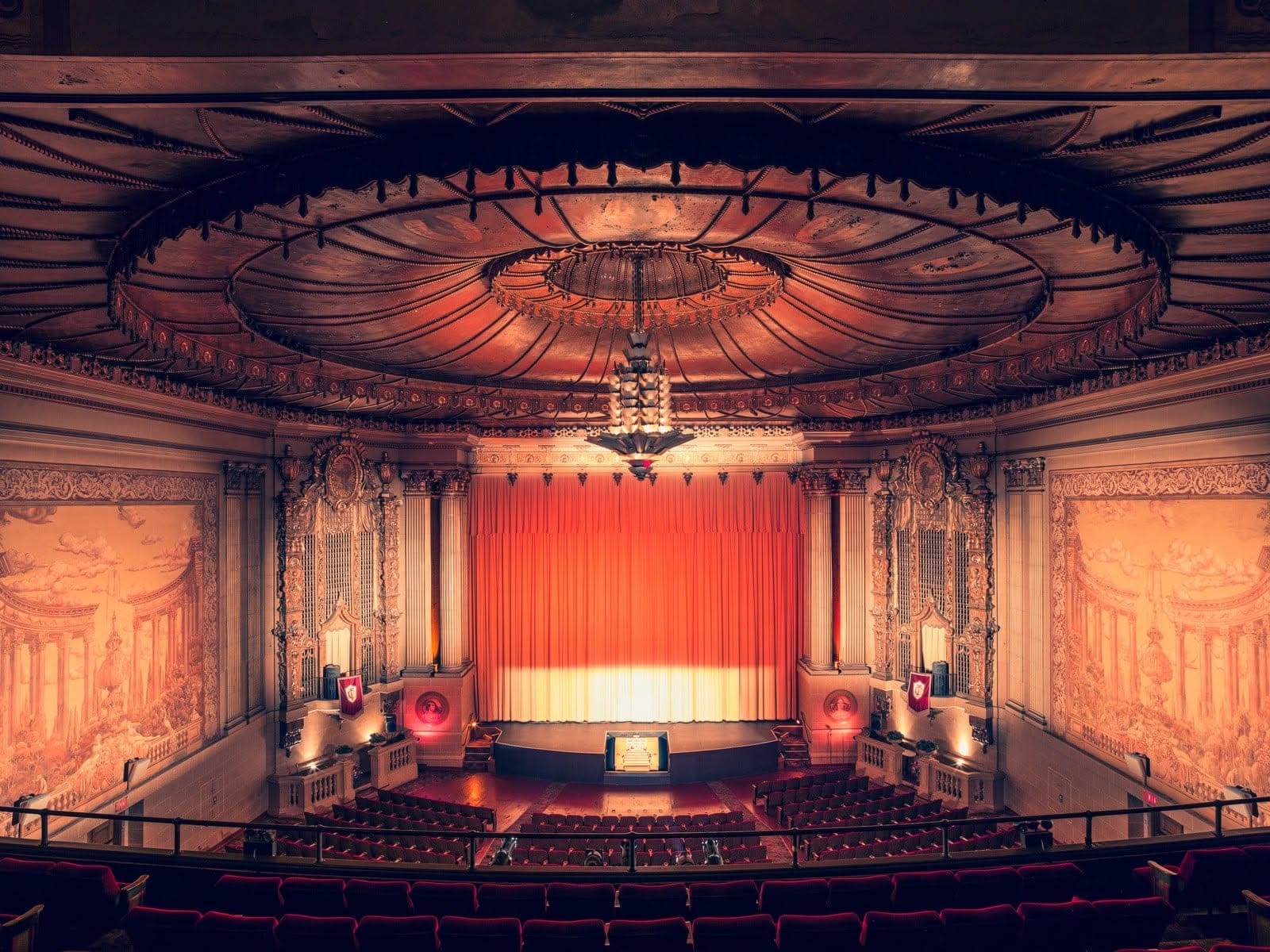
The Castro is or was the last grand single-screen theater in San Francisco, with a spacious lobby, broad stairs leading to the balcony, seats enough for 1400 people. It has plaster reliefs and murals on either side of the downstairs seating, a Wurlitzer organ that famously rises up between the front row and the stage. On it the organist for many decades played the music from the song "San Francisco" from the 1936 film of that title starring Clark Gable, and sometimes rowdy audience sang along. Its great glory was the ceiling, on which the zodiac was painted in a vast circle at the center of which was a great chandelier. But really, its great glory was the audience, because the Castro Theater was from the 1970s to its closure during the Covid-19 pandemic the heart of the most famous gay neighborhood on earth.
I wrote in 2010, "I have been visiting the magnificent Castro Theater, the last great movie palace in San Francisco, for more than two thirds of my life. The gay men in the dark with me taught me with sniggers and murmurs and sighs up and down the rows about reading the sexual subtexts and preposterous elements of movies, about how to enjoy the homoeroticism of westerns such as The Magnificent Seven, the spectacle of over-the-top femininity, the endless supply of unlikely plot twists and overwrought emotions."
I fell in love with the cinema of Tarkovsky and Antonioni at film festivals there, with the progressive blockbuster Giant starring Elizabeth Taylor and Rock Hudson, and with Taiga, the long documentary about nomads in northern Mongolia. I saw both the AIDS documentaryWe Were Here and the feature film Milk (about assassinated gay rights leader Harvey Milk) in the Castro, films in which the theater itself appears, and to be inside a theater that is inside the movie you are watching is a wonderful Moebius strip-Russian doll of an experience. I saw so many films there; I have lived for 46 years close enough to walk there, and so many evenings walked home still caught in the dream of the film I'd seen.
In that 2010 essay I wrote, "In Once Upon a Time in the West, the camera comes closer and closer to Charles Bronson’s squinting eyes, and you expect the camera, as conventional American cameras would have, to stop when his face fills the screen, a head as big and obdurate as one of those giant Toltec stone heads, but the camera travels inward and further in until the glare of his two staring narrowed eyes fills the great sail of the screen. It’s as though God were looking at you." Of course I'd seen that too at the Castro, and the sheer size of films on that screen was powerful. Bronson's eyes on a laptop or phone or back of an airplane seat or even a home screen would not have had that impact. Something sublime happens when we the congregation come into a temple of cinema and see the literally larger than life unfold.
But the theater was closed throughout most of the covid-19 pandemic and the heirs to the Nassar brothers it decided to lease it to a live-music production company, which ripped out the seats and made other renovations – but worse than that has left it closed most of the time. The theater had been a magnet pulling people into the neighborhood where they'd also shop or have dinner or drinks before or after, csupporting surrounding local businesses. The lease and the fight to preserve the seats and its historic role as a movie theater unfolded during the Biden administration, when it felt like there was more time to worry about things like that. I testified in one hearing before the city's historic preservation board, along with a lot of others, to no avail. The seats are gone. The theater has been dark most nights for the past six years.
And then came Trump's second inauguration and time to worry about things like that seemed to get shoved out of of the way by the crises, the brutalities, the destructions. What do we lose to emergencies? What poems don't get written when the poet is putting the fire out, why would any of us weed the garden or plant the lilies when the fire is raging in our home? What depths might we explore when we're not attending to crises on the surface, what would we be thinking about if we didn't all have what I think of as informational hypervigilance about the catastrophic second Trump regime and everything it's attempting to destroy?
(Symptoms of hypervigilance, Wikipedia tells us, "are clinically described as a perpetual scanning of the environment to search for sights, sounds, people, behaviors, smells, or anything else that is reminiscent of activity, threat or trauma. The individual is on high alert in order to be certain danger is not near; it can lead to a variety of obsessive behavior patterns." In my case and maybe yours, the combination of the endless stream of online political information and interpretation and constant anxiety about what is happening and what might happen in this destabilized country headed by a corrupt idiot means obsessively monitoring the news and the discussions of the news means you can never stop monitoring the crises. I think a lot of us feel that if we fully understand what's going on it is somehow not out of control. It does contribute to making us an informed electorate but there's a lot to be said to walking away from it all so you come back recharged and refreshed.)
I think about these impacts for all of us. I feel them for myself. In writing about the crisis again and again, what have I failed to pay attention to, to defend, care about, dream about, write about, what part of myself have I lost or forgotten? What do we neglect, what weeds spring up in the garden of civic life and the forests of imagination, in times like these? This newsletter is called Meditations in an Emergency, because I think understanding the emergency more deeply is what equips us to respond effectively, and because I love the oxymoron: meditation implies stillness and contemplation, an emergency something unfolding suddenly and dangerously. But I wonder how the emergencies capture us and undermine the meditations.
I have meant for years to write a follow-up essay to that 2010 piece about about the profundity of committing yourself to sitting in the dark – no fast forward, no rewind, no choosing another film unless you're prowling the multiplex – with strangers for an extended period, about all the beloved rituals of standing in line, the little colored tickets from the ticket booth very much like that lottery ticket, the alluring smell of popcorn at the concession stand, the trailers before the feature, and all the rest. And about what has happened to San Francisco as it has lost almost all the movie theaters it once had. Shared experience, being out in the world, has been so withered by the forces of Silicon Valley, which have in some ways taken over the city.
Walking down the street, going to the movies is not in itself the revolution or the cure. But something about that experience and many like it are what knit us together into a society, people who dare to coexist with each other and embrace the diversity of the nation, people who go out into the world among strangers, people who can sit in the dark together and take in a shared experience. This is how the big things are made up of little things.
The everyday habit of coexisting with others is, I think, foundational to democracy, because democracy is itself based on having a sense of connection to and something in common with people who are not like you, not known to you. That sense arises from experience, from being out in the world and those countless little interactions that acquaint you with these others and set you at ease among difference. Demagogues whip up hatred in some people for others they too often don't encounter in person but only imagine through the filters of fear and propaganda.
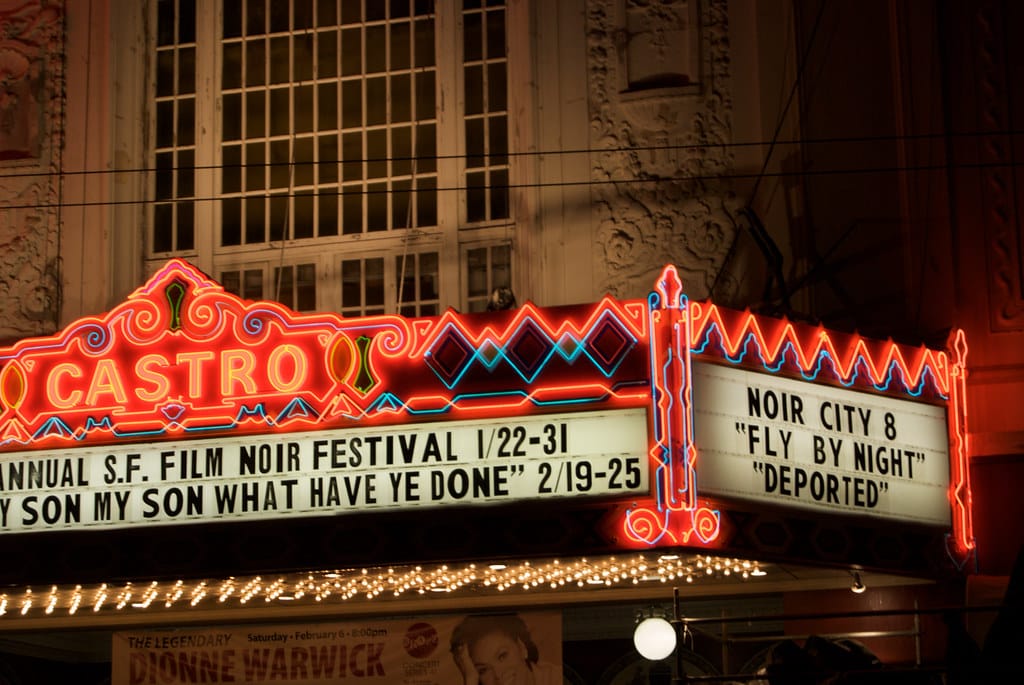
The Castro used to host Eddie Muller's annual Noir City film festival and I used to go every year (now it's at the Grand Lake Theater in Oakland). Watching these glorious, gritty movies taught me that, first of all, the beloved wasn't another human being, but the city itself, the place full of shadows and mysteries, rivals and allies, and if the protagonist survived he (or sometimes she) did so through intimacy with the place, by knowing the cop, the cabbie, the hat-check girl, the chop-suey-joint proprietor, by being a man or woman about town.
Are we neglecting the little things when we withdraw from civic life, even from getting to know the check-out clerk or the bus driver (maybe by no longer buying groceries in person or riding public transit)? The person zoning out staring at their phone to figure out where everything and anything is and flinching at unmediated human contact or just staying in all the time is about as unlike these protagonists as possible. Of course it's not all up to us: the grand gesture of hailing a cab is dead when there are no taxis, just Ubers you hail through an app.
I have written about Silicon Valley and its impact on our culture and consciousness for decades, and they are part of this crisis, which arises partly from the corruption of information at the hands of its oligarchs, from the money they have pumped into increasingly right-wing politics, from the way consciousness itself has changed, and from how they have lured us into spending more and more time online that is less and less time with each other and the greater world, urban and rural. We have withdrawn from public life and face-to-face social connections or it has withdrawn from us (though I think a quiet thing going on is an increasing dislike of this new tech-dependent, distracted, disconnected way of being and a desire to return to something more like the old one). The lottery ticket was a ticket back to when movie theaters were the only place you'd see films, when they were central to life, and all the rituals of dressing up to go out and see one were thriving.
The ticket to 1936 was a ticket to the height of the Great Depression, but also to a time when a kind of embodied experience, a kind of public life, a capacity for connection had not been undermined yet, which is to say they even in the dire poverty of the time had a kind of wealth we have squandered or had stolen from us. But the ticket dangled before me as if it was a ticket for me to write about something a little more removed, a little less urgent. I miss who I was as a writer before the current crises, which is to say I miss what I might have thought about, what I might have written, where my attention might have gone.
"In a peaceful age I might have written ornate or merely descriptive books, and might have remained almost unaware of my political loyalties. As it is I have been forced into becoming a sort of pamphleteer," George Orwell wrote in his essay "Why I Write" after the Second World War. To support his wife who took a government job in London during the war, he had left his beloved garden and rural life behind, and then taken a job with the BBC himself, during which he did little writing aside from scripts for the radio show he produced.
Later in that 1946 essay, he declares, "Every line of serious work that I have written since 1936 has been written, directly or indirectly, against totalitarianism and for democratic socialism, as I understand it. It seems to me nonsense, in a period like our own, to think that one can avoid writing of such subjects. Everyone writes of them in one guise or another." He's arguing that all art is political, that in what we value and deplore, focus on and ignore, we articulate a set of values and priorities.
In that spirit, I can argue for movie theaters as bastions of democracy, of shared experience, of common ground, now largely abandoned, and make it a parable about the larger issues, or discuss these spaces as speces of democracy. Or I could argue – and I have, including in my book Orwell's Roses when I talked about Orwell's insistence throughout his mature life on pursuing pleasures including gardening, keeping pets and livestock, going fishing, and wandering around the countryside – that we sustain ourselves through pleasures in the small things. Orwell's friend George Woodcock noted, “The source of his self- regenerative power lay in his joy in the ordinary, common experiences of day- to- day existence and particularly of contact with nature. He fed from the earth, like Antaeus.” I've been arguing about what connects us to other human beings, but what connects us to the more-than-human matters too.
I have not stopped connecting to it, and in fact I write from New Mexico, where I do so more than ever, but the way the shadow of the tree reaches out like a hand to hold me just after sunrise, and magpies fly into last summer light so thick and golden they looked like arrows shot into honey have not found their way into my writing. Those experiences anchor and reinforce us so that we can go back to address the large ones, the troubles and dangers of the political realm. I have done that in my personal life but in my writing, I have lost track of the small things. I want them back. I hope to bring them to you through my words.
I've also been thinking about the German playwright Bertolt Brecht and his famous lines:
What kind of times are they, when
A talk about trees is almost a crime
Because it implies silence about so many horrors?
That man there calmly crossing the street
Is already perhaps beyond the reach of his friends
Who are in need?
Reading them today, I picture the man crossing the street as perhaps someone about to be seized by ICE, thrown into a gulag or deported to a country he has never seen. But for a long time I disagreed with the rest of it, because trees are inside the politics of our time, but also because paying attention to trees is part of the reinforcing and grounding and renewing that equips us to go do something about the person about to be seized by ICE. Or about the trees threatened with clearcutting.
Still, I've long thought that maybe the Germans who didn't show up for their neighbors being sent to the camps and the gas chambers were focused on planting the tulip bulbs, on preserving norms, on keeping their own lives pleasant. Perhaps that's what Brecht meant. To check out of politics entirely is a sin, to wallow in them without reprieve a mistake. But how does anyone strike a balance in such unbalanced times?
In the 1990s, the American poet Adrienne Rich argued with Brecht, and it includes the kind of concern we have now. In her poem "What Kind of Times Are These," she described "our country moving closer to its own truth and dread,/its own ways of making people disappear."
Even so, she concluded:
so why do I tell you
anything? Because you still listen, because in times like these
to have you listen at all, it's necessary
to talk about trees.
She makes an argument I agree with and Orwell exemplified. In order to be the people who have the awareness, the concern, the capacity for attention and understanding necessary in ordinary times and times of crisis, we need to pay attention to trees, to talk about them, to think about them. By trees, I think Rich and then I mean the lives unfolding all around us, the details and the big patterns, the world of the senses, which tells us over and over that the most tangible and the most profound are often the same thing. After all, our metaphors, parables, and myths are all grounded in the embodied and organic realms.
In Nineteen Eighty-Four, Orwell wrote of the totalitarian regime looming over everything in the novel, “The Party told you to reject the evidence of your eyes and ears. It was their final, most essential command.” So does Trump and all authoritarianism. Studying Orwell while living through Trumpism taught me that authoritarians want to discredit all systems of knowledge other than themselves, to undermine the authority of fact, truth, science, history, independent media but also of our own senses and sensibilities.
To cultivate that awareness through, maybe, conversations about trees or gardens or cooking or songs, through relationship and thought and thoughtfulness but also through direct and unmediated experience with the world around us is a form of resistance. Or, rather, it helps us be those independent beings who are capable of resistance, whether it's simply a refusal to swallow a lie or actually participating in an uprising.
Orwell's protagonist in Nineteen Eighty-Four resists through independence of thought, memory, a diary, a love affair consummated in the ordinary rural glory of "the golden country." He fails in the end, but I do not think Orwell meant him to be a hero, only an everyman, one who thinks “if there is hope . . . it lies in the proles," and whose last thoughts before he is seized by the police are about a stout proletarian woman signing in a magnificent contralto voice he watches and listens to from a window. He admires her, thinks she is to a beautiful young woman "as the rose-hip to the rose," a metaphor only possible to one who knows roses.
And Brecht, my friend Joan Halifax reminds me, contradicted himself when he wrote:
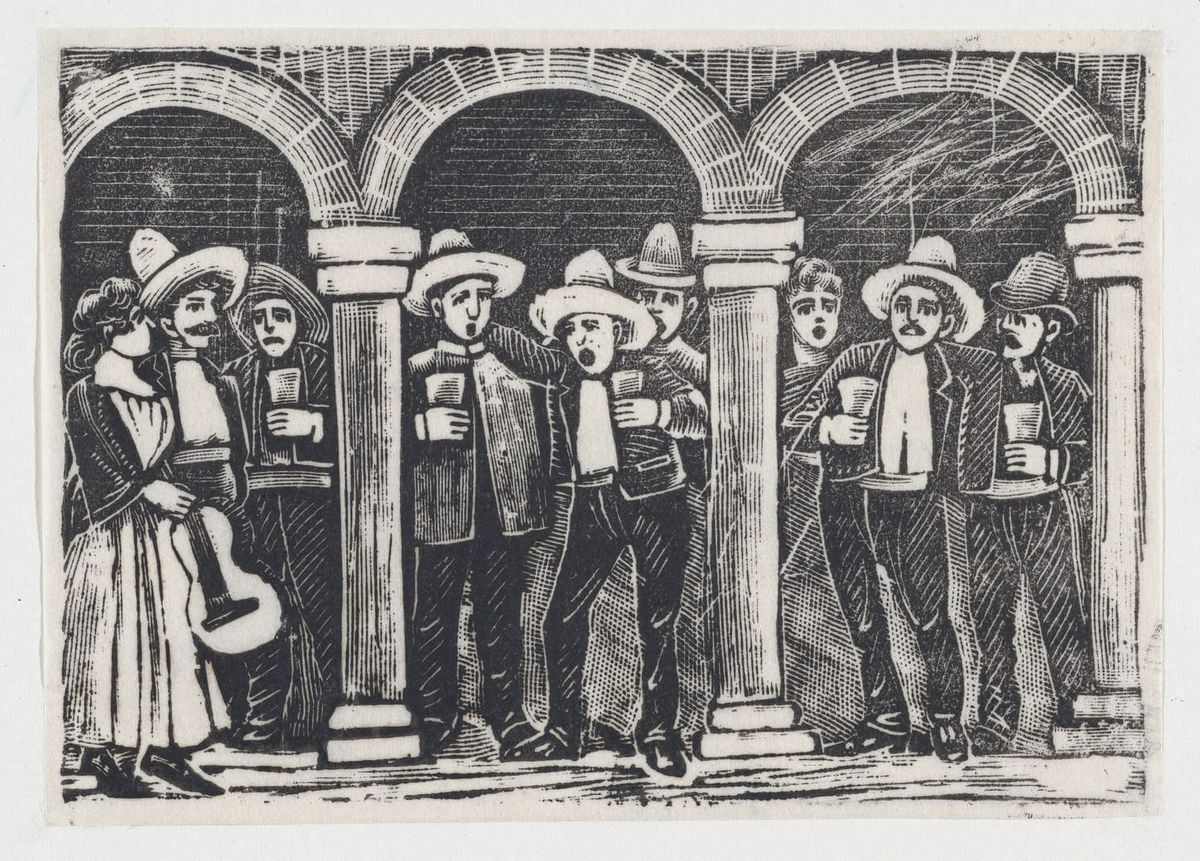
In the dark times, will there also be singing?
Yes, there will be singing.
About the dark times.
And maybe about hope, love, beauty, forests, rivers, light and darkness, summer and winter, apple blossom time, about flowers on graves and foxes in the snow and birds of a feather, about fast cars, and the Old Town road, about who we have been and who we can be.
I've worked hard on this one, and I'm publishing it because I try to publish at least weekly, but I'm still musing on these subjects, as a person, a citizen, an activist, a writer. I'm proud to have reached 100 essays/articles at this site and amazed to have reached 100 in not quite 500 days. And I'm grateful, as ever, to everyone who subscribes, especially the paid subscribers who make it possible for me to focus on this work.