We Are Crashing Into the Future (Or It Is Crashing Into Us)

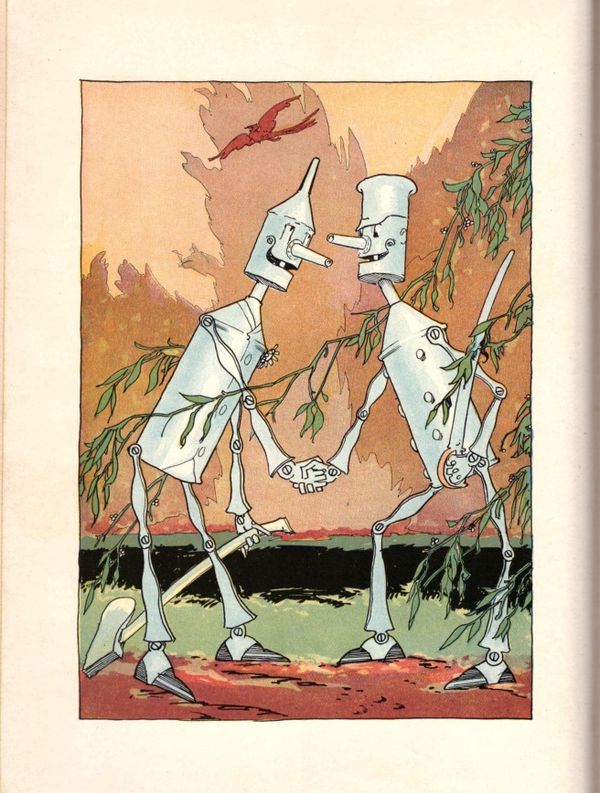
The Autumn of the Patriarchs
One common and inaccurate picture of change assumes this thing so obvious, so potent in the present, will just continue to expand and the future will be like the present, only more so. This version ignores that individual actors and collective forces can suddenly emerge or implode, that history often takes sharp turns, that something that has held for decades or centuries can suddenly snap. Those who assumed that authoritarianism could only expand from the successes of the Orban regime in Hungary, the Putin regime in Russia, and the Trump regime in the USA should be making their adjustments now.
A caterpillar hatches out of the egg and begins to eat voraciously, growing so much it repeatedly splits its skin and emerges in a new skin – instar is the word for these molts. But change isn't just successive instars. Several instars along, the caterpillar forms a chrysalis and literally liquidates itself into a kind of goo from which a butterfly will be formed. I believe that we are a global society in a state of dissolution, and out of this messy fluidity new things both monstrous and magical are emerging.
Viktor Orban was ousted in a surprise defeat a few Sundays ago, shortly after US Vice President JD Vance went there to campaign for him. Hungarians are celebrating a return to democracy and affirming their ties to the European Union. Newly elected prime minister Peter Magyar has said he's cutting off Orban's funding to CPAC (that these America First people were propped up by foreign money should be a huge scandal, but it's been quietly reported as no big deal when it's reported at all in the mainstream, like all the other grift, corruption, and lies). At his inauguration Magyar said, “I apologise to all those civilians, teachers, journalists, health workers and public figures who have been stigmatised, harassed, or treated as enemies for daring to speak out, for daring to stand up for the vulnerable, for criticising, or for simply expressing a different opinion.”

Meanwhile in the USA, Trump continues to fail politically, physically, and mentally (for one thing, he's dozing in public meetings more and more). The unbreakable low of his polling numbers broke and went lower, and Republicans are – well who knows what a party that has abandoned all its principles and larger goals to obey an idiot who's certainly a white nationalist but mostly interested in serving himself does when the idiot is no longer there, but we'll find out.
Trump aka Epstein's best friend has allied himself with the ultra-rich and a lot of the ultra-rich have returned the favor, notably the tycoons atop most of the fossil fuel industry and much of the tech industry. Centibillionaires Bezos, Musk, and Zuckerberg were there on the inauguration platform on January 20, 2025. Because an elite minority is breaking the majority's ability to get by, and that will come with consequences. The fact that farmers have been devastated first by Trump's tariffs and then by the huge spike in fuel and fertilizer costs may shift something in long-conservative rural America. Silicon Valley's oligarchs has swung right and made itself hated, and the men at the top seem too insulated to notice.
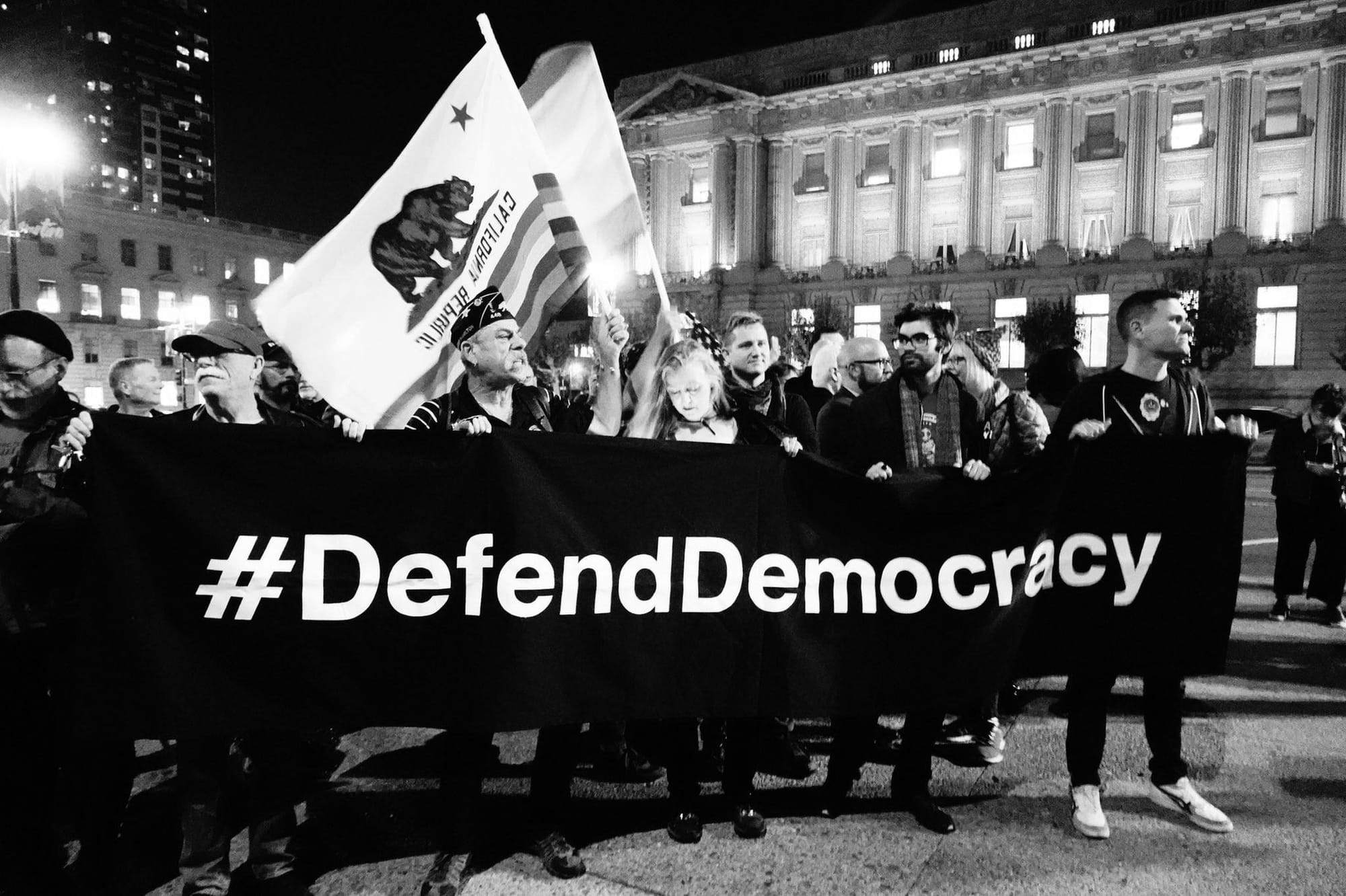
But a tide of anti-elitism has turned against the super-wealthy and manifestations of their privilege like the Jeff Bezos-hosted Met Ball and the Epstein revelations. Trump's obsession with building a gilded ballroom and other garish monuments to himself while countless people are sent into dire poverty domestically and starvation or death thanks to the destruction of USAID by Musk is not helping. Anti-elitism also includes the nationwide campaigns against data centers as well as against attempts to turn empty warehouses into ICE detention facilities, solidarity with the immigrants, refugees, and brown and Black people under attack, plans to levy new taxes on the ultra-rich from California to New York, and the expansion of #nokings protests into more rural and redder parts of the country.
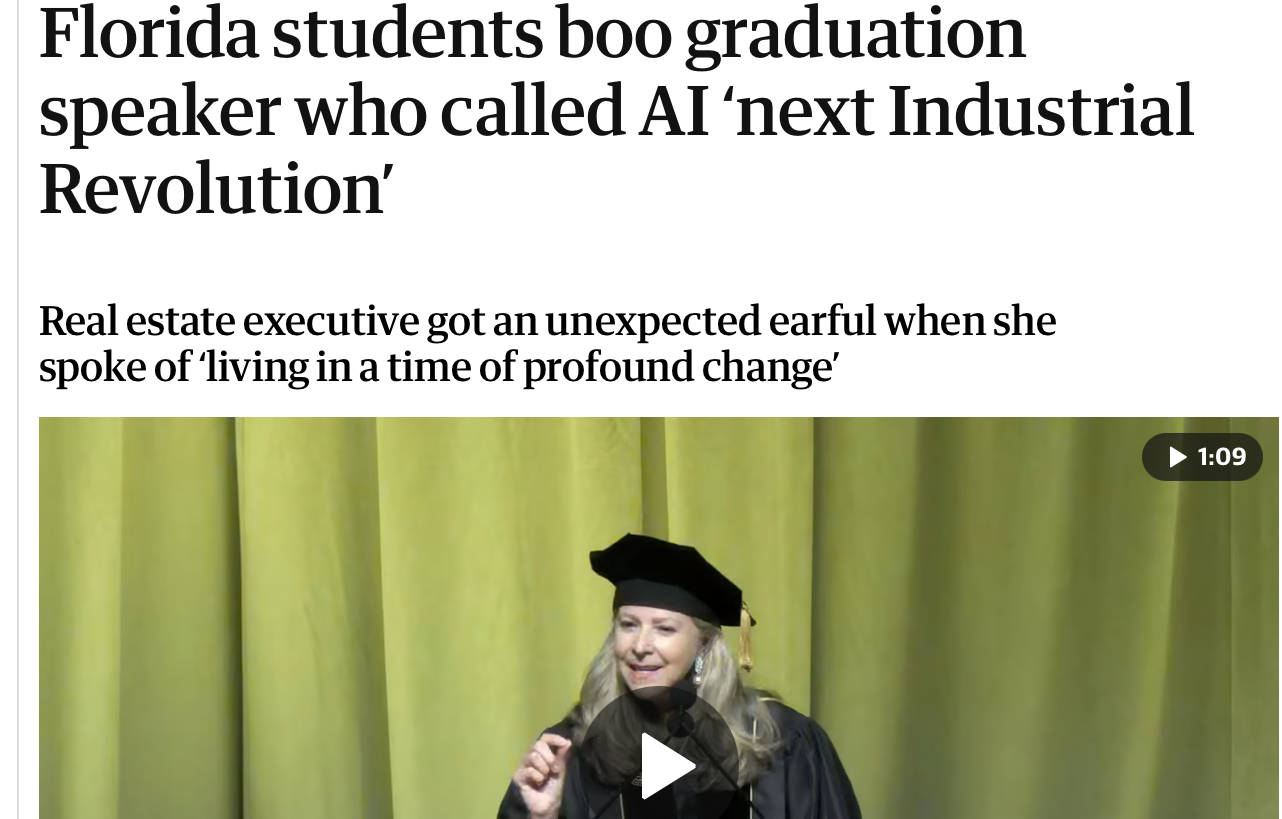
And it includes the fact that while elites and invested parties continue to insist that AI should invade every aspect of our lives, the pushback shows real and justified resentment and distrust. Among the young, various sources have told me, AI is pretty much an insult, something to jeer at. It is striking that few want the destruction of jobs and information corruption AI promoters intend to bring. It is an imposition, for profit, against the will of the people. (Happily, though, an insider tells me, OpenAI may go bust this year, and if it does, the schadenfreude will be off the charts even though it will also probably crash the economy that has dumped so many trillions into AI startups' money-burning furnaces.)
But about that federal failure: the New York Times states, "In January, a nationalistic Beijing think tank affiliated with Renmin University published a triumphant report about Mr. Trump’s first year back in office. The report argued that his tariffs, attacks on allies, anti-immigration policies and assaults on the American political establishment had inadvertently strengthened China while weakening the United States. Its title: 'Thank Trump.' The report called Mr. Trump an 'accelerator of American political decay.'" That the right is forever talking about manhood and strength and Trump cabinet members are even embarrassingly performing all those public pushups and chin-ups and flexes while the administration is greatly weakening what has long been the world's leading superpower will be an interesting thing for future historians to unpack.
Not that we have to wait: on May 9, historian Timothy Snyder said of the catastrophic attack on Iran: "The United States has just spent billions of dollars to lose a war that enriches its oligarchs, impoverishes the citizenry, sabotages its alliances, and strengthens its enemies. As justification for the self-destructive mindlessness, the White House gestures towards Jesus and genocide. Empires have risen and failed before, but to my knowledge no state has ever chosen to kill its own power, and succeeded with such rapidity." Things are changing fast.
Domestically, Trump and his supreme court and MAGA Republicans are trying to go backward as fast as they can. They're attempting and sometimes succeeding in taking away the rights so many fought so hard to secure: voting rights for Black and brown citizens, reproductive rights for women, queer rights, immigrant and refugee rights, vaccines and access to crucial healthcare, as well as our right to a clean and healthy environment. In the wake of the Supreme Court's six-to-three dismantling of yet another piece of the Voting Rights Act, Louisiana announced it would like to re-erect some of the Confederate statues that have been taken down there. Happily some of them in other states are in no condition to return. The much-contested Robert E. Lee statue in Charlottesville, Virginia, which is currently two tons of ingots awaiting its next form (and the proposals are in). In Los Angeles, artist Kara Walker exhibited an extraordinarily reconfigured Confederate monument in which horse and rider become a fractured monstrosity. She titled it Unmanned Drone.

Inside the national chrysalis, in our civic meltdown, something is shouting it would rather go backward. The right is openly, directly pursuing regression, rollback, backlash. They want their half-imaginary past back, and they also recognize that in order to pursue their anti-egalitarian agenda they need to suppress democratic participation. But the imaginal cells in the goo are instructions for it to reform as a butterfly, not return to a caterpillar.
Meanwhile, a number of observers are suddenly confident in declaring that Putin's Russia is losing the war launched on Ukraine in February of 2022. They note that Russia is fighting a twentieth-century war with masses of soldiers and heavy equipment that greatly exceed Ukraine's, but Ukraine is fighting a twenty-first century war. The key innovation is drones, which is why Russia suffers five or six times the casualties of Ukraine. They're also how Ukraine has been able to penetrate deep into Russia to attack infrastructure, notably fossil-fuel infrastructure – and fossil fuel is Russia's main export product, a pillar of its now crumbling finances. Russia is badly damaged, between loss of fossil-fuel revenue, massive losses of military equipment, and more than a million casualties, including by some estimates about a third of a million combat deaths.
Kateryna Odarchenko wrote late last month in CEPA (the Center for European Policy Analysis), "Ukraine’s war is increasingly shaped by operators, engineers, and algorithms — and systems that are expanding battlefield reach while reducing combatants’ exposure to risk. Since the full-scale invasion, drones have evolved from basic reconnaissance tools into the backbone of Ukraine’s battlefield operations and are now used against roughly 80–85% of frontline targets. Nowhere is this more visible than at sea. Ukrainian naval drones such as the MAGURA V5 have struck high-value Russian targets, damaging warships and even downing a Russian Mi-8 helicopter over the Black Sea. In effect, Ukraine has demonstrated that sea denial, once the domain of major navies, can be achieved with low-cost autonomous systems. Iran, too, has used cheap systems to contest the seas around its coasts. This system-level approach extends to long-range strikes on Russia’s energy infrastructure, defense industry, and military units."
The new weapons, Odarchenko notes, depend on satelllite systems and sometimes artificial intelligence. I can't say this is a good change in general, glad though I am that this time it's Ukraine that's wielding it. But it might be a democratizing one, in that the money for big armies and big weapons is no longer decisive. Maybe more broadly it invites a reconsideration of what is power or what powers matter. Putin, like Trump, has made his country weaker and more isolated in his pursuit of stale fantasies of power.
Fossil Ideas and Fossil Fuels
Strikingly, the USA, Iran, and Russia are all major fossil fuel powers; strikingly they have all created fossil-fuel crises that have sped the transition to renewables. Climate leader and writer Bill McKibben has also noticed the acceleration of change, writing, "Our world seems to me to be moving very very fast these days—often that’s because of the feral energy of the Trump White House, feverishly trying to do the wrong thing on as many fronts as possible. ...But something else is moving fast too, and far more productively—that’s the ascension of new technologies.... California’s new batteries, installed over the last 36 months or so, are the equivalent of a dozen new nuclear power plants. Bottom line, from Stanford’s Mark Jacobson on Tuesday: California using 61% less natural gas this year to generate electricity than it did three years ago."
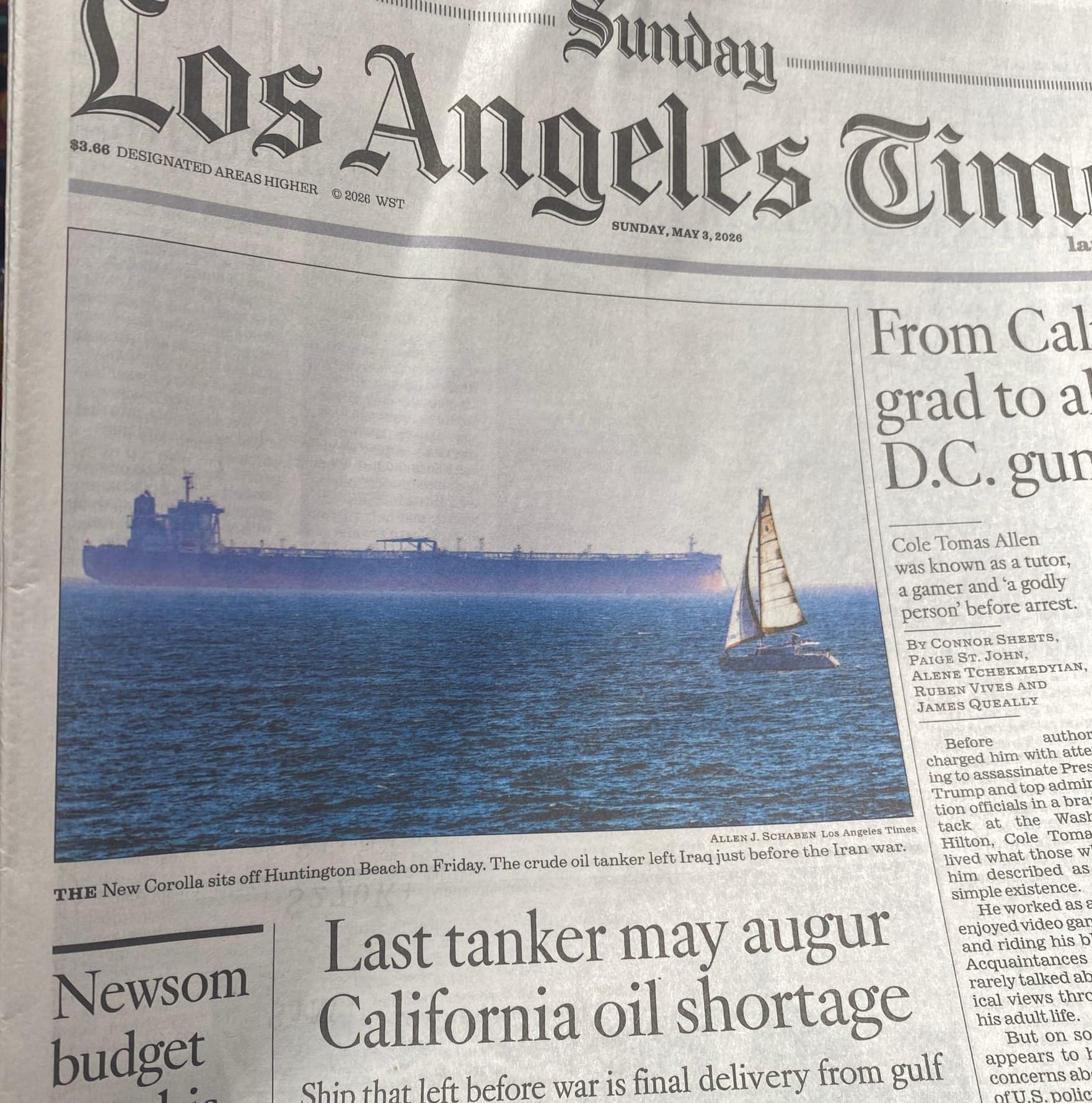
But the Trump Administration is trying to roll back change, punishing and preventing renewables, privileging fossil fuel even when it's the most expensive way to produce electricity for a community. The US is falling behind technologically and suffering economically from this blockage of renewables, but many states, municipalities, businesses, and individuals are proceeding anyway. And we are not off fossil fuel yet. Transit expert Tom Radulovich writes, "About a third of the oil used by Californians comes from the Persian Gulf. California isn't connected to the pipeline network that spans much of the central and eastern US and Canada, so it has been cheaper to bring oil by ship than over the mountains in tanker trucks and trains. The last tanker to leave the gulf before the US-Israel-Iran war closed the Strait of Hormuz arrived in Long Beach last week. The state estimates there's about eight weeks' supply of oil in storage or currently being refined, after which Californians will have to find a new source for a third of the oil we use." Bloomberg News notes, "The world has burned through oil inventories at a record speed as the Iran war throttles flows from the Persian Gulf, eating into the very buffer that protects against supply shocks." Across the world emergency supplies are being burned now. If and when they run out the trouble really begins.
The shutdown of the Straight of Hormuz is breeding many crises; many Asian countries felt it immediately; many places and parts of the economy in the US will later. Europe is feeling a second wave of impact, the first being, in the wake of the invasion of Ukraine, the loss of Russian oil and gas or the decision to turn away from them when Europeans realized they were Putin's cash register. The New York Times notes " For the second time in under five years, Europe is contending with an energy crisis set off by a war. Europeans have responded to the price shock by rushing to line up heat pumps, solar panels and electric vehicles. They are hoping to lower their bills and reduce their reliance on imported fossil fuels."
The Spring of the Matriarchs
Fossil fuel is itself something of a fossil. So is traditional patriarchy, and the two are linked in all sorts of ways. Andrew Boyd writes in the Guardian, "Coined by political scientist Cara Daggett in a 2018 paper, “petro-masculinity” describes a pernicious fusion between fossil fuel use, climate change denial, and defense of authoritarian white patriarchal masculinity. Noting how fossil fuel extraction and consumption are coded “masculine”, while environmentalism and green technology are coded soft, weak and “feminine”; it tracks how insecure men are increasingly leaning in to a petro-masculine identity in order to assert traditional masculine authority in the face of climate change, threats to traditional extractive industries, and changing social norms."
We have heard a lot about men's unmet needs in recent years, often with the idea that society should reorganize itself to meet them as though somehow men are the customers and the rest of us the servers who owe the men in question companionship, understanding maybe sex, rather than that men are part of society (and hold most of the economic and political power). One striking aspect of this is: a lot of what has isolated, alienated, and rendered miserable a lot of men is all the dank corners of the Internet – misogynist porn, the manosphere, conspiracy theories, the predatory industries of online sports betting and crypto currency, the sheer amount of time spent online that has withered habits and systems of face-to-face contact. The Internet is itself largely a creation of men in Silicon Valley; they have made their products most of all for people like themselves, and it turns out that their products are toxic. Yeah, those men who sat on the platform with Trump on inauguration day and their fellow broligarchs.
The loneliness and unslaked lust of women is not treated the same way: as a problem others need to rally to address or society should address, but maybe as a result women are – well insert Aretha Franklin and Annie Lennox singing, "Sisters Are Doing It For Themselves" here. Because what I am beginning to see more stories about is: women are self-sufficient now; they have economic and social lives that are often pretty good, and have overall done better than men in figuring out how to adapt to the new employment landscape. While many straight women would like to have a male partner, we are more than ever unwilling to accept neglect, abuse, and inequality the way that we once had to in a society that rendered women, especially women with children, financially dependent and socially pressured to be partnered (and a lot of young women are turning to other young women for partnership). A spate of articles celebrating female autonomy aka "decentering men" has begun to appear. Soraya Chemaly writes, for example, "Formally or informally, women are decentering men, even if they never use that word. This is not because women actively hate men but because women have access to the education, money, birth control, some reproductive rights, and legal standing that make male centrality and approval optional rather than necessary."
Meanwhile, there've been conversations among right-wing men that boil down to: how do we get what we want from women without giving them what they want? How do we make ourselves inevitable rather than desirable to women? (Which is what makes a lot of women not want to have anything to do with them.) Their answer is regression, of course: reinstate the economic inequality that leads to dependence, keep women at home cooking and tending babies. prevent their equal access to the professions, pretend they're less competent, discriminate against them – as Pete Hegseth is doing openly in the US military. Another part is depriving women of reproductive rights, and reproductive rights are an essential part of economic freedom and equality. It's Make America 1958 Again.
I know, not all men, and I was glad to read this at the Good Men Project's site: "On one side, men’s loneliness gets treated like a shocking new discovery, as though men just woke up one day and said, wow, this hollowed-out feeling seems suboptimal. On the other side, people say—often with plenty of reason— yes, but women have been dealing with the emotional fallout of men’s disconnection for generations, so are we really centering men right now? The answer, annoyingly, is that both things contain truth. Men’s loneliness is real. So is the labor it has often cost women." I often wonder why society doesn't just conclude something like "hey, the way we socialize girls leads to far less crime and far more capacity for friendship and caregiving, so let's study and emulate what we're doing right here?" Okay I know why.
But women have moved forward. The goo is not going to become the caterpillar again; and American women are not (influencer online tradwife poseurs aside) going back to the fifties; the only way out is forward. But to men's credit, I'm seeing a lot more of them, in the shadow of Epstein files, step up to talk about violence, including sexual violence, against women and children and its roots in rape culture and men's responsibility to address it.
From global geopolitics to major technologies and industries to our most intimate relationships and identities, everything is changing fast. I believe we're in an era of dissolution and that that's a lot of what transformation looks like; I also know that the struggle to emerge from the chrysalis is hard and not all of the butterflies make it. I see the past receding and the future emerging at dizzying speed.
p.s. I take great pleasure in the illustrations for these pieces and I hope you do too. I'm so grateful my friend Tino Rodriguez let me use his painting atop this one. Its variation on the Mexican motifs of flowers and skulls, life and death, felt perfect for the topics. He's also painted skulls made out of flowers and many other enchanting and fantastical subjects, and you can find and purchase his work in many forms at this link or calendars and cards at this one. Yeah, I love those butterfly metaphors and used them both in A Field Guide to Getting Lost (2005) and my latest book, The Beginning Comes After the End, which is a broader consideration of the theme of this essay, the way pretty much everything is changing.
p.p.s. The four main subjects of this piece --the decline of the oligarchs, the fossil fuel decline, the tech monstrosity, and the gender politics connected to all that left no room for what was going to be the fifth subject of this essay: the rise (or at least rise in visibility and impact) of progressive Christianity, which feels like another epochal shift, but I'll get to it sooner or later. It's kind of exciting and encouraging.
p.p.p.s. Great piece on the revolt against data centers by Brian Merchant at his newsletter Blood in the Machine: