"This May Well Be the Most Consequential Case in the History of Humanity"
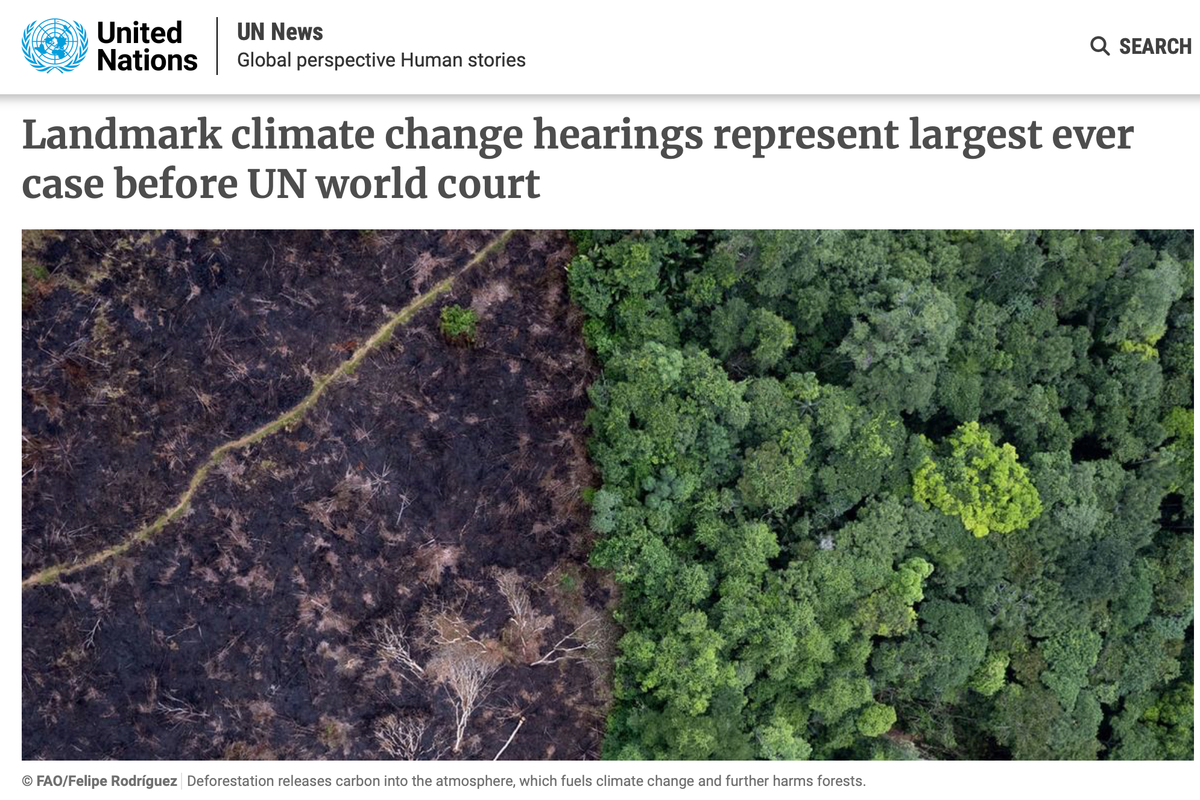
Something huge just happened. Or rather another step was taken in the successful trajectory of the most important climate action you probably never heard of. It was a follow-up to maybe the biggest thing that happened last year, though it didn't get much attention then either. There was a period when I used to head a lot of social-media posts with "climate: bigger than everything else." It literally is: it is the state of health or destruction of same of the entire biosphere – the space in which all known life exists, and the conditions of that existence for everything from krill in the arctic to rainforests in the tropics to you, me, and everyone we'll ever meet, to our weather, our crops, our economy, the very shape of our landmasses and currents of our oceans. It is almost too big to see, because it manifests in so many ways, as climate chaos, and because the solutions are likewise so manifold. In a way, if you imagine the earth as a house, we now have our collective hand on the thermostat; we've been turning it up for decades. We know how to turn it down, and we know who's stopping us from doing that.
The single biggest cause is the burning of fossil fuels, the single biggest solution the shift to clean energy, the single biggest obstacle is the power of the fossil fuel industry and the governments aligned with it. But beyond that solutions include how we design our transit, housing, cities and towns, how we grow our food and what we choose to eat. Beyond that what it might mean to move away from capitalism's sad notion of what constitutes abundance – lots of joyless stuff, not so much time for connection – to a vision in which maybe we have less material stuff but more immaterial wealth, such as confidence in the future, human and planetary health, public safety, time to connect to our deepest selves, each other, and the more-than-human world. That's the abundance that enriches our lives while protecting the earth.
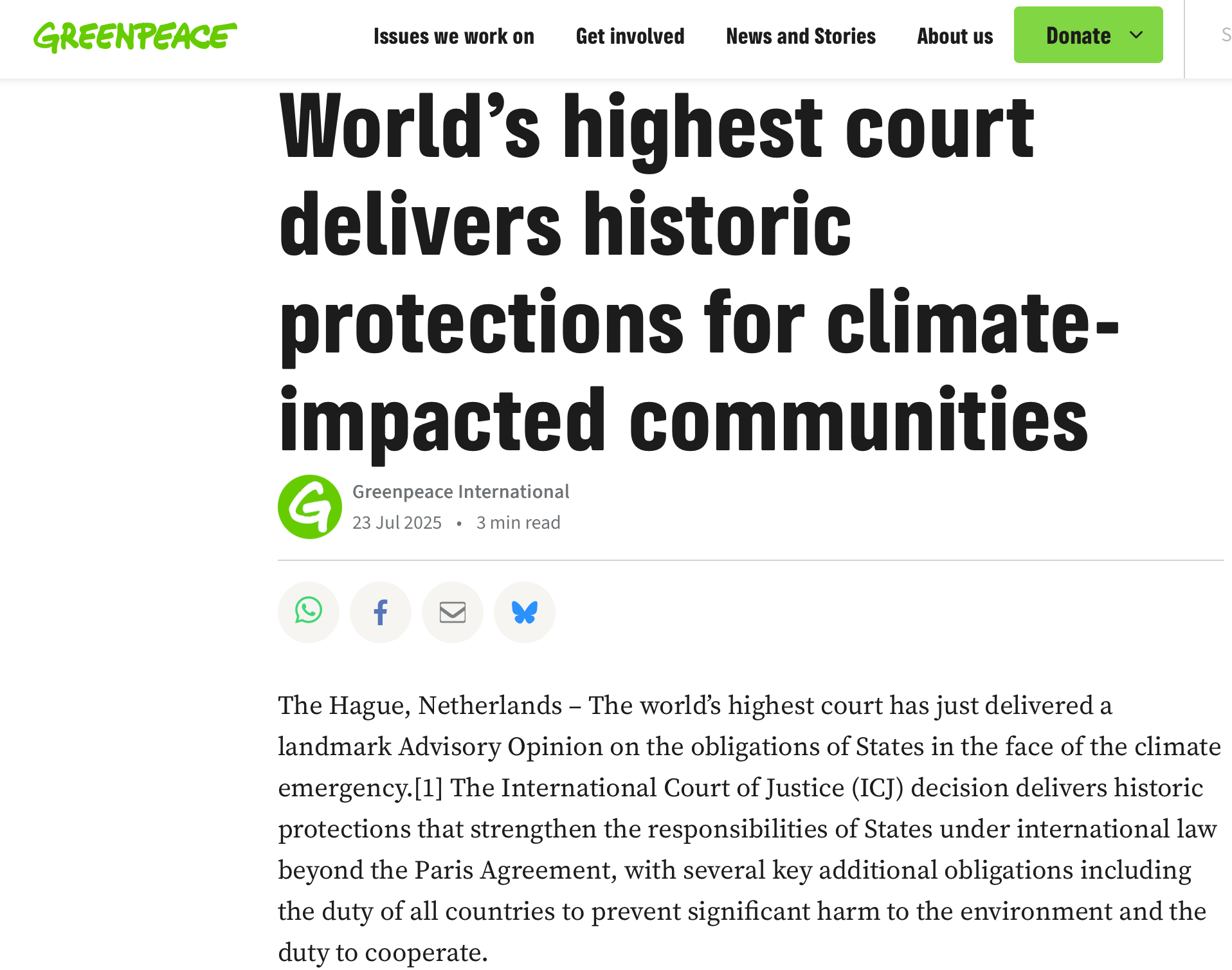
I wrote last year in a piece I never finished, "I had been dreading the tenth anniversary of the 2015 Paris climate treaty, but now I'm celebrating it. Because the International Court of Justice just handed down an epochal ruling that gives that treaty enforceable consequences it never had before. It declares that all nations have a legal obligation to act in response to the climate crisis, and as Greenpeace International put it, "obligates States to regulate businesses on the harm caused by their emissions regardless of where the harm takes place. Significantly, the Court found that the right to a clean, healthy and sustainable environment is fundamental for all other human rights, and that intergenerational equity should guide the interpretation of all climate obligations."
Ralph Regenvanu, Vanuatu's special envoy for climate, said of the decision: "I choose my words carefully when I say that this may well be the most consequential case in the history of humanity." Christiana Figueres, who presided over the negotiations that created that Paris Climate Treaty declared, with jubilation, on her podcast Outrage and Optimism: "this is without a doubt, the most far-reaching, the most comprehensive and the most consequential legal opinion we've ever had."
How this decision came into being might be one of the all-time great David and Goliath stories. Because this case that ended in the world's highest court began with 27 law students on the small South Pacific Island of Vanuatu who in 2019, asked themselves what they could do about climate--and it's not hard to imagine a "what can we do, we're only students" or "what can we do, we're in a tiny remote nation most people have never heard of" attitude, but instead they set out with the audacious ambition to ask the highest court in the world to render a verdict on the obligation of nations to address the crisis.
It took six years for proposition to become legal reality, and, as is now customary for all ambitious campaigns, naysayers and defeatists were there to do the opposite of cheer them on along the way. First the students needed actual lawyers, and they enlisted Blue Ocean Law, the firm that indigenous Guam lawyer Julian Aguon founded for exactly this kind of task and this kind of possibility. Then came the long march to the United Nations, which in 2023, by consensus, referred the case to the International Court of Justice. In December 2024, the case came before the court. Aguon (who is also a beautiful and powerful writer) recalls,
There, in the Great Hall of Justice, an even broader coalition of states — spanning Latin America, Africa, Asia, the Caribbean, and the Pacific — rose to reaffirm the key arguments Vanuatu and its allies had advanced: that international law has long imposed binding obligations to prevent environmental harm; that human rights frameworks continue to require all states to cooperate to address climate vulnerability and correct underlying inequities; that the right to self-determination is being violated by man-made climate disruption; that future generations are rights holders whose interests the law must protect; and, finally, that those states that have contributed most to the climate crisis must face consequences for breaching their obligations under the aforementioned bodies of law. Indeed, an unprecedented number of participants appeared before the court, with 97 states and 11 international organizations making statements. Many of them had never before appeared before the court. But they came in record numbers to ensure their voices, and the voices of their peoples, were heard.
In late July of last year, the verdict came down. Or up, without any of the caveats, carve-outs, hesitations that had been expected: it was a ringing victory for the climate, the climate vulnerable, and the bold and brilliant souls who brought the case. It was a gift to all of us, and all life, now and yet to come. It was the most powerful tool yet handed to those who care about the climate to use on those nations who were and are most responsible for destroying it. Including our own.
Later in 2025, the Right Livelihood Award – sometimes called the Alternative Nobel Prize – was given to Pacific Islands Students Fighting Climate Change (PISFCC), with this commendation:
After six years of campaigning, PISFCC’s tireless work as part of a dedicated, global movement that placed human rights at its core culminated in a historic victory at the International Court of Justice (ICJ) in July 2025. ...This ruling was a watershed in international law, opening a new pathway for climate justice worldwide. Central to their strategy was gathering testimonies from Pacific communities, who are among those contributing least for climate change yet facing some of its harshest consequences. By carrying these voices of loss, resilience and demand for justice into the halls of international law, PISFCC ensured frontline realities shaped the ICJ’s judgment.
Of Aguon, who shared in the prize, they wrote, that he "is a Chamoru human rights lawyer and writer from Guam, who has dedicated his life to defending the rights of Indigenous Peoples, advocating for their self-determination, and pursuing climate justice. His home, the Pacific, is among the regions most severely affected by the climate crisis. Through legal advocacy and storytelling, he has become a leading voice of Pacific resistance and a symbol of hope for a just and sustainable future."
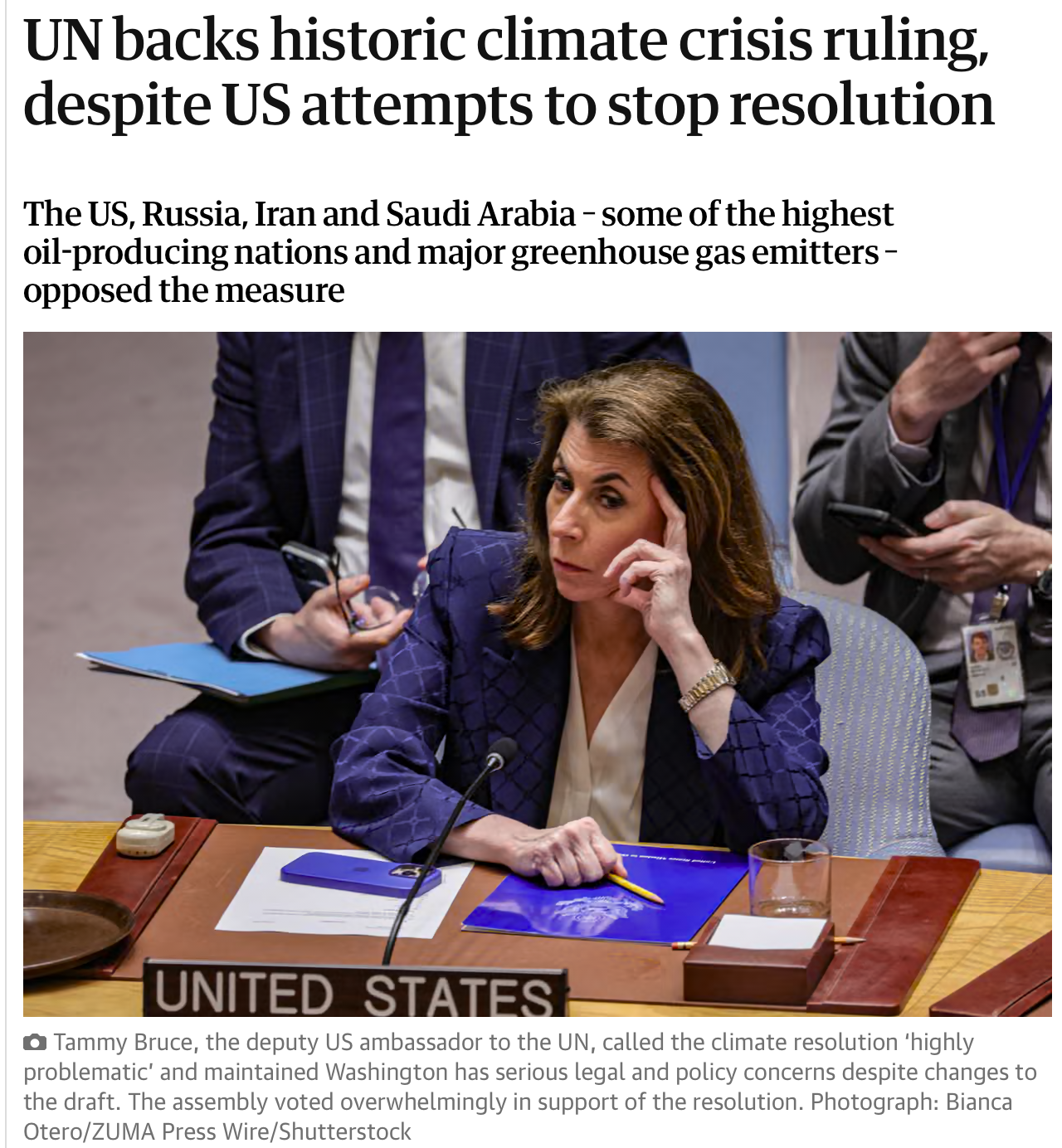
And then last week, the Guardian reported, "The UN has voted 141-8 to adopt a resolution backing a world court opinion that countries have a legal obligation to address climate change, with the US – which is the world’s biggest historical emitter – among the small group opposing it. The UN secretary general, António Guterres, said Wednesday’s general assembly vote, in which 28 countries abstained, underscored that governments are responsible for protecting citizens from the “escalating climate crisis”. The US joined Saudi Arabia, Russia, Israel, Iran, Yemen, Liberia and Belarus in opposing the resolution on Wednesday. Cop31 climate summit host Turkey, India, and oil producers Qatar and Nigeria were among those abstaining."
I suffer from what I've dubbed informational hypervigilance and you probably do too. It's that preoccupation with the crises of our time, notably what the would-be authoritarian white nationalists are doing to the United States and how that plays out as human rights abuses, corruption, lies, and so many kinds of destruction. But this informational hypervigilance too often narrows my and I daresay our focus to official politics, US version, and to what just erupted or crashed in the last twenty-four hours. There's so much more going on, good and bad, in local and international scales, at the level of the grassroots, on the margins and in the shadows, and in culture as it continues to be an unstoppable generator of ideas that turn into realities as laws, as the way we believe, as the values we act on.
I wrote my latest book, The Beginning Comes After the End, to broaden the picture to the powerful progressive transformations of the past seventy years on almost every front – environment and understandings of nature, gender, race, and a much more egalitarian set of values – and to show how what we're now fighting is backlash to undo all those achievements and the values and worldviews behind them. Nevertheless, I regularly get caught up in the the narrow focus on what lies, corruption, and destruction erupted in the last 24 hours. That news can obscure the larger arcs of change, the other powers at work, and the world beyond the benighted USA.
I have written and said less about climate in the first fifteen months or so of the second Trump Administration than at any point in the decade preceding that catastrophe. I felt that in order to act on climate, we had to claw back the democracy – the freedom of speech and assembly, the ability to make the government accountable, the laws protecting the environment – that lets us act in relative safety with real power. I haven't stopped my work as a board member of Oil Change International and Third Act (which is a climate-and-democracy group), haven't stopped reading, donating, posting , thinking, caring about climate. But somehow the other crises of truth, justice, human rights, the rule of law seemed urgent in a way that shoved climate to the side as a topic. I've been pleased that in this newsletter I've gotten back to climate recently.
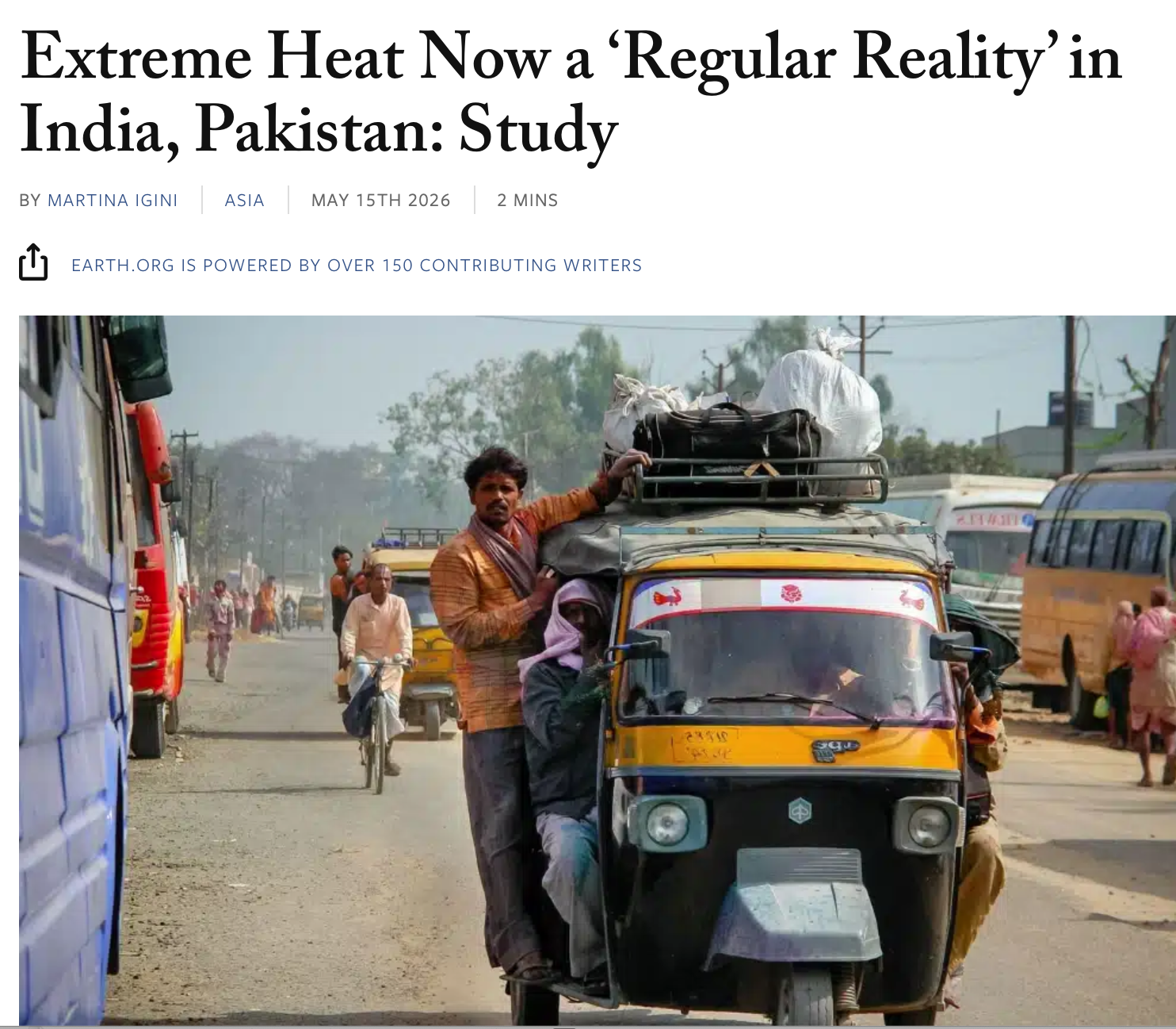
What we do now about climate will matter more than anything else we do in the next hundred or thousand and maybe ten thousand years (arguably keeping AI and nuclear weapons under control rank up there but they are at worst a catastrophe that might happen; climate chaos is happening now and will only get worse and worse without dramatic action). But also in the next ten, because climate chaos isn't something that will or might happen; it's happening now.
The climate issue is bigger than everything else. But sometimes the will of the fearlessly committed is big enough to shift our destiny. Julian wrote in 2009: “No offering is too small. No stone unneeded. All of us – whether we choose to become human rights lawyers or corporate counsel, or choose never to practice law at all but instead become professors or entrepreneurs or disappear anonymous among the poor or stay at home and raise bright, delicious children – all of us, without exception, are qualified to participate in the rescue of the world.”